
Last verified: September 7, 2026. Room rates, dive prices, park fees, flight frequencies and advisory wording on this page move constantly, and the southern access rules move with the security situation. I checked every figure here against a named operator’s own dated price list, an airline schedule, or gov.uk, quoted rather than paraphrased. I re-check this page monthly and update the date above each time. Where sources disagree, I say so instead of picking the tidiest number.
Two people get off the same charter flight at Marsa Alam. One is at their hotel in six minutes. The other is still on the coast road ninety minutes later, watching identical resort gates slide past in the dark. Nobody told either of them, because every guide to this coast writes about it as though it were a town.

Disclosure: Some links in this guide may earn us a commission, at no extra cost to you. It never changes what we recommend.
It isn’t. Marsa Alam is a road. The airport sits about 60 km north of a town of roughly 9,000 people, and the resorts are strung out along the coast between them and well beyond (Wikipedia). South of all of it, the road keeps going for another 300 km until a checkpoint stops you.
So this Marsa Alam travel guide answers six things before you book: how you get here, where your hotel actually is, what the diving costs, what the wildlife rules are, how far south you can go, and whether the boats are safe. If you’re still choosing between coasts, how the two big Red Sea resort towns compare is the wider view.
Key Takeaways
- “Marsa Alam” is 120 km of coast road, not a resort centre. The airport is about 60 km north of the town and Port Ghalib is 4 km from the terminal. Your transfer runs anywhere from six minutes to an hour and a half. Ask which kilometre your hotel sits on before you book, not after.
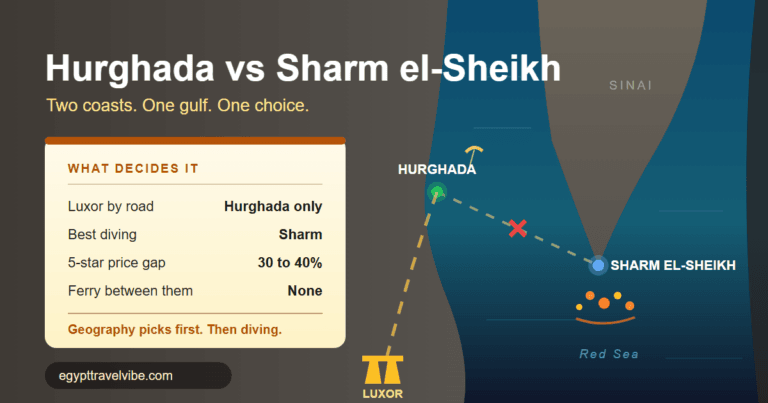
- Getting here is a charter problem. Marsa Alam’s airport was built privately and lives on European charter traffic. EgyptAir flies from Cairo twice a week, Thursday and Sunday. Miss those and it’s four hours by road from Hurghada or four to five from Luxor.
- Every price here is dated to a named operator’s list. Red Sea Diving Safari’s 2026 season rates run 89 euros a person a night for a royal tent, up to 185 for a suite. Unlimited house-reef diving is 77 euros a day. The mandatory extras nobody advertises are a 10 euro environmental fee and 7 euros for chamber support.
- The wildlife has rules, and one site enforces them. Samadai is zoned, capped and guided, with a published fee split. Sataya has no equivalent regime. At Abu Dabbab the boats are excluded and rangers patrol, and a guaranteed dugong sighting is a red flag, not a selling point.
- The deep south ends at a permit. Wadi el Gemal starts 50 km south of town and needs a guide. Past Hamata and Berenice, Shalateen requires clearance from military intelligence, and the FCDO advises against all but essential travel to the Hala’ib Triangle beyond it.
- The real safety question is the boats, not the country. The FCDO calls Red Sea resort areas including Marsa Alam generally low risk. The Sea Story capsized off this coast in November 2024 with 11 lives lost, and the UK’s accident investigators counted 16 accidents involving Red Sea liveaboards in five years.
Table of Contents
What Is Marsa Alam, and Where Will Your Hotel Actually Be?
Any useful Marsa Alam travel guide has to start with the shape of the place. It’s a town of about 9,001 people roughly 275 km south of Hurghada, with an international airport 60 km to its north and a resort coast filling the gap (Wikipedia). Development started in 1995. Before that this was a fishing and mining road, and in places it still looks like one.
The only walkable node on the whole coast is Port Ghalib. It’s a built marina about 4 km from the airport terminal, and it handles roughly 2,000 yachts a year (Wikipedia). There’s a promenade, shops and restaurants. Everything else is a gate on a road. That matters more than any brochure admits, because an all-inclusive 40 km from the nearest alternative restaurant means you eat where you sleep for a week.
So here’s the thing no ranking page publishes: the coast measured out from the terminal, with the point where access starts needing permission.
Abu Dabbab bay sits about 35 km north of the town, which puts it roughly 25 to 35 minutes from the terminal. Nightly rates have moved fast: the average daily rate across Marsa Alam short-term rentals hit 117 US dollars in June 2026, up 37.8% on the year before (AirDNA, 2026).
Ask three questions before you pay: which kilometre, house reef or no house reef, and jetty or shore entry. The third one decides whether you dive every morning or wait for a minibus. Hurghada and Sharm compared sets the resort styles side by side, and all four coasts compared for where to sleep goes further.
How Do You Get to Marsa Alam?
Four realistic ways in, and three of them aren’t flights to Marsa Alam. The airport is unusual. Kuwait’s Al-Kharafi Group built it and still runs it privately. It took its first commercial flights in October 2001 and opened officially in 2003, and it runs on European charters rather than domestic traffic (Wikipedia).
That single fact reshapes your whole itinerary, and no guide says it out loud. TUI fly, Wizz Air, Neos, Smartwings, easyJet and Lufthansa all serve this runway seasonally. EgyptAir’s link from Cairo runs twice a week, Thursday and Sunday, as MS184, about an hour and twenty minutes in a 737-800 (FlightConnections, checked September 7, 2026).
So Marsa Alam is easy to reach from Milan and awkward to reach from Cairo. That’s exactly backwards from every other Egyptian destination, and it’s why this coast doesn’t slot into a Nile trip the way Hurghada does.
Here’s the honest comparison, checked September 7, 2026.
| Way in | Door to door | Dated cost |
|---|---|---|
| European charter to Marsa Alam | Direct, plus transfer | Bundled with the package |
| EgyptAir from Cairo, Thu and Sun | About 1h25 plus transfer | Varies, book early |
| Fly Hurghada, then road south | About 4 hours on the road | From 43 USD private transfer |
| Road from Luxor via Safaga | 4 to 5 hours, about 358 km | 55 to 75 USD airport transfer |
The Luxor road deserves a footnote. Operators consistently route foreigners via Safaga rather than the shorter inland road, and their quoted timings assume that detour, so budget five hours rather than four. Buses exist and they’re cheap. The fares I found ranged from about 150 EGP on a forum to over 950 on aggregator sites, which tells you those numbers are stale rather than variable. Check the counter on the day.
Flights, trains and drivers across Egypt compared covers the rest of the country. For whether this coast belongs in your trip at all, see where a Red Sea week fits in ten or fourteen days.
What Is the Diving Like, and What Does It Cost?
Shore diving is the daily bread here, and the famous sites need a boat. Red Sea Diving Safari’s published 2026 season list puts a single house-reef dive at 39 euros for guests staying on site. Unlimited house-reef diving is 77 euros a day, and a full-day big-boat excursion is 61 (Red Sea Diving Safari, Summer 2026 list).
That’s the coast in three numbers: cheap to dive constantly, more to go offshore.
My own week ran on the house reef. Breakfast, walk fifty metres, drop over a wall that starts at four metres and keeps going. I did nine dives in five days without booking a single boat, which is not something I’ve managed in Hurghada. The boat days were the ones I remember, though. The 5:30 alarm, forty minutes of chop, and then a drift along a wall with nothing between you and open water.
| Dive site | How you reach it | Level |
|---|---|---|
| House reefs, Marsa Mubarak | Shore or short minibus | Open Water |
| Abu Dabbab bay | Shore, 3 to 15 m | Open Water |
| Elphinstone | Day boat, weather permitting | Advanced Open Water |
| Daedalus, St John’s | Liveaboard only | Advanced, logged |
Elphinstone is the site people fly here for. It’s an offshore pinnacle with walls on both sides and oceanic whitetips from October to December. Dive centres want Advanced Open Water as a minimum, because of the depth and the blue-water drift (Travel to Dive, April 2026). Sources disagree wildly on how far offshore it sits, quoting anywhere from 12 to 30 km. Judge it by boat time instead. It’s a morning crossing, and it gets cancelled when the wind is up.
Daedalus is about 80 km out and liveaboard-only.
Now the part every guide leaves out. The mandatory extras.
Off-site guests pay more for the same diving: 48 euros for a single house-reef dive against 39, and 96 for the unlimited day against 77. Low season knocks 30 to 40% off the rooms. The full Egypt budget in EGP and USD prices the rest of the trip the same way. All four coasts compared underwater is the diving-first version of this decision.
Can You Swim With Dugongs and Dolphins?
Yes, under rules, and the rules are much better at one site than the other. Shaab Samadai, the reef everyone calls Dolphin House, sits about six nautical miles offshore. HEPCA has managed it since February 2013 under a three-zone system that shuts the dolphins’ resting area completely (HEPCA).
The zoning is simple enough to check from the boat. Zone A is closed. Zone B bans boats and allows guided snorkelling only, with life jackets compulsory whether you can swim or not. Zone C is open to snorkellers and divers.
The fee is where it gets interesting, and I’ve never seen another guide print this. Your Samadai entry money splits three ways, and it’s the clearest example I know of a Red Sea site where paying to enter actually funds the thing you came to see.
Sataya, off Hamata, is the trip most resorts sell as the cheaper Dolphin House, and it has nothing like Samadai’s regime. Researchers reviewing both sites concluded that Samadai’s management is working while the Sataya population is under unsustainable pressure and needs better measures. If you’re choosing between the two, that’s the whole argument.
Abu Dabbab is the dugong question. Boats are excluded from the bay, moorings were removed to stop safari boats overnighting, rangers patrol, and some seagrass is closed to snorkellers entirely. It still isn’t enough: propeller strikes and constant close-quarters snorkelling injure animals and push them off the seagrass, and the Egyptian dugong population is small and unevenly counted. Go early, enter from the beach, stay off the seagrass, keep your distance, and don’t chase.
And here’s the line the excursion desks won’t give you: any operator who guarantees you a dugong is telling you how they find them. Book the ones who say you probably won’t see one.
How Far South Can You Actually Go?
Access degrades in four steps over roughly 330 km. Wadi el Gemal National Park is the first. It covers 7,450 square kilometres, 5,850 of them land and 1,600 sea, and Egypt’s environmental agency declared it in January 2003 (MarsaAlam.com, 2026).
The main gate sits about 50 km south of the town, and the visitor centre runs sunrise to sunset. You don’t drive in alone. The park’s own guidance is blunt about getting lost, jeep safaris run 50 to 55 euros a head, and the island caps visitors at twenty people at a time for three daylight hours.
Inside the park sits the strangest thing on this coast. Wadi Sikait, about 45 km inland, was Mons Smaragdus: the only source of emeralds in the entire Roman Empire. Its rock-cut temples are still standing, and a University of Liverpool project has been excavating them, with recent seasons extending to survey work across the park (University of Liverpool).
Entry fees are a mess. Quotes for the park and for Sikait run from 20 EGP to 10 US dollars to 25 LE per person plus a vehicle charge, and none of it is dated consistently. Treat the figures as unresolved and ask your operator what they’re actually paying.
Keep going and you reach Hamata, then Berenice, then Shalateen, roughly 270 km south of Marsa Alam and the largest town in the Hala’ib Triangle. Non-residents need clearance from Egyptian military intelligence, arranged days ahead through a licensed operator, and the checkpoints on the way down cross-check names against the permit (Wikipedia).
Beyond that the FCDO advises against all but essential travel to the Hala’ib Triangle and the Bir Tawil Trapezoid, disputed territory between Egypt and Sudan (GOV.UK, checked September 7, 2026). If you want a desert trip without paperwork, the White Desert overnight from Bahariya is the one that rewards a second visit to Egypt.
When Should You Go?
Any month works on this coast, which is exactly why the month-by-month guide sends July and August travellers to the Red Sea. August still averages a daily high of 35.6°C, though, and the sea peaks at 29°C (Wikipedia, climate table). The record high here is 45°C, set on May 10, 2010.
October to November and February to April are the sweet spots: warm water, manageable air, and boats that actually sail. That last part matters more here than on the northern coast. Elphinstone is an exposed crossing, and a windy morning cancels it outright, which is how people end up doing three house-reef dives instead of the trip they flew for. Build a spare day into the week if the pinnacle is the point.
If oceanic whitetips are what you’re coming for, that’s October to December, and it overlaps with the windier half of the year. Pick your compromise knowingly rather than being surprised by it.
One thing I won’t give you is a dugong season. Operator pages confidently name March to May, and I can’t find a source behind it that isn’t another operator page. The animals feed on seagrass that’s there all year, so treat sightings as opportunistic in any month and book the morning slot rather than the month.
February nights average 13.8°C, which surprises people who packed for a beach holiday. The water sits at 22°C in February and March. That’s cool enough that a 5 mm suit stops being optional after the second dive of the day. What to pack for each season covers the rest, reef-safe sunscreen included. Ramadan barely registers on this coast, since the resorts run normally and the diving day doesn’t change, which is not true of a Nile trip.
Is Marsa Alam Safe?
On land, yes, and the wording is clear. The FCDO says travel to Red Sea tourist areas “is generally low risk”. Security forces run routine vehicle and airport checks to protect resorts including Sharm el-Sheikh, Hurghada and Marsa Alam (GOV.UK, checked September 7, 2026).
The same page carries the Hala’ib exception above, and a separate permit requirement near the Sudan and Libya borders. The honest read on what the advisory zones mean covers the rest of the country.
The sea is a different conversation, and it’s the one no Marsa Alam travel guide is having. The Sea Story left Port Ghalib on November 24, 2024 with 46 people aboard. It capsized in the early hours of the next morning. Eleven people died, including two British divers, and 35 were rescued.
The UK’s Marine Accident Investigation Branch then issued a safety bulletin on February 6, 2025. It said 16 accidents had involved Red Sea liveaboards in five years, and that three liveaboard boats had been lost in the previous 21 months, with deaths (GOV.UK, MAIB safety bulletin, 2025).
Its concerns named poorly constructed vessels, defective lifesaving equipment, poor fire protection, unmarked escape routes and inadequate crew training. It also warned that guests have arrived in Egypt and been switched onto a different boat than the one they booked. That cancels out any research they did.
Egypt’s response included requiring two captains, one of them holding a Master Mariner’s licence, and two qualified marine mechanics on every liveaboard. That’s real, and it isn’t a substitute for checking. So before you pay a deposit:
- Get the vessel’s name written on the invoice, and refuse substitutions in writing.
- Ask for the current safety certificate and the date it was issued.
- Ask where the emergency exits are on the deck plan, not in the brochure.
- Ask which crew hold which licences.
- Book through a vendor who’ll answer all four without going quiet.
Day boats are a different risk profile and the coast runs hundreds of them without incident. As for sharks, one diver was bitten at Elphinstone on December 2, 2022, and thousands of people dive with oceanic whitetips there every season without anything happening (Divernet, 2022). Dive it with a guide who knows the site and don’t trail anything shiny.
Is Marsa Alam Worth It, and Who Should Skip It?
Worth it if you’ve already done the easy reefs. The reefs here beat Hurghada’s, the wildlife is bigger, and a house-reef week costs less per dive than anywhere else I’ve dived in Egypt. That’s the same verdict the region-by-region guide to where to go gives, and this page isn’t going to soften it.
Skip it if you’re a first-timer on a seven or ten-day Nile trip. The transfer is two hours longer than Hurghada’s, the town is thinner, and the flight connection from Cairo runs twice a week. Skip it if you don’t dive or snorkel, because there is no town to fall back on. Skip it if you want nightlife, and skip it if your dates are tight enough that a road transfer would eat a day you can’t spare.
Where should those people go instead? Sinai’s shore-diving and freediving town if you want a place with a street. Hurghada if you want flights and a road link to Luxor. And the other places that reward a second trip if you’re building trip number two.
Marsa Alam Travel Guide FAQs
Is Marsa Alam worth visiting?
For divers, yes. The reefs are quieter than Hurghada’s, the wildlife is bigger, and Red Sea Diving Safari’s 2026 list prices an unlimited house-reef day at 77 euros. For non-divers it’s a harder sell: the town has about 9,000 people, there’s no walkable centre outside Port Ghalib, and your resort may be an hour from anything else.
How far is Marsa Alam from Hurghada?
About 275 km, which is roughly four hours by road. Private transfers start around 43 US dollars. This is the standard route for anyone who can’t get a direct charter. It’s also the single reason Marsa Alam gets skipped on short trips, because it adds two hours at both ends.
How do you get to Marsa Alam from Cairo?
EgyptAir flies Cairo to Marsa Alam twice a week, Thursday and Sunday, as MS184, about an hour and twenty-five minutes, checked September 7, 2026. If those days don’t work, fly to Hurghada and drive four hours south. The airport here runs mostly on European charters, so domestic connections are thinner than at any other Red Sea airport.
Can you swim with dugongs at Abu Dabbab?
Sometimes, from the shore, under ranger-enforced rules. Boats are excluded from the bay, moorings were removed, and parts of the seagrass are closed to snorkellers. The Egyptian dugong population is small, so sightings are never guaranteed. Any operator promising one is telling you they don’t follow the distance rules.
Is Marsa Alam good for non-divers?
Less so, honestly. Port Ghalib’s marina is the one walkable evening. Wadi el Gemal National Park is the one big land day out: 7,450 square kilometres, declared in 2003, with jeep safaris at 50 to 55 euros. Beyond snorkelling, quad trips and the park, this coast is resorts on a road.
Are Red Sea liveaboards safe?
The record is poor enough to check carefully. In February 2025 the UK’s Marine Accident Investigation Branch reported 16 accidents involving Red Sea liveaboards in five years, with three boats lost in the previous 21 months. That followed the Sea Story, which capsized off this coast with 11 deaths. Get the vessel named on your invoice, ask for its safety certificate, and refuse substitutions.
The Bottom Line
Marsa Alam is the best diving on Egypt’s mainland coast and the worst place in the country to arrive without knowing the geography. That’s the one thing a Marsa Alam travel guide owes you. Get the kilometre marker before you book. Add the compulsory fees to the headline price. Name your boat on the invoice.
Would I come back? Yes, in November, on the house reef, with two boat days for Elphinstone and one long morning in Wadi el Gemal. But I’d send a first-timer to Hurghada without hesitating, and I’d tell anyone who doesn’t dive to spend the week somewhere with a street.
Egypt Travel Vibe carries advertising and partnerships, and discloses them. What it doesn’t do is sell dive packages or liveaboard berths. That’s why this Marsa Alam travel guide can tell you your transfer might be ninety minutes. Or that four separate fees get added after you think you’ve paid. Or that the boats have a safety record worth reading before you book one.
Where the record was unresolved, as with the park entrance fees and the road distance to Hamata, I dated the disagreement rather than smoothing it.
Marco re-checked every price, fee, flight, temperature and advisory line on this page against source on September 7, 2026.
Still deciding between coasts? Where the Red Sea fits against the rest of the country is the wide-angle view, and the full first-trip planning guide builds the rest of the trip around it.