
Last verified: August 17, 2026. Climate normals, current drone guidance and dress-code expectations were checked against source on the date above. Drone rules and dress codes are both moving targets, so I re-check this page monthly and update the date each time.
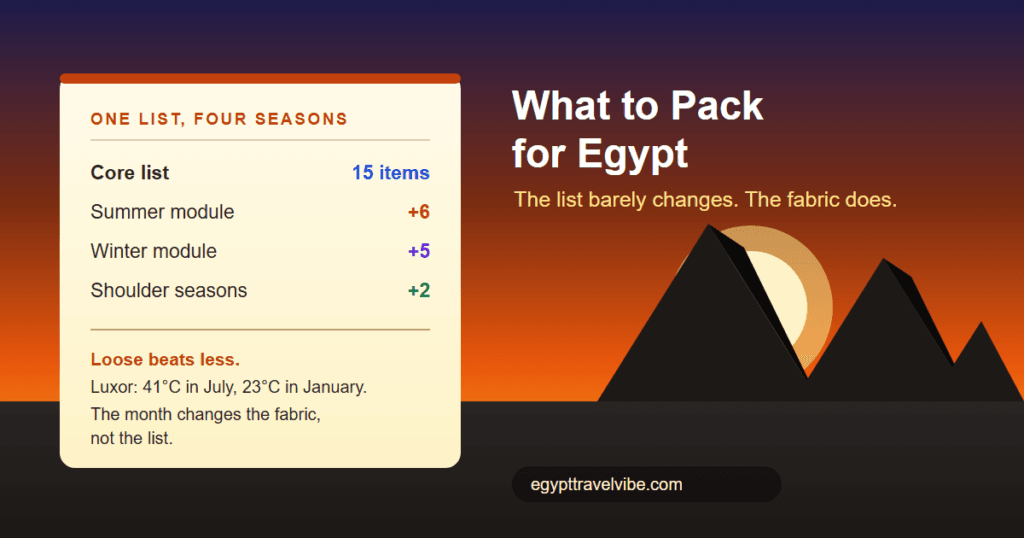
Most Egypt packing lists are answers to the wrong question. They hand you 27 products and a season label, when the truth is simpler: the list barely changes, the fabric does. Luxor runs about 41°C in July and 23°C in January, per climate normals via Weather & Climate, the same figures behind our month-by-month guide. That swing decides maybe six items in your bag.
Disclosure: Some links in this guide may earn us a commission, at no extra cost to you. It never changes what we recommend.
So here’s what to pack for Egypt organized the way you actually pack. One core list of 15 items that works year-round. Four small season modules. And the dress code explained as the three tiers it really is, rather than the one anxious rule most guides flatten it into. Everything here comes off my own list, refined across repeat trips, and none of it links to a product. If you’re still planning the trip itself, start with the first-trip planning guide.
Key Takeaways
- One core list works year-round. Luxor runs 41°C in July against 23°C in January, so the month you go decides the fabric, not the list.
- The dress code has three tiers: required (mosques), recommended (towns and sites: shoulders to knees, loose), and entirely fine (resorts, where normal swimwear is normal).
- Loose beats less. Long, light, breathable layers outperform shorts and tank tops in real desert heat.
- Leave the drone at home. Egypt has no tourist permit pathway, and airports confiscate them on arrival.
Table of Contents
What Should You Pack for Egypt No Matter the Season?
Fifteen items cover every Egypt trip, whatever the month. Here’s the core of what to pack for Egypt, grouped the way it goes into the bag:
Clothing, 6 items. Two pairs of loose, light long trousers or skirts. Three breathable tops with sleeves. One warm layer, even in August, because dawn starts and air-conditioned trains run cold. A scarf, which does triple duty: mosque visits, sun cover, and dust. Sturdy closed shoes for sites. Sandals for everything else.
Sun and health, 4 items. High-SPF sunscreen sized for the whole trip, since it costs more in Egypt. A real hat with a brim. Sunglasses. A basic kit with rehydration salts and stomach tablets.
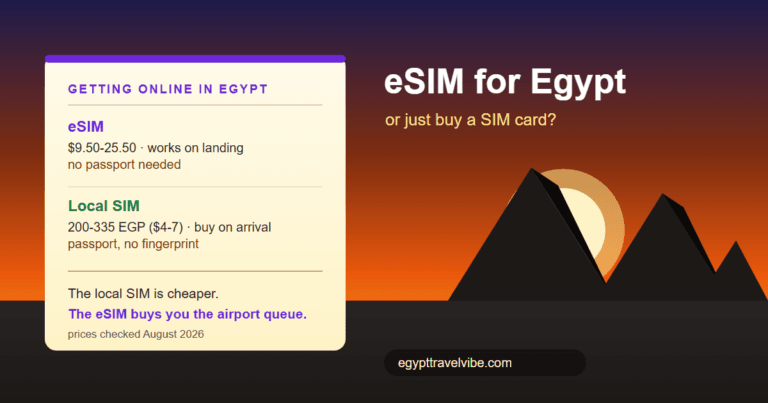
Tech, 3 items. A universal adapter for Egypt’s two-pin sockets. A power bank, because dawn-to-dusk days outlast phone batteries. Offline maps downloaded before you fly, with your eSIM sorted before departure.
One structural note before the seasons. The list stays at 15 because laundry in Egypt is cheap and fast. Hotels turn it around in a day, cruise boats offer it on board, and a Cairo laundry charges a fraction of what an extra kilo of clothing costs you in airline fees. Pack for five days, wash, repeat. That single habit shrinks every module below.
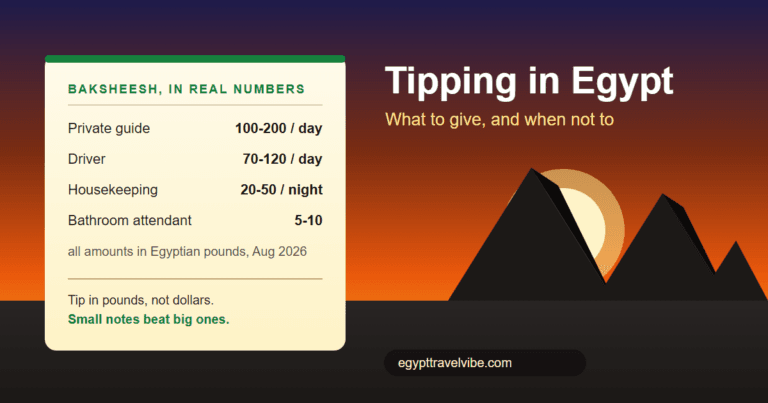
Money and admin, 2 items. A dedicated stack of small Egyptian notes for tips, since baksheesh runs on 10s and 20s, and cards for the sites themselves, because most major sites are now card-only while taxis and markets stay cash.
What’s the Dress Code in Egypt, Really?
Three tiers, not one rule. Published 2026 dress guides agree on the shape of it: shoulders and knees covered in towns and at sites, hair covered only inside mosques, and resort wear normal at the Red Sea (Egypt Photography Tours, 2026; Egypt Tours by Locals, 2026). Most of the anxiety in this search comes from guides flattening those tiers together, which overdresses people at Hurghada and underdresses them at Al-Azhar. The Egyptian culture guide explains the culture behind the dress code.
For women, the town-and-site baseline is shoulders to knees, loose over tight, and that’s the whole of it. A scarf lives in the daypack for mosque visits and comes out nowhere else. Longer skirts and trousers help you blend in and cut the attention our safety guide discusses honestly, but they’re a comfort choice, not a requirement. For men, knees covered at sites; tank tops read as beachwear away from the beach.
Tier three is genuinely tier three. Red Sea resorts, hotel pools, and cruise sundecks run on ordinary Western resort wear, bikinis included. Packing a resort holiday as if it were a mosque visit is the most common overcorrection in this niche.
Here’s the part the heat data settles for us. At 41°C, loose long cotton beats shorts and tank tops on pure comfort, because covered skin in dry heat stays cooler and burns less. Modesty and physics point the same direction in an Egyptian summer, so the “what should I wear” anxiety mostly dissolves into “what works.” For the wider picture, our guide to dressing and traveling solo as a woman in Egypt puts the dress code beside the safety data.
What Do You Wear to the Pyramids and Temples?
The town-and-site tier, plus three site realities. Dust: the plateau coats everything, so skip white. Ground: sand, uneven stone, and steep tomb stairs make sturdy closed shoes the single most-thanked item on this page. Sun: shade is nearly nonexistent, so the hat and sunscreen aren’t optional.
Tomb interiors add one more wrinkle. Inside the Valley of the Kings and the Great Pyramid, air sits hot and still year-round, whatever the month outside. A breathable top earns its place there in January as much as July, and a small water bottle in the daypack stops the climb back out from becoming the day’s low point.
One detail that surprises people: mornings start genuinely cool, even in summer. The dawn starts that our itinerary guide builds around mean you’ll be glad of that one warm layer at 6am in the Valley of the Kings, then stuffing it in the daypack by nine.
What to Pack for Egypt in Summer
The summer module is six items on top of the core. In 2026 terms, Luxor holds around 41°C from June through August, per the climate normals in our month-by-month data, and the whole trip reshapes around a dawn-and-done rhythm.
Add: a second hat or a buff, maximum-strength sunscreen beyond the core bottle, electrolyte sachets, one extra breathable top per three days, swim kit for the pool you will want by noon, and a small insulated bottle, because water goes warm in an hour. Remove: every heavy layer except the one dawn jacket.
Does the heat make summer a mistake? The honest answer from travelers on the ground splits between “dry heat, manageable” and “do not come in August,” and the practical resolution is the rhythm, not the wardrobe. Tour at dawn, be by the pool at noon, and the summer module carries you.
What to Pack for Egypt in Winter
The winter module is five items, and it surprises more people than the summer one. Egyptian winter days are glorious, but desert nights drop near freezing and Cairo evenings sit in the low teens, per the same climate normals family as the chart above.
Add: one genuinely warm layer for evenings, a light hat and gloves if your plans include a dawn balloon ride or a desert camp, socks you’d actually hike in, and one marginally smarter outfit. That last one is real: winter is cruise season, and a Nile cruise dining room is the only place Egypt will ever ask you to look slightly put together.
Closed shoes become the default rather than the site-day exception. Otherwise, the core list rides through unchanged.
What About Spring, Autumn, and the Khamsin?
The shoulder seasons take the core list nearly untouched, which is one reason our month-by-month guide rates them so highly. The module is two items, and both are about wind rather than temperature.
From roughly March to May, the khamsin can throw sand and dust across a day with little warning. A buff or scarf that covers nose and mouth turns a miserable afternoon into a manageable one, and sunglasses that sit close to the face do more than fashion frames. That’s the whole module.
What Should You Leave at Home?
The remove list taught me more than the packing list did. After several trips, here’s what came off mine. The second warm layer, which never left the bag outside December. The second pair of jeans in July, because denim in 41°C is a punishment. Anything white, which the dust claims by day two. Heels, which ancient pavements eat. Expensive-looking jewelry, which works as a hassle magnet for exactly the reasons our scams guide explains. What I doubled instead: sunscreen and small notes.
And the drone stays home, seriously. In 2026 Egypt has no permit pathway for tourist drone flights, and customs officials systematically confiscate drones at Cairo, Hurghada, and Sharm El-Sheikh airports, holding them until departure (Propel RC, Drone Laws in Egypt, 2026). Flying one without authorization carries penalties of one to seven years and fines of 5,000 to 50,000 EGP (Dronesgator, 2026). No aerial shot of the Pyramids is worth any part of that sentence.
Want the Whole List in One Table?
Everything above, in one screenshot-able place. Core column packs for every trip; add the module for your month.
| Core, every trip (15) | Summer adds (6) | Winter adds (5) | Shoulder adds (2) |
|---|---|---|---|
| 2 loose long trousers/skirts | Second hat or buff | Warm evening layer | Buff for khamsin dust |
| 3 breathable tops with sleeves | Max-strength sunscreen | Light hat and gloves | Close-fitting sunglasses |
| 1 warm layer (dawn, trains) | Electrolyte sachets | Hiking-grade socks | |
| Scarf (mosque, sun, dust) | Extra breathable tops | One smarter outfit | |
| Sturdy closed shoes | Swim kit | Closed shoes as default | |
| Sandals | Insulated bottle | ||
| High-SPF sunscreen | |||
| Brimmed hat | |||
| Sunglasses | |||
| Basic health kit | |||
| Universal adapter | |||
| Power bank | |||
| Offline maps + eSIM | |||
| Small-notes tip stack | |||
| Cards for sites |
Frequently Asked Questions
What should a woman wear in Egypt?
Shoulders to knees covered and loose in towns and at sites, hair covered only inside mosques, and normal Western swim and casual wear at Red Sea resorts, pools and cruise decks. Those three tiers are the whole code, and in 41°C heat the loose option is also the comfortable one.
Can you wear shorts in Egypt?
At resorts, pools and on cruise decks, absolutely. At ancient sites, longer shorts pass for men, though loose trousers genuinely beat them in the heat. In city streets and mosques, trousers or longer skirts fit the setting better for everyone.
Do I need to cover my hair in Egypt?
Only inside mosques, and only for women. Nowhere else in Egypt expects visitors to cover their hair, not at the Pyramids, not in bazaars, not in restaurants. Carry a scarf in the daypack for mosque visits and you’re covered, literally, for the whole trip.
What shoes should I wear to the Pyramids?
Sturdy closed shoes. The Giza plateau is sand and uneven stone, and tomb visits add steep stairs in low light. Sandals belong at the hotel and resort end of the trip. In winter, closed shoes become the everyday default anyway.
Can I bring a drone to Egypt?
No. In 2026 Egypt offers no tourist permit route, customs confiscates drones on arrival at major airports and stores them until departure, and unauthorized flying carries one to seven years and fines of 5,000 to 50,000 EGP. Leave it at home.
The Bottom Line
Deciding what to pack for Egypt comes down to three moves. Pack the 15-item core. Add the small module for your month, which our climate curve picks for you. And read the dress code as three tiers, so you neither sweat through a resort week overdressed nor get turned away from a mosque underdressed.
Loose beats less, dust beats white, and small notes beat big ones. The rest is fabric.
Pick your month first with the month-by-month guide, size the trip with the 7, 10 and 14-day comparison, and keep the first-trip planning guide open while you sketch. I re-check the rules and figures on this page monthly.