
Last verified: August 7, 2026. Every price, entry rule and ticketing figure on this page was checked against its own source on the date above. They each move on their own schedule, so I re-check this page monthly and update the date each time.
Egypt welcomed 6.1 million international visitors in the first four months of 2026 alone, a 7% rise on the same stretch of 2025 (Egypt’s State Information Service, 2026). A lot of them planned their trips using an Egypt travel guide that’s quietly out of date.
Disclosure: Some links in this guide may earn us a commission, at no extra cost to you. It never changes what we recommend.
That’s the awkward thing about Egypt right now. Three things changed between late 2025 and 2026: how museum tickets are sold, how you pay at major sites, and what a visa costs. Most of the pages ranking for “Egypt travel guide” mention none of them. Prices in Egyptian pounds go stale within months anyway. So this Egypt travel guide does two jobs. It walks you through every decision a first trip needs. And it dates every number, so you always know how fresh it is.
Key Takeaways
- Give Egypt 10 to 14 days for a first trip covering Cairo, Luxor, and Aswan, and go between October and April. Luxor averages 41°C in July against 23°C in January (Weather & Climate, climate normals).
- Budget roughly $85-130 a day mid-range, excluding international flights.
- The Grand Egyptian Museum sells tickets online only. Foreign adult entry, now 1,500 EGP at the official checkout, rises by $5 on November 1, 2026 (Ahram Online, 2026).
- Most major antiquities sites now expect card payment, but you still need cash for tips, taxis, and markets.
Table of Contents
Is Egypt Safe to Visit in 2026?
For the standard tourist route, yes. The U.S. State Department keeps Egypt at Level 2, \”Exercise Increased Caution,\” with Do Not Travel guidance limited to the Northern and Middle Sinai Peninsula and parts of the Western Desert near the Libyan border (U.S. Department of State, 2026). Cairo, Giza, Luxor, Aswan, Alexandria, Hurghada, and Sharm el-Sheikh all sit outside those zones. Our full Egypt safety guide goes deeper: what the advisories actually say, how far the flagged zones are from the route, and the risks that deserve real planning.
The UK draws its lines in a similar place. FCDO advice, current as of 19 July 2026, advises against all travel to North Sinai and to within 20 km of the Egypt-Libya border, with El Salloum the one exception. It also advises against all but essential travel to parts of South Sinai, eastern Ismailiyah, and parts of the Western Desert (GOV.UK, 2026). Notice what isn’t on either list: the entire Cairo-Luxor-Aswan corridor that a first trip is built around.
Level 2 is worth understanding rather than fearing. It’s the same tier the State Department applies to France, Italy, and Spain, a distinction most Egypt travel guides skip. It signals “pay attention,” not “reconsider your trip.”
Here’s the reframe I’d offer after watching a lot of travelers work through this question. The thing that actually wears people down in Egypt isn’t crime. It’s commerce. Persistent, close-range sales pressure at the major sites, camel touts at Giza, and a steady stream of people offering help you didn’t ask for. It’s exhausting the first day and manageable by the third, once you learn that a flat “no, thank you” and continued walking is a complete sentence. That’s a very different problem from danger, and conflating the two is why so much Egypt safety content reads as either alarmist or dishonest.
When Is the Best Time to Visit Egypt?
If you take one thing from this Egypt travel guide, make it the timing: October through April. Luxor averages a 41°C high in July against 23°C in January (Weather & Climate, climate normals). That 18-degree swing decides whether you get a full morning on the Theban west bank or you’re back at the hotel by 11am. Cairo runs cooler at both ends, 20°C in January to 36°C in July, but the pattern holds.
The sweet spots sit at the edges: late October and March give you comfortable daytime temperatures without December and January’s peak crowds and peak hotel rates. December through February is genuinely pleasant for sightseeing, but Luxor mornings can be cold enough for a jacket, and the Nile at dawn is chilly.
The Red Sea is the exception to all of this. Hurghada, Dahab, and Marsa Alam work year-round, because you’re spending the hottest hours in the water rather than walking a temple complex.
Ramadan shifts things too. Opening hours contract. Some restaurants close during daylight. The mood of the country shifts too. That’s genuinely interesting to travel through, if you know what to expect. Ramadan 2027 is expected to run roughly February 8 to March 9, though the exact dates depend on the lunar calendar and get confirmed closer to the time.
That timing question deserves more room than this section gives it, so we’ve broken it out: month-by-month heat, crowds, and the 2027 Ramadan dates covers every month, including the ones most guides tell you to skip.
How Many Days Do You Need in Egypt?
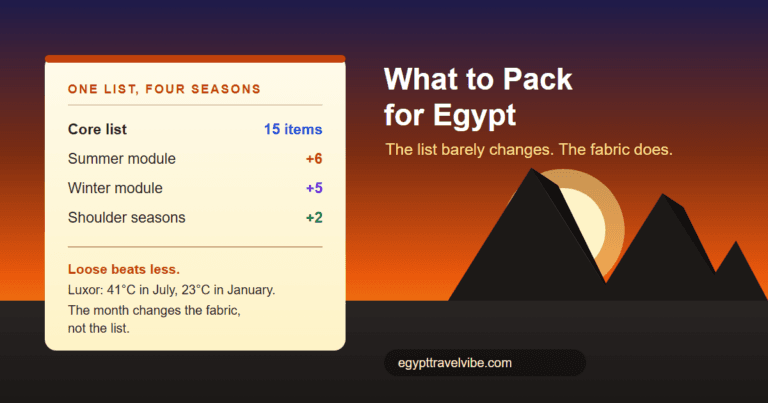
This is the question every Egypt travel guide gets asked first. Ten days is the shortest trip that covers Cairo, Luxor, and Aswan without turning into a series of transfers. Seven days works only if you cut one of the three. Fourteen is what you need if you want to add the Red Sea or the Western Desert without rushing the classics. Whatever you choose, our season-by-season packing list covers what the month changes in your bag. Our 7-day vs 10-day vs 14-day itinerary comparison maps all three day by day, with costs.
Minimum sensible stays, in my experience: three days in Cairo, two to three in Luxor, two in Aswan. Cairo needs three because Giza, the Grand Egyptian Museum, and Islamic or Coptic Cairo are three separate days once you account for traffic. What the Giza ticket actually covers prices the plateau day. Luxor splits naturally into an east bank day and a west bank day, and the west bank deserves a full morning. Aswan is the one place where a slower pace is the point.
What I’d change about my own first trip: I gave Cairo two days and Luxor three, which I had exactly backwards. Cairo’s sites are spread across a metro area of over 20 million people, and the transit time between them is the hidden cost nobody warns you about. Luxor’s east and west banks are twenty minutes apart. If I were redoing that trip, I’d move a day from Luxor to Cairo without hesitating.
What gets cut first when days are tight? Aswan, usually, which is a shame, because it’s the most relaxing stop of the three. If you’re at seven days, the honest choice is Cairo plus Luxor done properly rather than all three done at a jog.
How Much Does a Trip to Egypt Cost?
Every Egypt travel guide quotes a different number here, so this one comes with a date attached. Budget travelers run about $40-55 a day, mid-range travelers $85-130, and comfort travel with private guides and four-star hotels $160-250 or more. Those figures cover accommodation, food, local transport, and entry fees, and where to stay in Egypt prices the rooms base by base. International flights sit on top, typically $200-1,200 depending on where you’re coming from.
Every price on this page carries a date for a reason. The Egyptian pound closed at 50.30 to the US dollar on August 4, 2026 (Amwal Al Ghad, 2026). It has moved sharply in recent years, which means any Egypt budget guide without a conversion date attached is guessing at best.
The pattern most first-timers miss is where Egypt is cheap and where it isn’t. Food and local transport are genuinely inexpensive: you can eat well for a few dollars. Antiquities access is not. Entry fees stack up fast once you add tomb tickets, museum entry, and interior access to the pyramids. Over two weeks they become a real line item, not a rounding error.
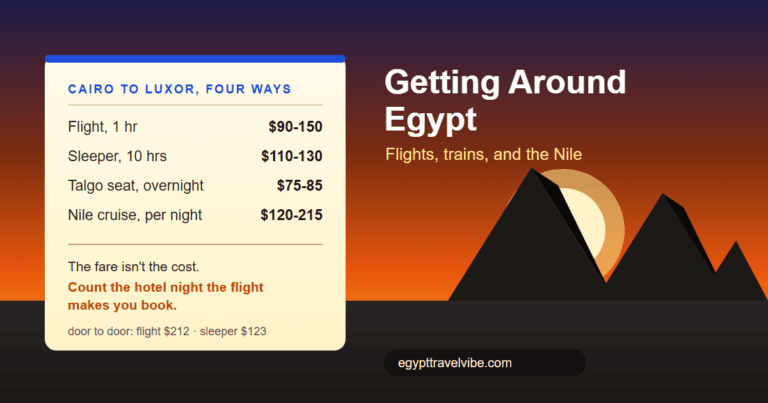
How much of a line item? Our full Egypt budget breakdown in EGP and USD itemizes it site by site: the classic Cairo-Luxor-Aswan circuit runs about 10,210 EGP, roughly $204 per person, in entry tickets alone. Moving between those three cities is its own decision, and our guide to flights, sleeper trains and Nile cruises compared covers it.
What Do You Need to Enter Egypt?
A visa and a valid passport. Most US, UK, Canadian, Australian, and EU travelers pay $30 for a visa on arrival in cash, or apply in advance through the official portal at visa2egypt.gov.eg. Your passport needs at least six months of validity beyond your arrival date, plus one blank page (GOV.UK, 2026).
The choice between the two comes down to when you’d rather deal with it. The e-visa takes 3 to 5 business days to process, so apply at least a week out. Visa on arrival needs nothing in advance but has historically been cash-only, in US dollars, with no guarantee of change at the counter.
That’s changing. A digital visa on arrival launched at Cairo Airport on August 1, 2026. You get a QR code and pay by card, roughly $36 total once the issuance fee is included.
One warning worth repeating: search “Egypt visa” and several of the top results aren’t the government. Third-party processors charge above the government rate, and the UK’s own advisory tells travelers they don’t need to buy a visa from an agent. Check for the `.gov.eg` domain before you enter a card number.
Full breakdown of every entry option, current fees, and how to spot a lookalike site: Egypt visa requirements, explained.
Where Should You Go on a First Trip?
Cairo, Luxor, and Aswan. Plenty of Egypt travel guides bury this under a top-20 list, but the default route earns its status: those three cities hold the Giza pyramids, the Grand Egyptian Museum, the Valley of the Kings, Karnak, and Philae between them. Everything else in Egypt is an add-on to that spine rather than a substitute for it.
Cairo is where the scale of the thing lands. Giza sits on the city’s edge, close enough that you can watch traffic pass in front of the pyramids. The Grand Egyptian Museum is a twenty-minute drive from the plateau. Add Islamic Cairo or Coptic Cairo, and you’ve filled three days without trying.
Luxor holds the densest concentration of ancient sites anywhere in the country. The east bank has Karnak and Luxor Temple. The west bank has the Valley of the Kings, Hatshepsut’s temple, and the Colossi of Memnon. Two banks, two days, minimum.
Aswan is slower and softer. The Nile widens, feluccas actually sail, and Philae Temple sits on its own island. It’s also the jumping-off point for Abu Simbel, three hours south by road or under an hour by air.
The two standard add-ons: the Red Sea for diving and beach time, and Abu Simbel from Aswan. Beyond those sit Alexandria, Siwa, the White Desert, Dahab, and Marsa Alam. All are excellent, and none of them belongs in a first ten-day trip. Save them. They’re the reason a lot of people come back. The second-trip list, priced and timed, is where to start when you do. Our region-by-region guide to where to actually go in Egypt covers all of them, with travel times and 2026 entry fees. For what to do once you are there, the best things to do in Egypt, priced and timed, is the next stop.
What Changed in Egypt Recently (and Why Old Guides Get It Wrong)
Three things shifted between late 2025 and 2026. The Grand Egyptian Museum opened and went online-only for tickets. Major sites moved toward card payment. The visa fee rose. Together they invalidate a lot of the Egypt advice still ranking today. If an Egypt travel guide doesn’t mention all three, treat its other numbers as stale too.
The Grand Egyptian Museum sells tickets online only. The GEM fully opened on November 1, 2025. Since December 2025, the on-site ticket office has been closed and booking runs through the official site, tickets.gem.eg. Foreign adult entry, now 1,500 EGP at the official checkout, rises by $5 on November 1, 2026, with Egyptian adult tickets going from 200 to 220 EGP (Ahram Online, 2026). The museum’s designed maximum is about 15,000 visitors a day, and Egypt’s Cabinet reported in December 2025 that it was averaging roughly that (Egypt Today, 2025). Turning up without a booking isn’t a gamble. It’s a closed door. How GEM booking works now covers every tier and the terms.
Card payment has reversed the old advice. Every legacy Egypt guide tells you the same thing: bring cash, bring small bills, Egypt runs on cash. That advice is now half wrong in a way that can strand you at a ticket window. Major antiquities sites, including the Giza plateau, have moved to card payment, and reports of cash being refused at ticket counters are widespread enough to plan around. Meanwhile baksheesh, taxis, markets, and small cafés remain firmly cash. So the honest answer isn’t “bring cash” or “bring a card”. It’s both, for different things. Carry a working card that your bank won’t freeze on an Egyptian transaction, plus small notes for everything the card can’t buy.
I’d flag one caveat on that, because it matters. I couldn’t find a single official Ministry announcement stating a blanket card-only policy. The evidence is a consistent pattern across site-level reporting rather than one authoritative rule. Treat it as “expect card, carry cash anyway” rather than a guarantee in either direction.
Where the famous things actually are has also changed, and it confuses almost everyone. Tutankhamun’s collection is at the Grand Egyptian Museum in Giza. The royal mummies are at the National Museum of Egyptian Civilization (NMEC) in Fustat. The original Egyptian Museum in Tahrir Square still holds a large collection and still exists. It just no longer holds the two things most visitors came for. My three-museum comparison shows which Cairo museum is worth your time.
| Museum | Where | What’s there |
|---|---|---|
| Grand Egyptian Museum (GEM) | Giza, near the pyramids | Tutankhamun’s full collection; book online only |
| National Museum of Egyptian Civilization (NMEC) | Fustat, old Cairo | The royal mummies |
| Egyptian Museum | Tahrir Square, downtown | A large general collection; the historic building itself |
How Do You Get Around Egypt?
Fly the long hops. Cairo to Luxor or Cairo to Aswan takes about an hour by air, against roughly ten hours on the sleeper train. For most ten-day itineraries, one or two domestic flights buy back a meaningful chunk of the trip.
The sleeper train is the interesting alternative, and it’s not really about the transport. You trade speed for a night’s accommodation and a slower, older way of seeing the Nile Valley. Plenty of travelers do one leg by train and one by plane, which strikes me as the right call: you get the experience without building the whole itinerary around it.
A Nile cruise handles the Luxor-to-Aswan stretch differently again, moving you between temples while you sleep. Standard cruise boats, smaller dahabiyas, and Lake Nasser routes are genuinely different products at genuinely different prices, and the gap between them is wide. Standard boat vs dahabiya vs Lake Nasser, priced honestly puts numbers on it.
Private drivers make sense for day trips like Saqqara and Dahshur, or Abu Simbel by road, where public transport is either slow or nonexistent. In-city, ride-hailing apps work well in Cairo and Alexandria. Elsewhere, agree the fare before you get in the taxi, and have cash.
Should You Book a Tour or Travel Independently?
Independent travel in Egypt is entirely doable, and it’s cheaper. The real tradeoff isn’t safety. It’s hassle tolerance and how much of your trip you want to spend arranging things. Most first-timers land somewhere in the middle.
A good guide adds two things. The first is context. Temples and tombs get enormously more interesting when someone can read the walls for you. Without that, the Valley of the Kings is a series of beautiful rooms you don’t understand. The second is friction removal: a guide at Giza absorbs most of the tout pressure before it reaches you.
What a full package tour costs you is pacing and freedom. Fixed schedules, group timing, and the shopping stops that quietly pad a lot of Egypt itineraries.
Where I’ve landed after doing it both ways: book independently, then hire guides by the site. A licensed Egyptologist for a morning in the Valley of the Kings or a half-day at Karnak is money extremely well spent. A guide walking you through a Cairo food market at your own pace is not. You get the expertise where it changes the experience and keep control of everything else.
Worth naming plainly: most Egypt travel guides ranking on Google are published by companies that sell Egypt tours. That doesn’t make their information wrong, but it does mean you’ll rarely see “you don’t need us for this” written on a tour operator’s website. Egypt Travel Vibe sells no tours and takes no booking commissions on this page, which is exactly why I can tell you when a tour isn’t worth the money.
What Should You Know Before You Land?
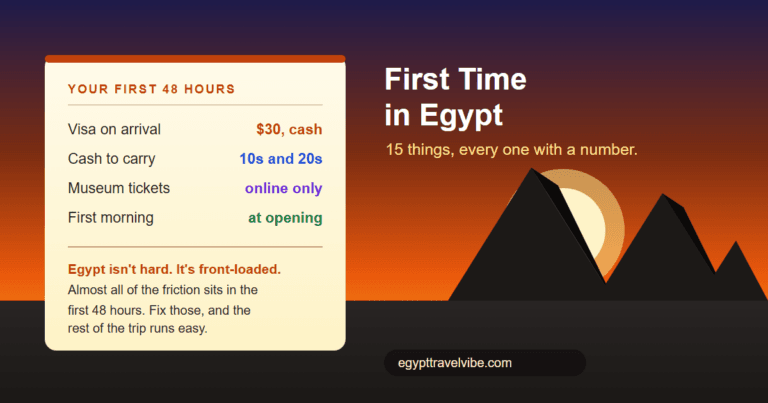
Four things cover most first-timer friction: dress, cash, sales pressure, and connectivity. Get those sorted and the rest of the trip is straightforward. For the wider list, here are 15 things worth knowing on a first trip.
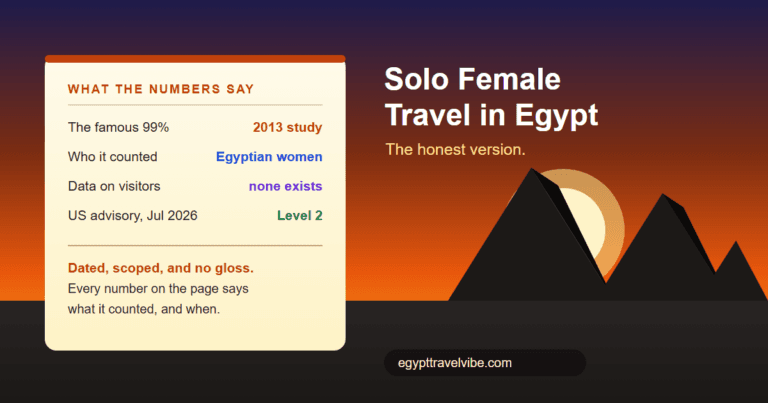
Dress. Shoulders and knees covered at religious sites and, for comfort more than rule, in most urban and market settings. Women should carry a scarf for mosque visits. Travelling alone as a woman changes some of this, and the honest solo female travel guide covers what does and what doesn’t. Red Sea resorts run by completely different norms, and swimwear is fine at the beach and pool. Loose cotton and long sleeves also outperform shorts and tank tops in genuine desert heat, which surprises people.
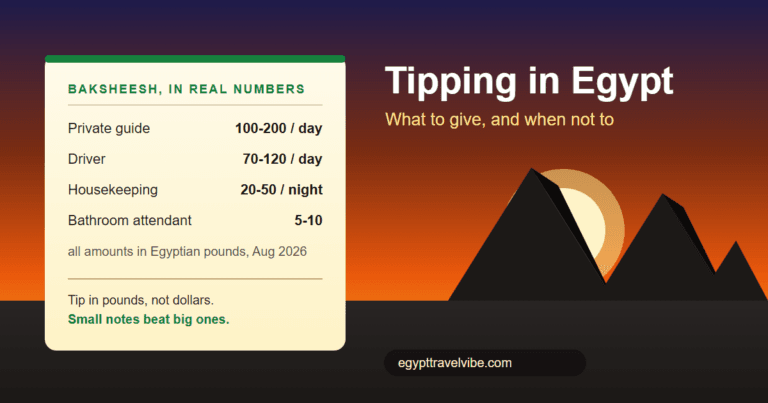
Cash for tips. Baksheesh is woven through daily life in Egypt, and it isn’t quite the same thing as tipping at home, as the guide to Egyptian culture and etiquette explains. Small amounts, given often, to a wider range of people than you’d expect. Carrying a stack of small notes solves 90% of the awkwardness, because the alternative is handing someone a large bill and hoping for change. Our guide to how baksheesh works, with real amounts gives the figure for every role you will meet.
Sales pressure. Expect persistent but non-threatening approaches at every major site. Someone will offer to take your photo, hand you a scarf, or point you toward a camel. The pattern is the same: an unrequested favour, then a price. A polite, firm “no thank you” while continuing to walk works. Stopping to explain doesn’t. Our guide to Egypt’s tourist scams breaks down all 11 setups and the real prices behind them.
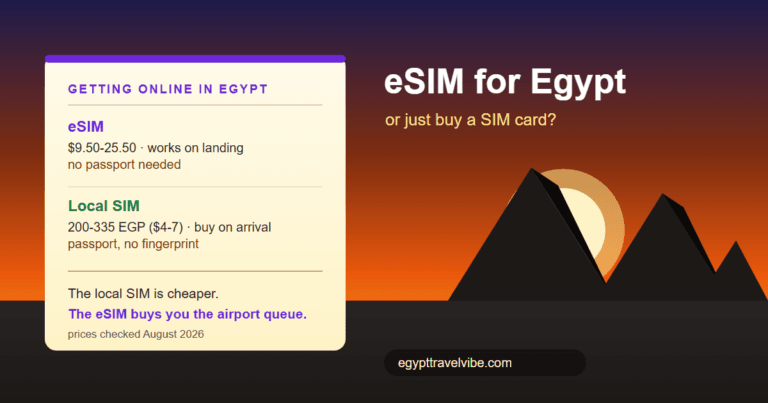
Connectivity. Sort an eSIM before you fly rather than hunting for a SIM counter at 2am after a long-haul flight. Egypt’s networks are decent in cities and along the Nile corridor, patchier in the desert. Our guide to getting connected before you leave the airport compares eSIM and local SIM prices, and explains which is actually cheaper.
Frequently Asked Questions
How many days do you need in Egypt?
Ten days is the realistic minimum for Cairo, Luxor, and Aswan without constant transfers. Seven days means cutting one of the three. Fourteen days lets you add the Red Sea or the Western Desert. Plan on three days in Cairo alone; transit between its sites eats more time than people expect.
Is Egypt safe to visit in 2026?
The U.S. State Department rates Egypt Level 2, \”Exercise Increased Caution,\” with Do Not Travel guidance limited to North and Middle Sinai and parts of the Western Desert near Libya (U.S. Department of State, 2026). The standard Cairo-Luxor-Aswan route falls outside every restricted zone.
How much does a trip to Egypt cost?
About $40-55 a day for budget travelers, $85-130 mid-range, and $160-250 or more for private guides and four-star hotels. Those figures exclude international flights, which typically add $200-1,200. Entry fees are the line item most people underestimate.
Do you need to book Grand Egyptian Museum tickets in advance?
Yes. The on-site ticket office closed in December 2025, and tickets.gem.eg is now the only way to buy. Foreign adult entry, now 1,500 EGP at the official checkout, rises by $5 on November 1, 2026 (Ahram Online, 2026). The designed daily maximum is about 15,000, and the museum has been running near it since late 2025.
Can you pay cash at Egyptian tourist sites?
Increasingly not. Major antiquities sites including the Giza plateau have moved to card payment, so bring a working card for tickets. You still need cash for baksheesh, taxis, and markets. Carry both, because they cover different things.
What’s the best month to visit Egypt?
October through April. Luxor’s July highs average 41°C against 23°C in January (Weather & Climate, climate normals), which makes midday summer sightseeing genuinely hard. Late October and March give good weather without peak-season crowds and rates.
The Bottom Line
This Egypt travel guide comes down to five decisions, and now you have all of them:
- Ten to fourteen days, weighted toward Cairo more than most itineraries suggest
- October through April, with late October and March as the sweet spots
- $85-130 a day mid-range, before international flights
- Book the Grand Egyptian Museum online. There’s no ticket window anymore, and the price goes up November 1
- Carry a card and cash: sites take cards, everything else runs on small notes
Sort your visa first, since it gates everything else, then build the budget around your actual route. Both of those have their own guides on this site.
One last thing about this page. Egypt’s prices and rules have moved repeatedly over the past year, which is precisely why every figure here carries a date and a source. I re-check the practical numbers in this Egypt travel guide monthly against the official portals and update the same week anything changes. Don’t trust an undated Egypt price from anyone, including me.