
Last verified: October 10, 2026. Train fares and the Talgo timetable were re-read on Seat61, and cruise prices against my own boat pricing on that date, while sleeper schedules and ride-hail figures were last checked on August 14. Fares move independently, so I re-check this page monthly.
Most first-timers settle on Cairo, Luxor, and Aswan within an hour of starting to plan. Then comes the part nobody warns you about: deciding how to move between them. The standard advice is “just fly, it’s only an hour,” and that advice quietly hides a hotel night and two airport transfers.
Disclosure: Some links in this guide may earn us a commission, at no extra cost to you. It never changes what we recommend.
Learning how to get around Egypt properly is worth about a hundred dollars and half a day on the classic circuit. This guide prices every option door to door, not by headline fare, and names which one wins each leg. It also covers the option most comparisons get wrong, along with what actually works inside Cairo. If you’re still choosing a trip length, our 7, 10 and 14-day itinerary comparison settles that first, and the first-trip planning guide covers the wider picture.
Key Takeaways
- Fly for speed, take the sleeper to save a hotel night, and take the cruise when the journey is the trip. Each one wins a different leg.
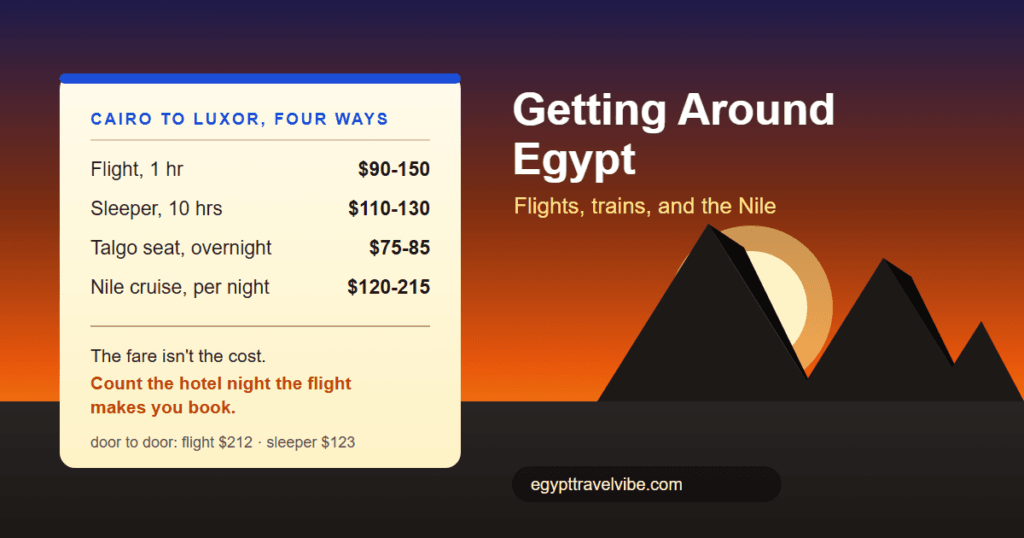
- The honest Cairo to Luxor comparison isn’t a $90-150 flight against a $110-130 sleeper fare. It’s the flight plus a hotel night and two airport transfers against a fare that includes your bed.
- Egypt’s Talgo train is the cheap option nobody explains properly. From Cairo to Luxor and Aswan it’s an overnight seated service at $75-85 to Luxor, not a daytime ride (Seat61, 2026).
- In cities, ride-hailing apps beat street taxis outright, because the fare is fixed before anyone moves.
Table of Contents
What Are Your Options for How to Get Around Egypt?
Four ways to cover the long legs, and three to cover a city. Each one wins a different job, which is why a single “best” answer to how to get around Egypt doesn’t survive contact with a real itinerary.
| Mode | Cairo to Luxor | 2026 cost | Best for |
|---|---|---|---|
| Flight | ~1 hr flying, 4.5-5 hrs door to door | $90-150 one way | Tight schedules, 7-day trips |
| Abela sleeper train | ~10 hrs overnight | $110-130 pp, double cabin | Saving a hotel night |
| Talgo seated train | ~8 hrs 40 overnight, seated (19:00 to 03:40) | $75-85 to Luxor (2nd/1st class) | Budget travel, short hops |
| Nile cruise | 3-4 nights, Aswan to Luxor | $120-215 pp per night, full board (high season) | When the journey is the trip |
| Private driver | Long, and priced by the day | 1,000-3,000 EGP per day | Families, multi-stop days |
Airfares move constantly, so treat the flight row as a live price rather than a fixed one. Everything else was checked in August 2026, and every dollar figure on this page uses a working rate of 50 EGP to the dollar.
Domestic flights run on EgyptAir, Nile Air, and Air Cairo, with Cairo to Luxor taking about an hour in the air and Cairo to Aswan about 1 hour 20 (FlightConnections, 2026). Trains run on two very different products that guides tend to blur together. That blurring is where most of the confusion about how to get around Egypt begins.
Should You Fly or Take the Train From Cairo to Luxor?
Take the train if you’d otherwise pay for a hotel that night. Fly if your trip is seven days or shorter. This is the central decision in how to get around Egypt, and the published fares make it look closer than it is. Flying costs $90-150 one way, against $110-130 per person for a sleeper cabin. That comparison leaves out everything the flight forces you to buy.
Here’s the full model, and the arithmetic is simple enough to check. A flight needs a bed at one end or the other, and a mid-range Egyptian hotel night runs $40-120. It also needs two airport transfers, roughly $20-25 combined. The sleeper fare includes your berth, dinner, and breakfast, and it drops you in the middle of Luxor rather than at an airport 15 minutes out.
Both directions, twice: I’ve taken the sleeper south from Cairo and north from Aswan, and I’d repeat the southbound leg happily. You board at dinner time, the cabin is small but private, and you wake up somewhere completely different. Northbound felt rougher, partly because arriving into Cairo at dawn dumps you into traffic before your day has started. If I could only do one, I’d sleep my way south and fly back.
Two honest caveats. Light sleepers do suffer, since the track is not smooth and cabins are compact. And the sleeper isn’t a bargain in absolute terms: at $110-130 it costs more than the flight fare alone. It wins only when you count the night.
How Long Does Each Option Really Take?
Door to door, the one-hour flight is a four-and-a-half to five-hour commitment, and every minute of it comes out of your waking day. The sleeper takes ten hours and costs you two or three waking hours, because you’d have been asleep for the rest of it anyway.
That’s the trade in one picture. If your trip is short enough that a single day matters, fly and accept the cost. If you have ten days or more, the sleeper hands you back a day you’d otherwise spend in transit.
Is the Talgo Train Worth Considering?
Yes, if you’re travelling on a budget and can sleep sitting up. This is also the option most guides describe incorrectly, so it’s worth being precise. Talgo is Egypt’s modern express fleet, introduced in 2023, with air-conditioned 1st and 2nd class and a cafe counter (Seat61, 2026). When I re-read Seat61’s 2026 fares in October, they were $85 in 1st class and $75 in 2nd from Cairo to Luxor, and $77 and $62 for the three-hour Luxor to Aswan hop. Seat61’s timetable has the train leaving Cairo Ramses at 19:00 and reaching Luxor at 03:40, about 8 hours 40 minutes, then Aswan at 06:40.
Here’s the part that gets garbled. Plenty of guides call the Talgo a “daytime train,” which is true on the Cairo to Alexandria route. On the Cairo to Luxor and Aswan run it operates as an overnight seated service, so you get a reclining seat rather than a berth. That single distinction changes who it suits. You’re not keeping your hotel night and riding through daylight scenery. You’re sleeping upright to save about $35-50 against a shared sleeper berth.
Who should take it? Budget travelers who don’t mind arriving tired, and anyone doing shorter hops like Luxor to Aswan where the seated stretch is only a few hours. Who shouldn’t? Anyone who can’t face a 03:40 arrival in Luxor, or whose next morning involves the Valley of the Kings at dawn.
One practical wrinkle worth planning around: foreigners can’t buy Egyptian rail tickets on the official site, which sells to Egyptian citizens only. Third-party agents like Bookaway or 12Go handle foreigner bookings, and sleeper services are e-ticketed while other trains need hard-copy delivery (Seat61, 2026). Book several days ahead in high season, since these sell out.
Is a Nile Cruise a Good Way to Travel Between Luxor and Aswan?
Yes, if the river is the point, but it isn’t the cheap way to make the trip. A standard boat runs about $120-215 per person per night twin-share in high season, full board, across the boats I priced in September. That one number covers your bed, your meals and the ride between cities, which is why it looks good against a hotel night. Temple visits are often extra, though: two of the Booking.com boat listings I opened say sightseeing isn’t in the rate. Here’s one real sailing, four nights from Luxor in mid-November, priced against hotels and a car:
Standard sailings run three or four nights between Luxor and Aswan, stopping at Kom Ombo and Edfu along the way. Sail south to north where you can choose, so the trip ends in Luxor at the densest cluster of sites. Dahabiyas, the smaller sailing boats, run $160-400 or more per night and move at a genuinely slower pace.
If a cruise doesn’t fit your dates, the same stretch works by land. A train runs the Nile Valley between the two cities in about three hours, and a road transfer costs roughly 2,000 EGP for the car. Both are cheaper than a cruise night, and both mean arranging your own guide for Kom Ombo and Edfu. When I priced the same four nights both ways, hotels and a car came to about half the boat for two, so run the numbers for your own party.
The cruise is the one mode where the transport is the attraction. That’s exactly why it belongs in a 10-day trip and not a 7-day one.
Which kind of boat is its own decision: standard boat, dahabiya or Lake Nasser, priced honestly compares the three.
How Do You Book Egyptian Trains and Flights?
Booking is where how to get around Egypt trips people up, because the rules differ by mode and none of them are obvious from abroad. Trains are the awkward one. Egypt’s official rail site sells to Egyptian citizens only, so foreigners work through third-party agents like Bookaway or 12Go (Seat61, 2026).
The practical difference matters more than it sounds. Sleeper tickets are e-ticketed and arrive by email, so you can book those from home and simply turn up. Other train tickets, including Talgo seats, need hard-copy delivery to your hotel or collection at Cairo’s Ramses station. Leave a few days of slack rather than booking the night before.
Book the sleeper at least a week out in high season, which runs October through April. Cabins genuinely sell out. The double cabin goes first, because it’s the best value per person. Solo travelers pay a single-cabin supplement of roughly $130-190 in peak months, so travelling as a pair changes the maths considerably.
Domestic flights are the opposite: easy to book, harder to price. EgyptAir, Nile Air, and Air Cairo all fly the Cairo-Luxor-Aswan triangle, and the route runs frequently enough that a missed flight isn’t a lost day. EgyptAir alone schedules well over a hundred Cairo-Luxor departures a month, with Cairo-Aswan busier still (FlightConnections, 2026). Fares move with demand rather than sitting at a fixed rate, so check them the day you plan rather than the month before. Expect the December to February peak to run well above the $90-150 band. EgyptAir also discounts some domestic legs for travelers holding its international tickets, which is worth checking if you’re already flying them in.
What about the Abu Simbel run, the one leg that doesn’t fit this pattern? It works by short flight, by road from Aswan, or as part of a Lake Nasser cruise, and the logistics deserve their own treatment. Our Aswan guide covers the day-trip options, and the full comparison follows.
One booking habit saves the most grief. Lock the long legs before you lock hotels. Transport availability shapes an Egypt itinerary far more than room availability does, especially around the Christmas fortnight.
How Do You Get Around Cairo?
Use a ride-hailing app. Of all the questions about how to get around Egypt, the capital has the clearest single answer. A hop across central Cairo runs 40-80 EGP, about $0.80-1.60, and the fare is fixed before the car moves. That one detail removes the most common friction in the city. Uber and Careem both operate widely, and forum regulars consistently recommend them over street taxis (Rick Steves Travel Forum, 2026).
The metro is the other genuinely good option. It’s cheap, it avoids traffic entirely on the lines it serves, and it has women-only carriages that many solo travelers prefer. It won’t reach everywhere you want to go, but for a Downtown to Coptic Cairo run it beats anything on wheels.
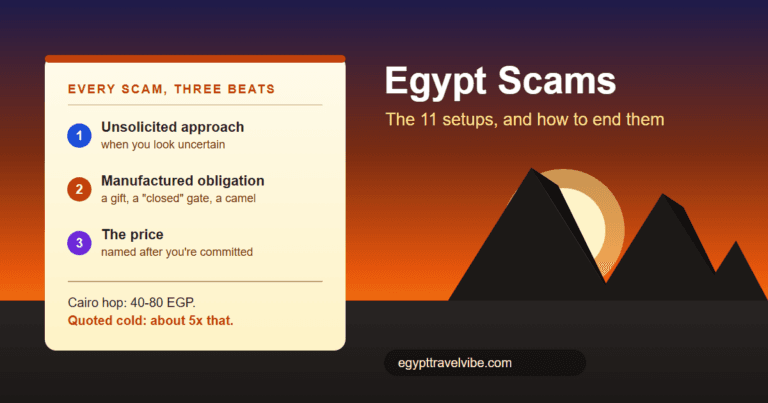
Street taxis still work, though you’ll meet the “broken meter” opener that our guide to Egypt’s tourist scams covers in detail. Agree a price before you open the door, or skip the negotiation entirely with an app.
One thing worth internalizing: traffic is the real physical risk of an Egypt trip, well ahead of anything travelers usually worry about. Our honest safety guide has the road-fatality comparison. Cross with locals, and use the bridges and underpasses where they exist.
When Is a Private Driver Worth It?
On multi-stop days and for families, where the per-head cost drops and the alternative is three separate negotiations in the heat. A full day with a car and driver in Cairo runs roughly 1,000-3,000 EGP, about $20-60. Published rates vary widely by vehicle type and operator, so treat that as a range rather than a quote.
Sources genuinely disagree here. Budget sedans get quoted near the bottom of that band, while limousine services and luxury vehicles run well above it. Get a written quote for your specific day rather than relying on any published figure, including this one. Between cities, a Luxor to Aswan transfer sits around 2,000 EGP.
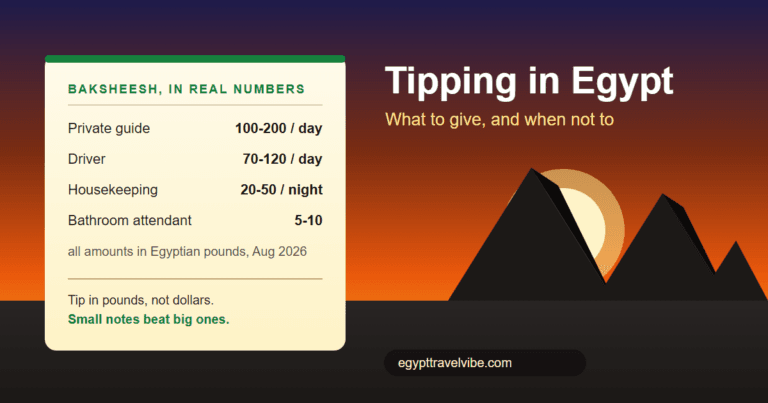
The driver day earns its cost on spread-out itineraries. Think the Giza plateau plus Saqqara and Dahshur, or a full Luxor west bank circuit, where taxis between sites are a nuisance. Agree the route in writing before you start, and specify no shopping stops. Commission detours are the most common way these days go sideways. Drivers are also one of the roles where tipping matters, and our guide to baksheesh with real amounts has the figure.
Which Option Should You Choose?
Match the mode to the leg rather than hunting for one best answer. Here’s the rule set, by traveler:
- 7-day trip: fly both legs. A week can’t absorb two ten-hour transfers, and the itinerary comparison explains why that week is tight to begin with.
- 10-day trip: fly south to Aswan, cruise north to Luxor. This is the standard circuit for good reason.
- Budget travelers: sleeper south, and count the hotel night you didn’t buy. Or the Talgo seat if $35-50 matters more than sleep.
- Light sleepers: fly, or take the Talgo in daylight on shorter hops. A bad night before the Valley of the Kings is a false economy.
- Families and multi-stop days: private driver, agreed in writing.
Frequently Asked Questions
Is the Cairo to Luxor sleeper train worth it?
Yes, if you’d otherwise book a hotel that night. At $110-130 per person in a double cabin it costs more than the flight fare alone. But it includes your bed, dinner and breakfast, and it lands you in central Luxor around 5am rather than at an airport.
Should I fly or take the train in Egypt?
Fly if your trip is seven days or shorter, since a week can’t absorb ten-hour transfers. Take the sleeper on longer trips. Door to door the flight costs 4.5-5 waking hours against the sleeper’s 2-3, so the time gap is smaller than the timetable suggests.
How do you get around Cairo?
Ride-hailing apps first, metro second. A central Cairo hop costs 40-80 EGP, about $0.80-1.60, with the fare fixed before the car moves. The metro avoids traffic entirely on its lines and runs women-only carriages that many solo travelers prefer.
Is Uber safe in Egypt?
Yes, and it’s widely used in Cairo and Alexandria. The main advantage is the fixed fare, which removes the “broken meter” dispute that street taxis open with. Traffic itself is the genuine risk in Egypt, not the ride-hailing service.
How do you get from Luxor to Aswan?
Three ways: a 3-4 night Nile cruise at about $120-215 per person per night in high season, full board, a train down the Nile Valley, or a road transfer at roughly 2,000 EGP. The cruise covers the same ground with your bed and meals included, though many boat rates leave the temple visits at Kom Ombo and Edfu to pay separately.
The Bottom Line
There isn’t one single answer to how to get around Egypt, and any guide that names one is skipping the arithmetic. Fly when the calendar is tight. Take the sleeper when you’d otherwise buy a hotel night, because that’s the comparison that actually decides it. Take the Talgo seat when the budget rules and you can sleep upright. Take the cruise when the moving is the point of the day.
Inside cities, the answer is simpler: open a ride-hailing app and stop negotiating. And whichever combination you land on, book the long legs before the hotels. Transport availability shapes how to get around Egypt far more than room availability ever will.
Next: our 7, 10 and 14-day itinerary comparison decides most of this for you by setting the trip length, and the full Egypt cost breakdown prices everything else with a date on every figure. I re-check these fares and schedules monthly against operators and primary sources.