
Last verified: August 29, 2026. Every price, fee, transfer cost, advisory line and climate figure in this Dahab travel guide was checked against source on the date above, including the St Catherine’s Monastery situation. Prices came from two named dive centres, not aggregators. I re-check this page monthly.
Most people arrive in Dahab knowing two things. It’s cheap, and its famous dive site kills people. One of those is true. The other is true in a much narrower way than the internet suggests, and the gap between them is the reason this guide exists.
Disclosure: Some links in this guide may earn us a commission, at no extra cost to you. It never changes what we recommend.
Egypt logged a record 19 million visitors in 2025 and is targeting up to 20 million this year (State Information Service, 2026). Almost none of that lands here. Dahab is a former Bedouin fishing village on the Gulf of Aqaba that turned into Egypt’s dive and backpacker capital and then, unusually, stopped. It never became a resort.
So this Dahab travel guide settles five questions before you book: how you actually get here, what diving really costs, whether the Blue Hole is dangerous, whether the Mount Sinai trip still works, and how long to stay. If you’re still deciding whether Sinai belongs in the trip at all, our region-by-region look at where to go in Egypt is the wider view.
Key Takeaways
- Dahab is the one place in Egypt with nothing to tick off. No timed museum slot, no convoy, no temple closing at five. That’s exactly why people arrive for four days and leave after three weeks.
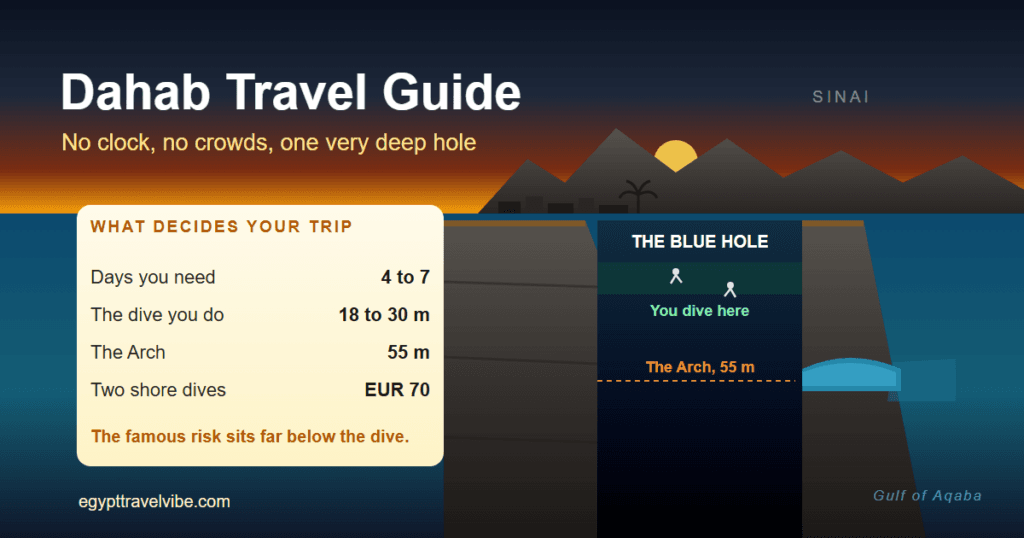
- The Blue Hole’s reputation and its actual risk are two different things. The deaths cluster at one 26 m tunnel whose ceiling sits around 52 to 55 m. The dive nearly everyone does runs 18 to 30 m and is genuinely gentle.
- No official register of Blue Hole deaths exists. Published estimates run from about 40 to over 200. I give you both ends and the reason they disagree.
- Almost everything here is a shore dive, which is why Dahab undercuts Sharm’s boat diving. Two guided dives with your own gear ran 70 euros at both centres I priced on August 29, 2026.
- The FCDO redrew its Sinai line on August 4, 2026. Coastal South Sinai and the St Catherine to Nuweibaa road now sit inside normal advice. Any page still describing a “Sharm perimeter” rule is stale.
- Check the monastery before you book the Mount Sinai overnight. St Catherine’s is in an unresolved ownership fight with the Egyptian state. It closed its gates once already during this dispute.
Table of Contents
What Is Dahab, and Why Does Everyone Stay Longer Than Planned?
Dahab is a small town of low buildings strung along about three kilometres of shoreline, 90 minutes north of Sharm el-Sheikh, with no ticketed attraction of any kind inside it. Not one. That single fact explains more about how a trip here goes than any list of things to do.
The old town splits into three stretches. Assalah sits north around Ghazala bay, quieter and cheaper. Masbat is the middle, where the seafront restaurants and most dive centres are, and where the Lighthouse reef comes almost to the pavement. Mashraba runs south, more spread out, with the cheaper long-stay rooms. You can walk the whole thing in under an hour.
Here’s the thing nobody says out loud. Every other stop in an Egypt itinerary runs on a clock. Grand Egyptian Museum tickets are booked online for a slot. Temples close. The Abu Simbel road moves in convoys. Cruise boats sail on schedule. Dahab has none of that, and when you remove the clock, length of stay stops being a decision and starts being a drift. That’s the whole mechanism behind the “came for four days, stayed three weeks” line every guide repeats without explaining.
The practical consequence matters more than the anecdote. Put Dahab at the end of your trip, never in the middle. It’s the only stop in Egypt that can absorb an extra week without rebooking a single thing, and the only one where an extra week is a real temptation.
I’ve based here, and what surprised me was how little effort the town spends on visitors. Nobody is selling you a felucca ride. The dive centre is a hundred metres from the water, the water is the attraction, and the evening happens on cushions at a low table with your feet more or less in the sea. If you want to be entertained, this is the wrong town. If you want somewhere the country turns down a notch, it’s close to perfect.
How Do You Actually Get to Dahab?
Fly into Sharm el-Sheikh (SSH) and drive 90 minutes north. Everything else is a compromise. There’s no airport in Dahab, and the Cairo bus runs around nine hours, a figure that hasn’t moved in years. On August 29, 2026, private airport transfers were quoted anywhere from about $25 to $55 depending on the operator, which is a wide enough spread to be worth ten minutes of shopping.
The cheap version works fine if you’re not landing at 2am. East Delta runs buses from Sharm’s bus station, and shared microbuses cover the same road for 40 to 60 EGP, though you’ll pay a taxi to reach the station from the airport first. Going by road you’ll pass checkpoints. Have your passport out, expect a glance, and keep moving.
Coming from Israel or Jordan, the Taba crossing is roughly two and a half hours up the coast. From Cairo, the overnight bus is the standard budget move and it’s exactly as comfortable as that sounds. Our full breakdown of Egypt’s flights, buses and trains sets it against the alternatives.
One thing most Dahab travel guides miss entirely. If your whole trip stays inside Sinai, you may not need a visa at all. A trip confined to Sharm El-Sheikh, Dahab, Nuweiba, Taba or the St. Katherine area likely qualifies for a free electronic entry stamp instead of a paid visa. GOV.UK words the allowance as “staying for less than 15 days,” though other sources cite 14, and the cutoff isn’t consistent across every reference I checked (GOV.UK, 2026). The moment Cairo or Luxor enters the plan, you need the full e-visa or visa on arrival instead.
Is the Blue Hole Actually Dangerous?
For the dive almost everyone does, no. The Blue Hole is about 150 m across and drops to roughly 110 m, and its entire reputation rests on one feature: a tunnel over 26 m long whose ceiling sits at around 52 to 55 m, leading out to open sea (SCUBA Travel, 2026). That is deep technical territory. The dive you’ll actually be sold is not that dive.
The standard trip starts at the Bells, a short walk north. You drop through a chimney at 18 to 20 m, reach about 30 m at the exit, then drift south along a wall and over the saddle into the hole itself. It’s one of the gentlest, prettiest dives in Egypt. No overhead, no decompression, no drama.
So why does the Arch catch people? Because from the surface it looks like nothing, and because narcosis at 55 m on air removes exactly the judgement you need to turn around. The divers who die there are overwhelmingly recreational divers on air attempting a technical dive without the training, the gas or a team. The most famous case, a young diver whose fatal 2000 descent to 115 m was recorded on his own camera, is also the single most-watched piece of content about this town. That video, more than anything else, built the legend.
Now the numbers, honestly. Nobody knows. The most-quoted estimate is about 130 deaths over the fifteen years to 2012, and it comes from Tarek Omar, the Dahab technical diver who has recovered most of the bodies, reported in Der Spiegel in 2012 and repeated in The Guardian in 2017. Other counts run as low as roughly 40 recorded and as high as 200. No Egyptian authority publishes a register, and some tallies fold in surface snorkelling deaths that have nothing to do with the Arch. The spread is the finding, and any page quoting one confident figure is guessing.
The risk that actually applies to most readers isn’t the Arch at all. It’s snorkelling a shore entry in current without fins, walking between sites in full sun without water, and a first shore dive in unfamiliar rental kit. Those are the things that hurt people here, and none of them make videos.
For the record: I’ve done the Bells drift into the hole. I have not been through the Arch, I’m not qualified to, and neither are you unless you already know that you are.
Where Should You Dive, and What Does It Cost?
Nearly every dive in Dahab is a shore dive, and that one structural fact is why it undercuts Sharm’s boat days on price. No boat means no boat fee. Two guided shore dives with your own gear ran 70 euros at both centres I priced on August 29, 2026, against boat day trips out of Sharm or Hurghada that typically cost considerably more for the same two dives.
The site shortlist is short and honest. The Canyon is a narrow fissure you enter at 18 to 20 m, dramatic and slightly serious. The Bells into the Blue Hole is the signature drift. Eel Garden is a gentle sandy slope with garden eels, ideal for a second dive or a snorkel. The Islands is shallow coral topography at 17 to 18 m. The Lighthouse, right in town, runs from the surface to 10 m and is where most courses start (SCUBA Travel, 2026).
| Site | What it is | Who it suits |
|---|---|---|
| The Lighthouse | In-town reef, surface to 10 m | Courses, night dives, first fins |
| Eel Garden | Gentle sandy slope, garden eels | Snorkelers, second dives |
| Bells to Blue Hole | Chimney at 18 m, drift to 30 m | Any certified diver |
| The Canyon | Narrow fissure from 18 to 20 m | Confident divers only |
| Ras Abu Galum | Remote reefs, camel or boat access | Overnight safari types |
Budget one cost nobody mentions. Reaching the Blue Hole by road, foreign visitors pay a site fee on top of the diving, listed at $20 by one centre’s own 2026 pricelist and commonly reported as $25 once the checkpoint fee is included, in cash (Scuba Seekers, 2026). It’s small, but it’s per person per day, and it surprises people who arrived expecting a free beach.
The honest limit of this town: the boat scene is thin. If the Thistlegorm or Ras Mohammed is the point of your week, you’re in the wrong place and should read how the two big resorts compare instead. Reef purists eventually drift south to Egypt’s quietest Red Sea coast, and I set all four coasts side by side in our Red Sea diving comparison.
Can You Learn to Dive or Freedive Here?
Yes to both, and Dahab is one of the better places on earth to learn freediving specifically. A PADI Open Water course ran 400 to 450 euros across the two centres I priced, over roughly four days, with eLearning and certification included (H2O Divers Dahab, 2026; Scuba Seekers, 2026). Beginner freediving courses started at 300 euros for AIDA 2.
Why does freediving cluster here rather than anywhere else on this coast? Geometry. Deep, flat, sheltered water sits a few metres from a walk-in shore entry. No boat, no swell, no schedule, so a training day costs a fraction of what it costs somewhere you have to sail to. That’s the same shore-access argument as the scuba pricing, applied to a sport that needs a lot of repetition.
It also explains a number you’ll see contradicted everywhere. Some sources give the Blue Hole as 90 m deep, others as 110 m or more. Both are right about different things. Around 90 m is the competition line depth used for freediving events held in the hole. The seabed is deeper. If a guide quotes 90 m as the depth of the hole, it has copied a freediving figure without knowing what it was measuring.
Picking a centre matters more than picking a site. Look for small groups, published prices you can read before you arrive, and instructors who ask what you’ve dived recently rather than what you’re certified to. Women travelling alone consistently rate this town highest in Egypt, and our honest guide to solo female travel explains the structural reasons why.
What Is There to Do Besides Diving?
Three things, in descending order of reliability. The Blue Lagoon and the Ras Abu Galum protected area, reachable only by camel, boat or four-wheel drive from the Blue Hole. Kitesurfing in the lagoon, where wind funnels down between the Sinai and Saudi ranges most summer afternoons. And the Mount Sinai overnight, which is the one that needs a caveat this year.
The Blue Lagoon run is the day trip worth doing. Jeep to the Blue Hole, then roughly an hour and a half by camel along a coastline with no road, to shallow turquoise water, a few wooden shelters and someone making tea. Boat excursions to Ras Abu Galum were listed at 60 to 120 euros depending on meals and whether you stay overnight (Scuba Seekers, 2026). Overnight is the better version.
Now the caveat, and I haven’t seen another Dahab travel guide mention it. The Mount Sinai night hike for sunrise runs normally. The monastery at the foot of it is the problem.
St Catherine’s, inscribed by UNESCO in 2002 and the world’s oldest continuously operating Christian monastery, is in an unresolved ownership dispute with the Egyptian state. In May 2025 an Egyptian appeal court ruled it holds usage rights rather than ownership, with the land classed as state property. A separate fight over the monastery’s own leadership then shut its gates to visitors for 10 to 16 days, until it reopened on September 6, 2025 (Mada Masr, 2025). Cassation appeals were still pending as of late August 2026, and UNESCO’s World Heritage Committee has separately asked Egypt to pause a large development scheme around the site.
Here’s my honest position on it. As far as I can establish the monastery is admitting visitors, but I could not confirm that from an official Egyptian source on August 29, 2026, and most of the reporting comes from religious press outlets with a stake in the outcome. It has already closed at no notice once. So confirm entry with your operator before you pay for the overnight, and don’t assume a package that lists the monastery can actually deliver it. The full night-hike logistics covers the climb itself.
If you’re weighing Sinai against Egypt’s other independent-traveller trip, the desert is the alternative, and I’d pick the White Desert in winter and Sinai in the shoulder months.
Where to Stay, and What a Week in Dahab Really Costs
The accommodation ladder here runs camp, guesthouse, mid-range hotel, and that’s essentially it. There’s no all-inclusive tier in the old town, which is exactly the point for the people who come. The eight resorts that sell it sit on the lagoon south of town, as my Red Sea stays comparison shows. Dorm beds were listed from around $8 to $14 and simple doubles from roughly EGP 1,400 on August 29, 2026, though rates move with season and the exchange rate moves under both.
A “camp” in Dahab usually means a walled courtyard of simple rooms with a shaded seafront terrace, not a tent. Many are Bedouin-owned and have been running for decades. Assalah is quieter and cheaper, Masbat central and louder, Mashraba spread out and best for long stays. Monthly rates exist at almost every property and are worth asking about from day one if you might stay more than ten days.
On the long-stay economy, be realistic. Crowdsourced figures put a single person’s all-in monthly cost somewhere around $460 to $560 with a central one-bedroom near $190 a month, but those are self-reported and they drift. The number that actually matters is the connection. Wi-fi here is fine for email and unreliable for video calls, and a local data SIM isn’t optional, it’s the backup that makes the week work. Sort your eSIM or local SIM before you need it.
Bring cash. Card acceptance is patchy outside hotels and the bigger dive centres, ATM withdrawal limits are low, and the Blue Hole site fee is cash only. The full Egypt budget in EGP and USD prices the rest of the trip the same way, and tipping works differently here than you expect. For how Dahab beds compare with the resort coast, see our Red Sea accommodation comparison.
Is Dahab Safe, and When Should You Go?
Yes, with one advisory detail that changed on August 4, 2026. As of that update, the FCDO advises against all but essential travel to the northern part of South Sinai Governorate beyond the St Catherine to Nuweibaa road, “except for the coastal areas along the west and east of the peninsula” (GOV.UK, 2026). Dahab is coastal. The old Sharm perimeter rule is gone, and any page still describing it is out of date.
The US holds Egypt at Level 2, refreshed July 15, 2026, with elevated risk confined to North Sinai, the Libya border strip and parts of the Western Desert (US State Department, 2026). North Sinai and South Sinai are different places with a mountain range between them, and conflating them is the single most common error in Egypt safety writing. Our honest read on the advisory zones maps it properly.
On the ground, Dahab has the lowest hassle level of anywhere in Egypt, and the reason is structural rather than cultural. A town built around multi-day dive courses and long-stay guests has no incentive to squeeze a stranger once. Compare that with a monument gate where every visitor is a one-off. That’s the whole difference. One practical warning though: check whether your travel insurance actually covers diving, and to what depth. Most standard policies don’t by default.
When to come? Shoulder months. January highs run about 20°C with a 22°C sea, July hits 37°C with a 26°C sea, and annual rainfall is around 24 mm, which is effectively none (Weather2Travel, 2026). Wind is the real variable: great for kiters, less so if you wanted a still afternoon on a lounger.
One honest note about the reef. The Gulf of Aqaba’s corals were long described as unusually heat-tolerant, but the 2024 marine heatwave produced the first documented bleaching there (Mongabay, 2025). Recovery has varied by species and site. You can check current thermal stress yourself on NOAA’s Gulf of Aqaba coral reef gauge before you book, which is more than any brochure will tell you. Month-by-month timing for the rest of Egypt sets this against the Nile Valley heat.
Dahab Travel Guide FAQs
Is the Blue Hole in Dahab dangerous?
Not for the dive most people do. Deaths cluster at the Arch, a tunnel over 26 m long with its ceiling around 52 to 55 m, well past recreational limits. The standard guided dive enters at the Bells at 18 to 20 m and drifts in around 30 m, with no overhead and no decompression.
How many days do you need in Dahab?
Four is the honest minimum: two dive days plus one excursion plus a rest day. A week is the sweet spot. Because the town has no ticketed attractions and no schedule, treat it as the elastic block at the end of your trip rather than a fixed stop in the middle.
Do you need a visa for Dahab?
Possibly not. A trip confined to Sharm El-Sheikh, Dahab, Nuweiba, Taba or St. Katherine likely qualifies for a free electronic entry stamp. GOV.UK words it as under 15 days, other sources say 14. Add Cairo or Luxor and you need a full e-visa or visa on arrival instead.
How do you get from Sharm airport to Dahab?
About 90 minutes by road, and there’s no airport in Dahab. Private transfers were quoted from roughly $25 to $55 in late August 2026 depending on operator. East Delta buses and shared microbuses from 40 to 60 EGP run the same road, but you’ll need a taxi to the bus station first.
Is Dahab safe for solo female travelers?
It’s the lowest-hassle town in Egypt by a clear margin, for structural reasons: a place built on multi-day dive courses and long-stay guests has no incentive to squeeze a one-off visitor. The FCDO’s August 4, 2026 wording places coastal South Sinai inside normal travel advice.
Can you visit St Catherine’s Monastery from Dahab?
The Mount Sinai night hike runs normally, about 2.5 hours away. The monastery itself is in an unresolved ownership dispute and closed its gates to visitors for 10 to 16 days in 2025 during a parallel leadership crisis. It appears to be admitting visitors, but confirm with your operator before paying for the overnight.
The Bottom Line
Dahab is for divers, freedivers and anyone who wants a stretch of an Egypt trip that no ticket time can interrupt. Four days works. Seven is better. Put it last.
Who should skip it? Anyone with under ten days in Egypt whose priority is the Nile Valley, because Sinai costs you two extra flights through Cairo. Anyone whose week is about boat diving on the famous wrecks, because that’s Sharm’s job. And anyone who needs reliable video calls, because the connection here will let you down at the worst moment.
Egypt Travel Vibe carries advertising and partnerships, and discloses them. What it doesn’t do is sell Sinai packages, which is why this Dahab travel guide can tell you the monastery in your itinerary might not open, that the scariest number about the Blue Hole is unverifiable, and that the reef you came for bleached two summers ago. Where the record was genuinely unresolved, I dated it rather than smoothed it.
Marco re-checked every price, fee, advisory and figure on this page against source on August 29, 2026.
Still building the trip? Where Sinai fits in the whole country is the wide-angle view, and the 7 vs 10 vs 14-day comparison shows which shapes of trip can actually reach this coast.