
Last verified: August 11, 2026. Package price bands, GEM ticketing, domestic transport fares and the August heat figures were checked against source on the date above. They shift through the year, so I re-check this page monthly and update the date each time.
Most people book their Egypt flights before deciding how many days the trip actually needs. Then they discover, somewhere around Luxor, that they did it backwards. In the first four months of 2026 alone, Egypt logged a record 6.1 million visitors, up 7% on the year before (Egypt’s State Information Service, 2026). A lot of them are running an Egypt itinerary that’s one size too small.
Disclosure: Some links in this guide may earn us a commission, at no extra cost to you. It never changes what we recommend.
Here’s the problem. Seven days feels affordable. Fourteen feels indulgent. And nearly every “perfect Egypt itinerary” in your search results was written by a tour operator whose perfect trip length happens to match a tour they sell. This guide compares the three standard trip lengths honestly: what each one covers day by day, what each one costs, and a simple rule for picking yours. If you’re still deciding whether Egypt is the right trip at all, start with our complete Egypt travel guide.
Key Takeaways
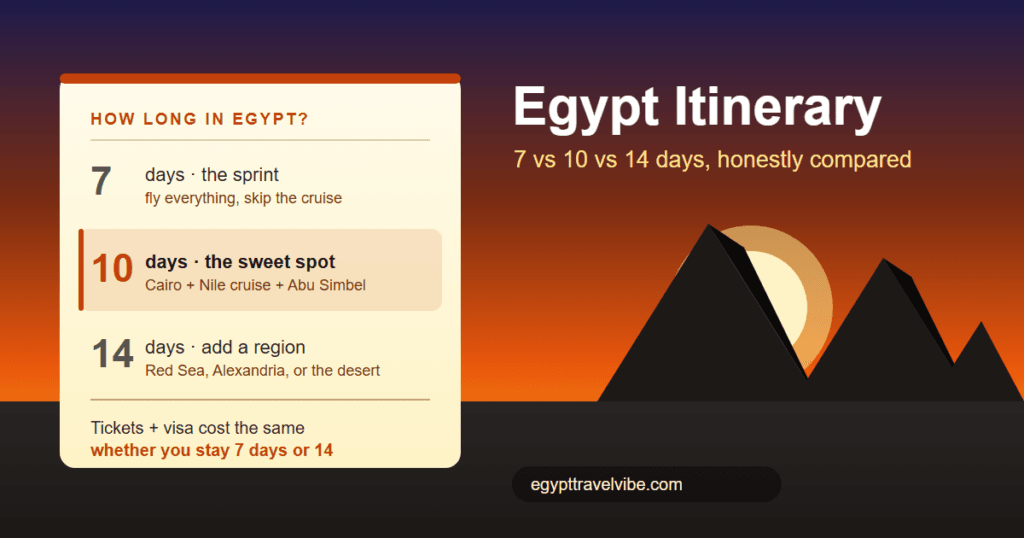
- 10 days is the sweet spot for a first Egypt trip: Cairo, a 3-4 night Nile cruise, and Abu Simbel without the sprint. Mid-range 10-day packages run $1,100-1,600 per person in 2026, including domestic flights.
- Choose 7 days only if you’ll skip the cruise and fly between cities.
- Choose 14 to add the Red Sea or the Western Desert, not more temples.
- Shorter is pricier per day: entry tickets and visa cost the same whether you stay 7 days or 14.
Table of Contents
How Many Days Do You Need in Egypt?
Ten days, for most first-timers. Seven works if you drop the Nile cruise and fly between cities. Across guidebooks, forums, and the tour operators themselves, the consensus is striking: 10 days is the trip that people who’ve done Egypt once say they should have booked the first time (Global Highlights, 2026).
Why does the answer cluster so tightly? Because every first-trip Egypt itinerary shares the same three anchors: Cairo with Giza and the Grand Egyptian Museum, Luxor’s temples and tombs, and Aswan on the slower stretch of river. Those anchors alone eat six or seven days once you include getting between them. The real fork in the road is the cruise. A standard Luxor-Aswan sailing takes 3 to 4 nights, and it simply doesn’t fit inside a week.
Season changes the math too. In August, Luxor runs around 41°C and Aswan 42°C, which pushes sightseeing into a dawn-and-done rhythm and effectively costs you a day of pace over a week (Global Highlights, 2026). Our month-by-month guide to heat, crowds, and prices covers which weeks to target. Safety, for the record, isn’t the variable people fear: the US advisory was refreshed on July 15, 2026 and held at Level 2, with the standard tourist corridors operating normally (Travel.State.Gov, 2026).
Cairo’s block never shrinks. The trip lengths differ almost entirely in what happens south of it.
What Does 7 Days in Egypt Look Like?
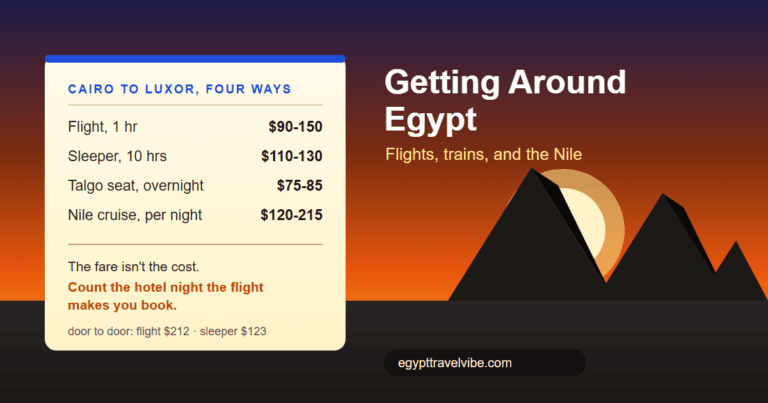
A 7-day Egypt itinerary covers Cairo, Luxor, and Aswan by air, with no cruise and no slack. As of August 2026, the Cairo-Luxor hop costs about $90-150 one way and takes an hour, while the sleeper train runs $110-130 per person in a double cabin and takes around ten (Nile Empire, fares as checked August 2026). On a 7-day clock, you fly. The train eats a night you don’t have.
Here’s the version of the week that actually works:
| Day | Where | What you’re doing |
|---|---|---|
| 1 | Cairo | Arrive, sleep off the flight |
| 2 | Cairo | Grand Egyptian Museum, full day, ticket booked in advance |
| 3 | Cairo | Giza plateau at opening, Saqqara after lunch |
| 4 | Luxor | Morning flight, Karnak and Luxor Temple |
| 5 | Luxor | West Bank at dawn: Valley of the Kings, Hatshepsut |
| 6 | Aswan | Morning train down, Philae Temple, felucca hour at sunset |
| 7 | Home | Fly out via Cairo |
Notice what’s missing. Abu Simbel becomes a brutal 4 a.m. add-on or gets cut. Kom Ombo and Edfu, the two temples the cruise delivers between Luxor and Aswan, disappear entirely. And you average two to three major sites a day with zero buffer, so one upset stomach or one delayed flight breaks the chain.
From my own 7-day run: the day I regretted was Day 3. I’d stacked Giza and Saqqara back to back in the heat, and by Saqqara I was too cooked to care about the world’s oldest pyramid. That’s what a bufferless week does. You see everything and absorb about seventy percent of it.
One budget note on this version. Two domestic flights make it the transport-heaviest itinerary per day, and August fares move with demand. If the Cairo-Luxor leg prices above $150 when you check, the sleeper train still works here, but only southbound on night one of the Luxor block: board around 8 p.m. in Cairo, wake up at Luxor station, and you’ve traded a hotel night for the fare instead of losing a sightseeing day.
So when does 7 days win? Repeat visitors chasing one region. Travelers on hard PTO limits. And anyone who’d honestly rather do Cairo plus Luxor properly than five cities badly. That’s a respectable trip. It just isn’t the classic.
What Does 10 Days in Egypt Look Like?
The 10-day Egypt itinerary is the classic for a reason: it fits the full circuit with a real cruise inside it. Three days in Cairo, a flight south to Aswan, Abu Simbel, then a 3-4 night sailing back north to Luxor. In 2026, mid-range 10-day packages with domestic flights, hotels, cruise, and guiding run about $1,100-1,600 per person, with budget versions from roughly $650 and luxury ones past $2,000 (Voyaged, 2026).
| Day | Where | What you’re doing |
|---|---|---|
| 1 | Cairo | Arrive |
| 2 | Cairo | Grand Egyptian Museum, full day |
| 3 | Cairo | Giza at opening, Saqqara or Dahshur after |
| 4 | Aswan | Morning flight, Philae, Nubian village afternoon |
| 5 | Aswan | Abu Simbel day trip, board the cruise |
| 6 | On the Nile | Kom Ombo and Edfu temple stops |
| 7 | Luxor | Disembark, Karnak and Luxor Temple |
| 8 | Luxor | West Bank at dawn: Valley of the Kings, Hatshepsut |
| 9 | Cairo | Fly back, Old Cairo or Khan el-Khalili |
| 10 | Home | Depart |
Sail south-to-north if you can choose. Ending in Luxor puts the densest site cluster last, when you’ve found your rhythm, and the current makes northbound sailings a touch calmer. The boats themselves run about $120-215 per person per night twin-share with full board on standard four- and five-star hulls in high season (a $135 median on the boats I priced for one four-night November sailing), and which cruise to book and what it should cost compares the three kinds; our full cost breakdown itemizes what the cruise adds against hotel nights.
One 2026 change quietly broke the older versions of this itinerary. Since December 2025, the Grand Egyptian Museum sells tickets online only, at tickets.gem.eg, for 1,500 EGP, rising by $5 on November 1, 2026 (Ahram Online, 2026). Visitor reviews consistently say the museum needs a full day. Yet most itineraries you’ll find still cram GEM, Giza, and Old Cairo into a two-day Cairo block written before the museum fully opened. Book the GEM day before you fly, and give it its own line. How GEM booking works now covers every tier.
Tickets are the slice nobody budgets for. They’re bigger than food.
What Does 14 Days Actually Add?
A 14-day Egypt itinerary doesn’t add more temples. It adds a region. The standard move is the 10-day circuit plus a three-night block on the Red Sea, in Hurghada or Dahab on the Sinai coast, reached by a roughly four-hour transfer east from Luxor. Either way, you also gain what the shorter trips never have: genuine rest days.
Not a beach person? Two other extensions fill the same slot. Alexandria hangs off the Cairo end as an easy rail day-trip-plus-overnight, and it suits travelers who want cafes, the Mediterranean, and a city that works at walking pace. The White Desert runs the other direction: an overnight camp among white chalk formations about five hours southwest of Cairo, booked as a two-day 4×4 trip from Bahariya. It’s the single most un-Egyptian-looking landscape in Egypt, and the cold night sky alone justifies the drive. Both cost less than the coast option.
Traveling in summer? Flip the order of importance. In August 2026 terms, Luxor and Aswan sit at 41-42°C while the Red Sea coast holds a far more livable 37-38°C with 28°C water (Global Highlights, 2026). Between June and September, the honest play is to treat the coast as the core of the trip and the antiquities circuit as the carefully-timed excursion, not the other way round.
Is it worth the extra cost? Here’s the thing: the extra days are the cheap ones. Using the same daily bands as our budget guide, which run $40-55 budget, $85-130 mid-range, and $160-250+ for comfort travel in 2026, the totals stack up like this:
Doubling the trip length doesn’t double the cost, because the expensive parts don’t repeat.
Which Trip Costs More Per Day?
The 7-day trip, and it isn’t close. The reason sits in the parts of the budget that don’t care how long you stay. Entry tickets for the classic circuit run about 10,210 EGP, roughly $204 per person in 2026, whether you spread them over one week or two (our itemized fee table lists every site). The visa is $30 flat (GOV.UK, 2026). Your intercity flights and trains barely change either, because the route is the same triangle.
Run the arithmetic and the shape is obvious. Call the fixed block $465: tickets at $204, visa at $30, and about $230 of intercity transport. On a 7-day trip that’s $66 a day before you’ve eaten or slept anywhere. Across 14 days, the same block thins to $33 a day. Add mid-range daily living costs of roughly $88 for hotels, food, and taxis, and the 7-day trip runs about $154 a day against $121 for the two-week version. The short trip pays a 27% daily premium to see the same monuments.
The blue band is the same every day. The orange band is the reason a week in Egypt is the most expensive way to see it.
Nobody selling tours frames it this way, because “stay longer, it’s cheaper per day” isn’t how packages are priced. But if you’re weighing an extra vacation day against its cost, this is the honest exchange rate. Two small costs sit outside the math, and they scale with days rather than sights: tipping, which runs a few dollars a day in small Egyptian-pound notes across drivers, guides, and bathroom attendants, and bottled water, trivial in price but constant. Neither changes the conclusion. The expensive part of Egypt is the seeing, not the staying. And if visa logistics are the thing holding your dates hostage, the current e-visa and visa-on-arrival rules take ten minutes to sort out.
Which Egypt Itinerary Should You Choose?
Picking an Egypt itinerary is a shorter decision than the debate suggests. Match your constraint, not someone else’s highlight reel:
- First trip, normal vacation allowance? Take 10 days. You get the cruise, Abu Simbel, and a full GEM day without the sprint, near the $1,100-1,600 mid-range band.
- Hard 7-day ceiling, or a repeat visit? Take the week, fly everything, and accept the cruise isn’t happening. Cairo, Luxor, and Aswan by air is a good trip when you stop comparing it to the 10-day one.
- Divers, families, or anyone traveling June through September? Take 14 and anchor on the Red Sea. The coast carries the heat far better than the Nile Valley, and kids forgive temples faster with a snorkel day between them.
- Fewer than 6 days? Skip Aswan entirely. Do Cairo plus Luxor properly rather than the whole triangle badly. Once the length is settled, our comparison of flights, sleeper trains and Nile cruises covers how to move between the three cities.
Frequently Asked Questions
How many days do you need in Egypt?
Ten days is the right Egypt itinerary length for a first trip with a Nile cruise; seven is the honest minimum for the Cairo-Luxor-Aswan circuit without one. In 2026, mid-range 10-day packages run about $1,100-1,600 per person including domestic flights (Voyaged, 2026).
Is 7 days enough for Egypt?
Yes, if you fly between cities and skip the cruise. Expect two to three major sites a day with no buffer days. Domestic flights run about $90-150 one way as of August 2026, and they’re what makes the week workable at all.
Is a Nile cruise worth it on a 10-day trip?
Yes. A 3-4 night Aswan-to-Luxor sailing covers Philae, Kom Ombo, and Edfu at roughly $120-215 per person per night in high season with full board in 2026. Doing those stops by road costs less but converts your two calmest days into logistics.
Can you do Egypt and the Red Sea in 10 days?
Only by cutting the cruise or Abu Simbel. The Luxor-Hurghada transfer alone takes about four hours each way. Twelve to fourteen days is the honest threshold for the full circuit plus a coast stay worth having.
What do you need to book before you arrive?
Two things. Grand Egyptian Museum tickets, sold online only at tickets.gem.eg for 1,500 EGP, rising by $5 on November 1, 2026 (Ahram Online, 2026), and your visa: the e-visa in advance or $30 cash on arrival.
The Bottom Line
The 10-day Egypt itinerary is the default for a reason: it’s the shortest trip that holds Cairo, a real cruise, and Abu Simbel without breaking anything. Seven days works when you fly everything and let the cruise go. Fourteen buys you a second region and the cheapest per-day version of the same monuments, since the $204 ticket bill and $30 visa never scale with your trip length.
Whichever length you pick, two bookings come before your flights: the GEM ticket and the visa. After that, the itinerary mostly builds itself around the triangle.
Next steps, in the order most people need them: pick your month against heat, crowds, and Ramadan dates, build the budget line by line, and keep the wider first-trip planning guide open while you sketch. I’ve walked all three versions of this trip, and I re-verify the prices and booking rules on this page monthly against primary sources.