
Last verified: October 24, 2026. Entry fees, the EGP rate and the CAPMAS inflation data were checked against source on the date above, at a working rate of 50 EGP to the dollar. Prices move with the pound, so I re-check this page monthly and update the date each time.
Two guides published this year price the same week in Egypt at roughly $700 and at $2,400. Both say 2026 on them. Neither shows how it got there.
Disclosure: Some links in this guide may earn us a commission, at no extra cost to you. It never changes what we recommend.
That gap isn’t sloppiness so much as a symptom. Egypt trip cost is the hardest number in the region to pin down right now. The pound keeps moving, urban inflation ran near 15% in early 2026, and antiquities fees get revised almost annually. A number without a date on it rots within months.
So this Egypt trip cost breakdown works differently. Every figure is itemized, converted at a rate I’ve stated out loud, and dated. Add them up yourself and check my arithmetic. If you’re still shaping the trip itself, start with our complete Egypt travel guide and come back here to build the number.
Key Takeaways
- Budget travelers spend about $40-55 a day in Egypt, mid-range $85-130, and comfort travel with private guides $160-250 or more, before international flights.
- Entry fees are the line item everyone underestimates. The full Cairo-Luxor-Aswan circuit costs roughly 10,210 EGP (about $204) per person in tickets alone.
- Egypt is cheap to live in and expensive to see. Food and lodging are priced in pounds; antiquities tickets track the dollar.
- Annual urban inflation hit 15.2% in March 2026 before easing to 14.6% in May (Daily News Egypt, 2026). That’s why undated EGP prices are worthless.
- Most major sites now expect card payment. Tips, taxis, and markets still run on cash. Budget for both.
A note on conversions: every USD figure on this page uses a working rate of 50 EGP to the dollar. The pound closed at 49.74 to 49.84 on August 6, 2026 (Amwal Al Ghad, 2026). Rounding to 50 keeps the arithmetic checkable and errs slightly in your favor.
Table of Contents
How Much Does a Trip to Egypt Cost in 2026?
Budget travelers run about $40-55 a day, mid-range travelers $85-130, and comfort travel with private guides and four-star hotels $160-250 or more. Those bands cover accommodation, food, local transport, and entry fees. International flights sit on top, typically $200-1,200 depending on where you fly from.
What the ranges hide is the composition, and that’s where Egypt gets interesting. Below is how a typical day actually splits across the three tiers, built from the line items in the rest of this post rather than pulled from a competitor’s summary.
Where you land inside each band comes down mostly to hotels and whether you hire guides. Food and local transport barely shift your Egypt trip cost. That last observation turns out to matter more than anything else on this page, and I’ll come back to it.
Why Most Egypt Trip Cost Estimates Are Already Wrong
Egypt’s annual urban inflation peaked at 15.2% in March 2026 before easing to 14.9% in April and 14.6% in May (Daily News Egypt, 2026). At rates like that, an Egyptian pound price quoted a year ago is off by roughly a seventh before you account for anything else that’s changed.
Here’s the part that confuses people. Egyptian pound prices climb while the pound itself weakens against the dollar, so the foreign cost of a Cairo lunch can hold steady or even fall while locals watch the same lunch get more expensive. Two forces, opposite directions. Egypt trip cost guides written in one currency and read in another get caught in the middle constantly.
Want a quick test for whether an Egypt trip cost guide has actually been maintained? Check its own numbers against each other. Several well-ranked 2026 pages quote daily rates and week totals that can’t both be true. One puts budget travel at $50 a day and then prices a week at $650, which is more than the seven days it just described. The daily figures get refreshed and the trip totals don’t, because nobody re-derives the arithmetic.
That’s why this post carries a verification date, and why I re-check these numbers every 30 days rather than every time Google nudges me.
What Do Entry Fees Actually Add Up To?
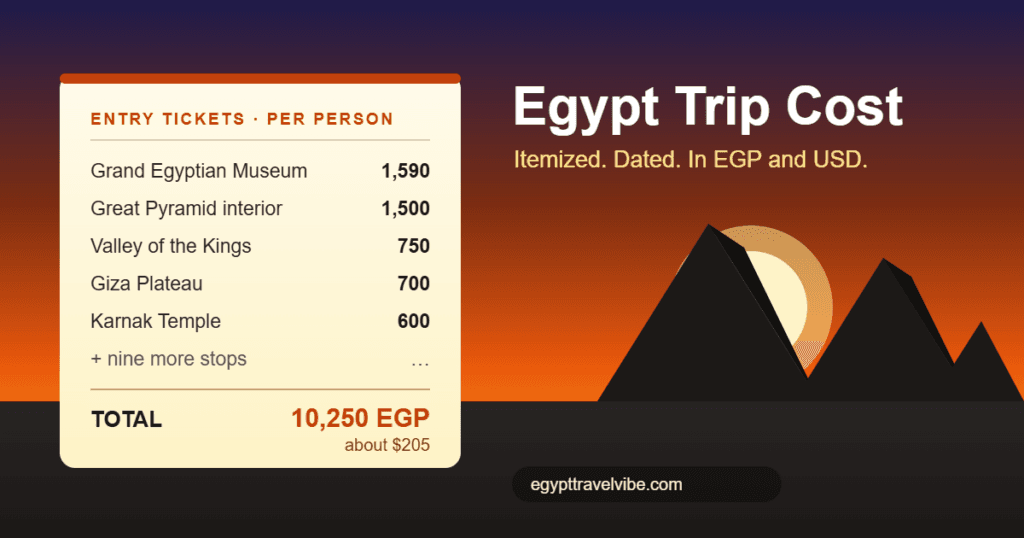
A first-timer doing the full Cairo-Luxor-Aswan circuit spends roughly 10,210 EGP, about $204, on entry tickets alone before a single hotel night. Skip the two big optional add-ons and it drops to about 8,010 EGP, or $160. Nobody else publishes this total, which is odd, because it’s the number you’re actually trying to build.
Here’s the itemized version. Prices are foreign adult rates, cross-checked across published fee lists in August 2026.
| Site | EGP | ≈ USD |
|---|---|---|
| Grand Egyptian Museum | 1,500 | ~$30 |
| Great Pyramid interior (Khufu), optional | 1,500 | $30 |
| Abu Simbel | 822 | $16 |
| Valley of the Kings (3 tombs) | 750 | $15 |
| Giza Plateau | 700 | $14 |
| Tutankhamun’s tomb (KV62), optional | 700 | $14 |
| Saqqara (Step Pyramid) | 600 | $12 |
| Karnak Temple | 600 | $12 |
| Egyptian Museum (Tahrir) | 550 | $11 |
| Philae Temple | 550 | $11 |
| Edfu (Temple of Horus) | 550 | $11 |
| Luxor Temple | 500 | $10 |
| Kom Ombo | 450 | $9 |
| Hatshepsut Temple | 440 | $9 |
| Full circuit total | ~10,210 | ~$204 |
| Without the two optional tickets | ~8,010 | ~$160 |
Three things about that table deserve saying plainly. First, Egypt’s Ministry of Tourism and Antiquities publishes no consolidated English fee schedule, so this list was assembled by cross-checking independent published fee lists (Nile Empire and Egypt For Travel, both 2026) and re-verifying before publication. Both are commercial tour sites, which is worth knowing.
Second, Abu Simbel is the line where the two official sites disagree: the ministry information page still shows 750 EGP, while the official checkout charged 822 EGP for a foreign adult when I read it on October 24, 2026, the same figure as in July. I’ve used the checkout figure in the total so you don’t get caught short. Third, the Grand Egyptian Museum set foreign adult entry at 1,450 EGP when it opened, the official checkout now charges 1,500 EGP, and it rises by $5 on November 1, 2026 (Ahram Online, 2026). Published pound figures for the GEM still run anywhere from 1,450 to 1,700, but the museum’s own checkout totals in pounds, and in September 2026 it charged 1,500 EGP. That’s the figure I use. Every price here, the GEM included, moves when the ministry revises its schedule, so check the date at the top. How GEM booking works now lists every tier from the checkout.
Egyptian residents pay a small fraction of these rates. Any figure you find elsewhere needs to specify which pricing it’s quoting, and most don’t.
Why Egypt Is Cheap to Live In and Expensive to See
Entry fees take roughly 35% of a budget traveler’s daily spend and under 10% of a comfort traveler’s, even though both pay identical ticket prices. That single asymmetry explains more about Egypt trip cost than any daily average, and it’s why the usual advice about cutting hotel costs works less well here than almost anywhere else.
The mechanism is a currency mismatch. Hotels, meals, and taxis are priced in Egyptian pounds, so they get cheaper for foreign visitors every time the pound slides. Antiquities tickets effectively track the dollar, and even the Grand Egyptian Museum’s November rise is announced in dollars. The two halves of your budget move in opposite directions, which means the spread between a backpacker’s trip and a four-star trip is narrower at the bottom than you’d expect. Both people hand over the same 10,210 EGP to see the same things.
The practical consequence is simple and slightly annoying. Downgrading your hotel in Egypt saves less, proportionally, than it does in most countries. The only lever that moves the big number is cutting sites, and cutting sites is presumably why you came.
Egypt’s own tourism figures back this up. Revenue reached roughly $16.7 billion in 2025 (Trading Economics, 2026) against somewhere between 17.8 and 19 million arrivals (SIS, 2026). Divide one by the other and the average visitor spent about $880 to $940 per trip. That includes package tours, resort stays, and flights booked in-country, so treat it as a sanity check rather than a personal budget. It still sits a long way above the “$30 a day, Egypt is dirt cheap” claims that circulate.
What Do Hotels, Food, and Getting Around Cost?
Hostel dorms and simple guesthouses run about $10-25 a night, comfortable three- and four-star hotels $40-120, and the top tier $150-500 or more. Food is where Egypt earns its reputation: a plate of koshary costs 30-50 EGP ($0.60-1.00), bottled water about 10 EGP, and a sit-down restaurant meal 150-400 EGP depending on the city. The 20 dishes worth ordering, with dated prices, are in my food guide. Where to stay, by city and budget has dated room prices for each base.
Those bands move with the calendar more than most people expect: cruise and hotel rates run roughly 30-50% below peak between May and September, which is the single biggest lever on this whole budget. Which month you pick, and what it costs you, is worth settling before you price anything else. Cairo hotels cost more than Luxor or Aswan for the same standard, and Red Sea resorts price on their own logic entirely. Local transport stays cheap almost everywhere. A ride-hailing hop across central Cairo runs 40-80 EGP ($0.80-1.60), and taxis elsewhere cost less than that if you agree the fare first. Quoted cold, the same hop often opens several times higher, which our guide to the common overcharge setups breaks down side by side.
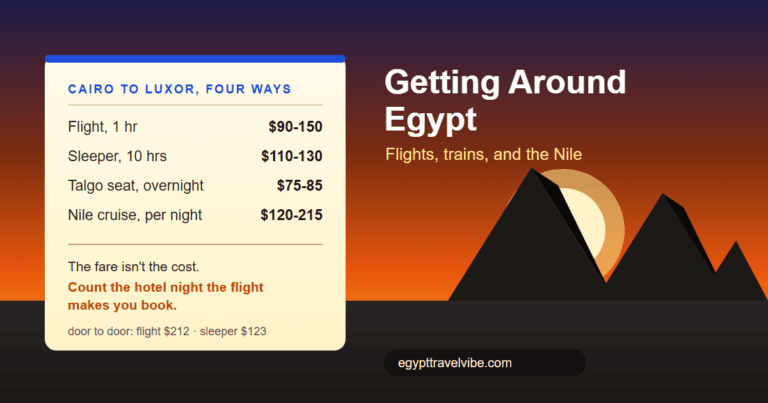
The long hops are where real money moves. Cairo to Luxor takes about an hour by air, with one-way fares typically landing between $90 and $150 depending on how far ahead you book. The sleeper train covers the same route overnight in roughly 10 hours and costs about $110-130 per person in a twin cabin, dinner and breakfast included (Nile Empire, 2026).
Most comparisons stop there and call the flight the better deal. That misses the point. The sleeper train removes a hotel night from your budget, so the honest comparison is train fare against flight plus a night in Cairo or Luxor. Once you run it that way the train usually wins on cost and loses on comfort, which is a much more useful thing to know than a fare table. I’ve taken it both directions and would do the Cairo-to-Aswan leg again; the northbound return, less enthusiastically. Our full comparison of flights, sleeper trains and Nile cruises prices every option door to door.
How Much Does a Nile Cruise Add?
Standard four- and five-star cruise boats run about $120-215 per person per night twin-share in high season on a Luxor-Aswan itinerary, with full board included, across the boats I priced in September. On one real four-night sailing from Luxor in mid-November, the median standard boat on Booking.com came to $135 per person per night. Dahabiyas, the smaller sailing boats, start near $160 a night at the low end and climb past $400 on premium sailings.
Those numbers look alarming next to a $40 hotel room until you notice what’s inside them. A cruise fare covers your cabin, all meals, and sometimes the guided site visits along the way, though two of the Booking.com boat listings I opened leave sightseeing out of the rate. Comparing it to a nightly hotel rate alone overstates the cost by a wide margin. Set it against hotel plus food plus transport between Luxor and Aswan plus a guide, and the gap narrows considerably.
One caution. Cruise pricing online is almost entirely published by the operators selling the cruises, and it’s wildly inconsistent between sites. I’ve given ranges rather than figures deliberately, because a specific number here would imply a precision the available sourcing doesn’t support.
I have since done that pricing properly: Nile cruise classes, priced honestly gives a dated per-night band for every class.
Card or Cash? How You Pay Changes What You Budget
Most major antiquities sites now expect card payment, while tips, taxis, markets, and small restaurants still run on cash. You need both, for different things. That reverses the advice nearly every older guide gives, which is to bring plenty of cash because Egypt is a cash country.
It was, and in most of daily life it still is. What changed is ticketing. The Giza plateau and other major sites moved to card payment during 2025 and 2026, and several published fee lists now state it outright. The ministry did announce it: cash payments at the Giza pyramids area and other sites were “suspended in full” in June 2023 (Egypt Independent, June 3, 2023), and what the Giza ticket actually covers has the detail. Treat it as a strong pattern rather than a rule. Carry a working card and small notes, and you’re covered either way.
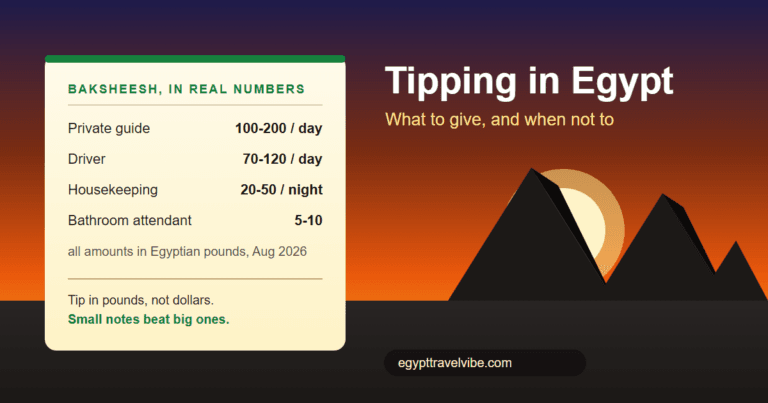
How much cash? For a mid-range week, something like 3,000-5,000 EGP ($60-100) handles tips, taxis, market purchases, and the odd cash-only café comfortably. Withdraw from bank ATMs rather than airport kiosks, and when a card terminal offers to charge you in dollars, decline it. Paying in Egyptian pounds always beats the terminal’s conversion rate. How much of that cash is actually tips? Our guide to how baksheesh works, with real amounts itemizes it role by role.
One firm exception to all of this: visa on arrival is still $30 USD in cash at most entry points, so bring the notes with you (GOV.UK, 2026). Cairo Airport began piloting a card-payable digital version at about $36 in August 2026, but the cash option remains the default. Full detail on that is in our guide to what an Egypt visa actually costs.
Egypt Trip Cost by Length: A Week, Ten Days, or Two Weeks
Excluding international flights, a week in Egypt runs about $280-385 at the budget end, $595-910 mid-range, and $1,120-1,750 for comfort travel. Ten days runs $400-550, $850-1,300, and $1,600-2,500 respectively. Add $200-1,200 for the flight in, depending on where you’re starting.
| Trip length | Budget | Mid-range | Comfort |
|---|---|---|---|
| 7 days | $280-385 | $595-910 | $1,120-1,750 |
| 10 days | $400-550 | $850-1,300 | $1,600-2,500 |
| 14 days | $560-770 | $1,190-1,820 | $2,240-3,500 |
Those are the daily bands multiplied out, nothing more. I’ve shown them that way on purpose, because the Egypt trip cost totals floating around the internet mostly aren’t derived from anything you can check.
A worked example, since abstractions get slippery. Ten days mid-range, one person: about $550 in hotels, $200 in food, $130 in local transport, $204 in entry tickets, plus roughly $110 for the Cairo-Luxor sleeper and $120 for the Aswan-Cairo flight home. That lands near $1,315 before your international flight. That sits inside the mid-range band, and it is heavier on tickets than most people plan for.
Swap the hotels for hostels and it falls to about $700. Add a four-night cruise instead of hotels in Luxor and Aswan and it climbs past $1,900. Trip length drives all of it, so our 7, 10 and 14-day itinerary comparison prices each length side by side.
Frequently Asked Questions
How much does a week in Egypt cost?
About $280-385 at the budget end, $595-910 mid-range, and $1,120-1,750 for comfort travel, all excluding international flights. Flights add $200-1,200. Entry fees are the line item most people underestimate: the classic circuit costs roughly 10,210 EGP (~$204) per person in tickets alone.
Is Egypt expensive for tourists?
Cheap to live in, not cheap to see. Food, hotels, and local transport are among the region’s best value, with koshary at 30-50 EGP and a Cairo taxi hop at 40-80 EGP. But the classic-circuit ticket bill is about 10,210 EGP (~$204) and doesn’t scale down with your travel style.
How much cash should I bring to Egypt?
Less than older guides suggest for tickets, and more than you’d expect for everything else. Major sites now expect cards; tips, taxis, and markets are cash. Budget 3,000-5,000 EGP ($60-100) in cash for a mid-range week, plus $30 USD in notes for visa on arrival.
How much are entrance fees in Egypt in 2026?
Giza Plateau 700 EGP, Great Pyramid interior 1,500 EGP, Grand Egyptian Museum 1,500 EGP, Valley of the Kings 750 EGP for three tombs, Karnak 600 EGP. GEM entry rises by $5 for foreign visitors on November 1, 2026 (Ahram Online, 2026).
How much does a Nile cruise cost per person?
Roughly $120-215 per person per night twin-share in high season on a standard four- or five-star boat, with full board included. The median boat I priced for a four-night November sailing came to $135. Dahabiyas start near $160 a night and run well past $400. Cruise fares replace hotel, food, and some transport costs rather than adding to them.
The Bottom Line
Egypt trip cost comes down to four numbers, and now you have all of them:
- $40-55, $85-130, or $160-250+ a day, depending on how you travel, before international flights
- About 10,210 EGP (~$204) per person in entry tickets on the classic circuit, or $160 if you skip the two big optional add-ons
- A card for tickets and cash for everything else, with 3,000-5,000 EGP in notes for a mid-range week
- 50 EGP to the dollar, the rate every conversion on this page uses, checked August 6, 2026
Sort your visa first, since it’s the one cost with a hard deadline attached, then size the trip and build the budget around your actual route.
One last thing, and I’d rather say it than have you find out later. Egypt Travel Vibe sells no tours, no cruises, and no tickets. That’s precisely why this page can publish a ticket total that makes Egypt look more expensive than the operator guides do. It’s also why the Abu Simbel discrepancy and the card-payment caveat sit on the page instead of getting quietly rounded away. I re-check these figures every 30 days and update the same week anything moves. Don’t trust an undated Egypt price from anyone, including me.