
Last verified: September 18, 2026. Every ticket price here was read off the official checkout that day, and every tomb size comes from the Theban Mapping Project. Tombs rotate open and shut, so I re-check this page monthly.
Tutankhamun’s tomb is the most famous room in Egypt. Per square metre, it’s also the most expensive. At 700 EGP for about 110 square metres of floor, it costs roughly fifteen times as much per square metre as the tomb of Ramesses V and VI, a short walk away.
Disclosure: Some links in this guide may earn us a commission, at no extra cost to you. It never changes what we recommend.
That’s the puzzle with the Valley of the Kings tombs. Your 750 EGP ticket covers three of them. Four more are sold separately, from 200 to 2,000 EGP. The one everybody asks about, Nefertari’s, isn’t for sale at all. And a big royal tomb opened in October 2025, after most of the guides you’ll find were written.
So here’s every ticket, what each one physically gets you, and a straight answer on which extras earn their price. It’s one morning of a bigger trip, and the experiences worth planning an Egypt trip around puts the valley next to everything else.
Key Takeaways
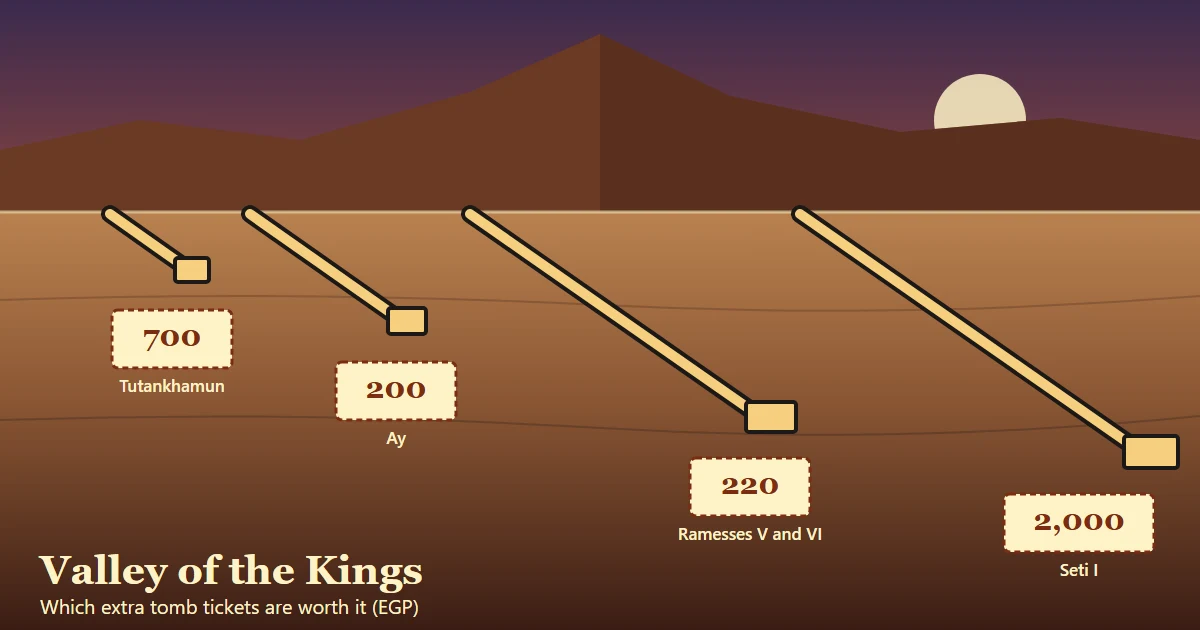
- 750 EGP buys three tombs. Four more cost extra: Ay 200, Ramesses V and VI 220, Tutankhamun 700, Seti I 2,000.
- Ramesses V and VI is the best value: nearly five times Tutankhamun’s floor space for under a third of the price.
- Tutankhamun’s tomb is small. His treasures are at the Grand Egyptian Museum.
- Seti I is the finest tomb and costs 2,000 EGP, students included.
- Nefertari is closed and not sold.
Table of Contents
What Does the 750 EGP Valley of the Kings Ticket Include?
In September 2026, the official checkout charged 750 EGP for a foreign adult and 375 for a foreign student (egymonuments.com, Valley of the Kings booking). That’s about $14 and $7 at the Central Bank’s September 17 rate of 52.19 EGP to the dollar (Central Bank of Egypt). That buys three tombs of your choice from the ones open that day. Egyptians pay 60 and 30, and children under six go free.
Which three? Whichever are on the board by the ticket office that morning. Tombs rotate open and shut for conservation, and the ministry doesn’t publish the list ahead of time. Four tombs never count toward your three. Each has its own ticket.
I read every line off the checkout on September 18. This is the complete menu, and most pages only show you the first row.
| Ticket | Foreign adult | Foreign student | Where it is |
|---|---|---|---|
| Entry, three tombs of your choice | 750 EGP | 375 EGP | Main valley |
| Seti I (KV17) | 2,000 EGP | 2,000 EGP | Main valley |
| Tutankhamun (KV62) | 700 EGP | 350 EGP | Main valley |
| Ramesses V and VI (KV9) | 220 EGP | 110 EGP | Main valley |
| Ay (WV23) | 200 EGP | 100 EGP | Western Valley |
| Everything above | 3,870 EGP | 2,935 EGP |
The Valley of the Kings ticket costs 750 EGP for foreign adults in 2026 and covers three tombs chosen from those open that day. Four tombs are sold separately on the official checkout, from 200 to 2,000 EGP. Seti I is the only one with no student discount, so a student pays more than five times their own entry price for it.
The valley opens at 6am every day. Last entry is 5pm in summer, and 4pm in winter and Ramadan, on the checkout’s own schedule. The ministry’s information page lists 6am to 5pm with no seasonal split (egymonuments.gov.eg, Valley of the Kings), so plan on the earlier time from autumn onward.
Bring a card, not cash. Egypt began moving its archaeological sites to card-only ticketing in 2023 (Daily News Egypt, June 5, 2023). In January 2024 the valley got the country’s first self-service ticket machines, card only (Egypt Independent, January 2024). Phone photography is free under the ticket terms, and tickets can’t be refunded (egymonuments.com, FAQ). For the rest of the West Bank morning, the two-day Luxor plan, bank by bank covers the river crossing and Hatshepsut.
Is Tutankhamun’s Tomb Worth the Extra 700 EGP?
Only if standing in that room means something to you. The Theban Mapping Project measures Tutankhamun’s tomb at 30.8 metres long with about 110 square metres of floor, the smallest tomb on the checkout by a wide margin (Theban Mapping Project, KV62). Only the burial chamber is painted. The ticket is 700 EGP on top of your entry.
Here’s what you actually see. A stair and a short corridor lead to the burial chamber. The king’s mummy lies there in a climate-controlled case, beside his stone sarcophagus and one gilded coffin. The wall paintings include the twelve baboons, one for each hour of the night. You’ll be through it in minutes.
What you won’t see is everything that made the tomb famous. The gold mask, the shrines and the chariots are at the Grand Egyptian Museum, which opened in full on November 1, 2025 (Egypt State Information Service, GEM opens to the public). If that’s what you came for, where Tutankhamun’s treasures are now covers booking the museum.
Why is the room behind a barrier, and why are there brown spots on the walls? In 2019 the Getty Conservation Institute finished a ten-year project in the tomb. It found that visitors’ humidity, carbon dioxide and dust were the main threats. It installed ventilation and filtration in 2015 and added a platform that keeps people off the walls (The Art Newspaper, January 23, 2019). The brown spots are dead microbial growth, not active decay.
That’s the honest reason tombs close and visits are short. Every visitor breathes moisture onto painted plaster. A short, expensive visit is the price of the paintings still being there.
One cheaper option for the curious: a full-size facsimile of the burial chamber was installed at Howard Carter’s house, near the valley road, in 2014. The house reopened in November 2022 after a restoration led by the American Research Center in Egypt (ARCE, Carter House). It’s its own 220 EGP ticket (egymonuments.com, Carter House), not a free extra.
My view: pay for Tutankhamun once, if he’s part of why you came. Skip it if you want painted walls, because your free three will give you far more. On photography, follow the guard at each tomb door.
Is Seti I Worth 2,000 EGP?
For the right visitor, yes. At 137 metres, Seti I’s tomb is one of the longest in the valley, and it’s decorated from the entrance down to the burial chamber (Theban Mapping Project, KV17). In 2026 it’s also the most expensive single ticket at any Luxor site: 2,000 EGP, and students pay the same.
What does 2,000 EGP buy? Colour, mostly. The painted reliefs run corridor after corridor in reds, yellows and blues that still look wet. The burial chamber’s vaulted ceiling carries an astronomical scene, the night sky mapped as gods and constellations. After Seti I, most other tombs look like sketches.
The price has doubled in a decade. In June 2016, officials decided to reopen Seti I and Nefertari after years of restoration forced by visitor humidity, and set each ticket at 1,000 EGP (Ahram Online, tombs of Nefertari and Seti I to reopen, June 9, 2016). The checkout now charges 2,000.
Seti I’s tomb in the Valley of the Kings costs 2,000 EGP in 2026, double the 1,000 EGP it cost when it reopened in 2016. It’s the only ticket in the valley with no student discount. At 137 metres and decorated throughout, it’s the finest painted tomb in the valley.
There’s a copy, too. Factum Foundation recorded the whole tomb between 2001 and 2022 and showed replica chambers in Basel in 2017 (Factum Foundation, the tomb of Seti I). Its stated plan is a full replica near the valley entrance. I couldn’t confirm it’s been built, so don’t plan around it.
My call: on a first visit where tombs are one interest among many, skip it. That money buys a third day in Luxor with four more sites. If tombs are the reason you flew here, or it’s your second trip, buy it and walk straight there at 6am.
Which Extra Ticket Is the Best Value?
Ramesses V and VI, and it isn’t close. For 220 EGP you get 117 metres of tomb and 510 square metres of floor, close to five times Tutankhamun’s, by the Theban Mapping Project’s measurements (Theban Mapping Project, KV9). That works out at 0.43 EGP per square metre, against Tutankhamun’s 6.37.
The long corridors are carved with the Books of Gates and Caverns. The burial chamber’s vaulted ceiling carries the Book of the Day and the Book of the Night, the sky goddess Nut stretched across it twice. Look closer and you’ll find nearly a thousand Greek, Latin and Coptic graffiti left by ancient tourists. People have been coming to see this tomb for two thousand years.
This is the ceiling people stand under with their mouths open. I’ve paid for it every time I’ve been, and I’ve never once regretted it.
Price the four extras by floor area and the ranking is stark. I combined the checkout prices with the Theban Mapping Project’s measurements, and the numbers below are my own calculation.
Square metres aren’t a verdict, though. A bare corridor counts the same as a painted one, and Seti I’s case is quality, not size. But when two tickets cost about the same, size tells you how long you’ll be inside and how much there is to look at.
Ay is the quiet one. At 200 EGP his tomb sits in the Western Valley, a side valley well off the main loop that you need a driver to reach. It’s worth it if you like quiet and have the transport. If you’re counting every pound, where the West Bank sits in a full Egypt budget puts these tickets in context.
Can You Still Visit Nefertari’s Tomb?
No. Nefertari’s tomb in the Valley of the Queens has been closed since March 2024, and no reopening had been announced when I checked in September 2026. The official checkout doesn’t sell it. The Valley of the Queens appears only as a 220 EGP entry with no add-ons (egymonuments.com, Valley of the Queens).
Why is it shut? The same enemy as Tutankhamun’s: moisture. In October 2024, with the tomb shut since that March, the Supreme Council of Antiquities said it was studying a reopening. Its secretary-general inspected the tomb, called it well preserved, and set up a committee to measure humidity (Egypt Independent, October 28, 2024). Nothing has been announced since.
If a page tells you Nefertari is worth every penny, check its date. Many of the reopening stories still circulating come from 2016, when it reopened after an earlier closure. Treat any pass or tour that promises Nefertari with the same suspicion, and the Luxor guide’s take on the pass explains why it rarely pays anyway.
If anyone offers you a Nefertari visit, ask exactly what they’re selling. The government’s own ticket system doesn’t offer one.
The Valley of the Queens itself is open, at 220 EGP. Ask at the gate which of its tombs are open that day. It won’t replace Nefertari, but it’s quieter than the Kings, and the colour in the open tombs can be superb.
Amenhotep III’s Tomb Is Open, but Not Online
Amenhotep III’s tomb opened to visitors on October 4, 2025, after about twenty years of conservation led by a Japanese team with UNESCO (CBS News, October 4, 2025). It sits in the Western Valley near Ay, off the main loop. It isn’t sold on the official checkout, and no official source I could find explains how it’s ticketed.
Amenhotep III was Tutankhamun’s grandfather and ruled Egypt at the height of its wealth. His tomb is one of the largest in the necropolis, and its reopening got wide coverage (Asharq Al-Awsat, via AFP, October 2025). Most tomb guides published since still leave it out.
The practical version: ask at the main ticket office before you drive out to the Western Valley, and pair it with Ay if you do. Where the research runs out, I’d rather print the gap than a guess, so I’ll update this section with the on-site answer.
One more tomb you can’t visit. In February 2025, archaeologists identified the tomb of Thutmose II about 2.4 km west of the valley (CNN, February 19, 2025). It’s an excavation, not a visitor site, whatever you read about special permits.
Which Valley of the Kings Tombs Should Fill Your Free Three?
Go long. If they’re on the board, the big later tombs give you the most wall for your ticket. Merenptah runs 165 metres, Tausert and Setnakht 158, Siptah 125 and Ramesses III 114, all from the Theban Mapping Project’s tomb pages (KV8; KV11). The short ones, like Ramesses VII at 44 metres, are lovely but quick.
Ramesses III is the one I’d grab if it’s open. Its 726 square metres of floor are more than Seti I’s 649, and it costs you nothing extra. Merenptah goes steeply down into the hill. Tausert and Setnakht is long and bright, and it rarely gets the attention of the famous names.
Read the board before you queue. The open list changes with conservation work, so a list from somebody else’s trip is a guess. I pick by length first and by queue second, and I leave the smallest tomb on the list until last.
The walls make more sense with a key. Most of what you’ll see comes from the Books of the Underworld, guides to the sun’s twelve-hour journey through the night, which the king hoped to join.
This is the one Luxor morning where I think a licensed guide earns the fee, because the walls are the whole point.
One warning. Deeper tombs are hotter, not cooler, because they’re poorly ventilated rock full of people. What to wear into a hot tomb matters more here than anywhere else in Egypt.
When Should You Go, and How Long Do You Need?
Be at the gate at 6am, when the valley opens (egymonuments.com, Valley of the Kings booking), and allow two to three hours for three tombs plus one extra. Leave the afternoon alone, because that’s when the valley is hottest.
Why so early? The cruise coaches arrive mid-morning, and the queues at the famous tombs arrive with them. In high summer I was at the gate before it opened, done with Hatshepsut by nine, and finished by half past ten. That wasn’t the plan; the heat made the decision. In a cool month you can stay longer, but the early start still beats the coaches. Month-by-month heat and crowds shows how much worse the valley gets from May.
A dawn balloon costs you only the first hour, because you’re down by breakfast with the tombs a short drive away. On a Nile cruise, the valley usually gets one compressed guided morning, so the early start matters even more. What a cruise day in the valley actually gives you is drawn hour by hour in the cruise guide.
Once you’re through the gate, a small electric tram, the Tuf-Tuf, runs from the ticket office up to the tombs. I couldn’t confirm whether it’s charged or what it costs, so ask at the gate.
Valley of the Kings Tombs FAQs
How many tombs does the Valley of the Kings ticket include?
Three, chosen from those open that day, for 750 EGP for foreign adults and 375 for students. Four tombs are sold separately on the official checkout: Ay at 200 EGP, Ramesses V and VI at 220, Tutankhamun at 700 and Seti I at 2,000. Buying all of them costs 3,870 EGP.
Is Tutankhamun’s tomb worth the extra ticket?
Only if seeing his burial chamber and mummy matters to you. At 30.8 metres and about 110 square metres, it’s the smallest tomb on the checkout, and its 700 EGP ticket costs the most per square metre. The treasures that made it famous are at the Grand Egyptian Museum.
How much is the tomb of Seti I?
2,000 EGP in 2026, on top of the 750 EGP entry ticket, and students pay the same 2,000. It’s the only ticket in the valley with no student discount. The price has doubled since 2016, when Seti I reopened at 1,000 EGP after a closure for visitor humidity.
Is Nefertari’s tomb open?
No. Nefertari’s tomb in the Valley of the Queens has been closed since March 2024. In October 2024 the Supreme Council of Antiquities said it was studying a reopening, but nothing had been announced by September 2026, and the official checkout doesn’t sell a Nefertari ticket.
What time does the Valley of the Kings open?
6am every day. On the official checkout, last entry is 5pm in summer and 4pm in winter and during Ramadan. The ministry’s information page still lists 6am to 5pm all year, so plan on the earlier closing from autumn onward, and arrive at opening either way.
Can you take photos in the Valley of the Kings?
Yes, with a phone. The official ticket terms say phone photography is free of charge at the site. Rules at individual tomb doors can be stricter, so follow the guard at each entrance, and keep the flash off on painted walls.
The Bottom Line
The Valley of the Kings tombs reward a plan more than a budget. The whole page, in five lines:
- 750 EGP buys three tombs. Pick the longest ones on the board, and grab Ramesses III if it’s open.
- Always add Ramesses V and VI. 220 EGP for the best ceiling for the money in Egypt.
- Buy Tutankhamun for the meaning, not the room. The treasures are in Giza.
- Save Seti I for a second visit, unless tombs are why you came. Then buy it first.
- Nefertari is closed. Don’t pay anyone who says otherwise.
Next, plan the rest of your West Bank morning with the Luxor guide, or stack a dawn balloon before the valley opens on top of it, then set an alarm for 5am.