
Last verified: August 26, 2026. Entry fees, Luxor Pass prices, the Nefertari closure, cashless payment rules, crossing fares, balloon regulations and train times were checked against source on the date above. Crossing costs and touring-hour estimates are my own, built from repeated trips, not measured data. I re-check this page monthly.
Luxor International Airport handles roughly a million passengers a year against a listed capacity of 3.5 million, and traffic climbed 37% in 2025 with another 26% added in the first four months of 2026 (Egyptian Gazette, 2026). Almost everyone who lands gives the place a day and a half.
Disclosure: Some links in this guide may earn us a commission, at no extra cost to you. It never changes what we recommend.
That’s not enough, and it’s the wrong day and a half. Luxor holds more standing monuments per square kilometre than anywhere else in Egypt, split across two banks of a river, in a climate that ends outdoor touring before lunch for eight months of the year. Guides list the sites. Very few tell you how the day is actually shaped.
So this Luxor travel guide starts with the clock and the river. How many days, which bank to sleep on, how to cross, which tombs justify their extra ticket, whether the pass is worth it, and how to survive the heat. If you’re still working out where Luxor sits in the trip, our region-by-region look at where to go in Egypt covers that first.
Key Takeaways
- Give Luxor two full days minimum, three if you want the smaller West Bank sites or a balloon morning. One day is what a cruise sells you, not what Luxor needs.
- Sleep on the East Bank for a first visit. That’s where the hotels, restaurants, station and airport road are. The West Bank is quieter and better looking, and it charges you a river crossing every time you want dinner.
- The Valley of the Kings costs 750 EGP and includes three tombs of your choice. Tutankhamun is 700 EGP extra and Seti I is 2,000. Nefertari has been shut since March 2024 and no reopening has been announced.
- The Luxor Pass almost never pays. At $130 it needs about 6,565 EGP of tickets to break even, and even a five-day visit to every site on both banks lands near 5,550.
- Site gates are card only. The Luxor Pass is cash only, in clean US dollar or euro notes. Carry both, which is the one thing nobody tells you.
Table of Contents
How Many Days Do You Need in Luxor?
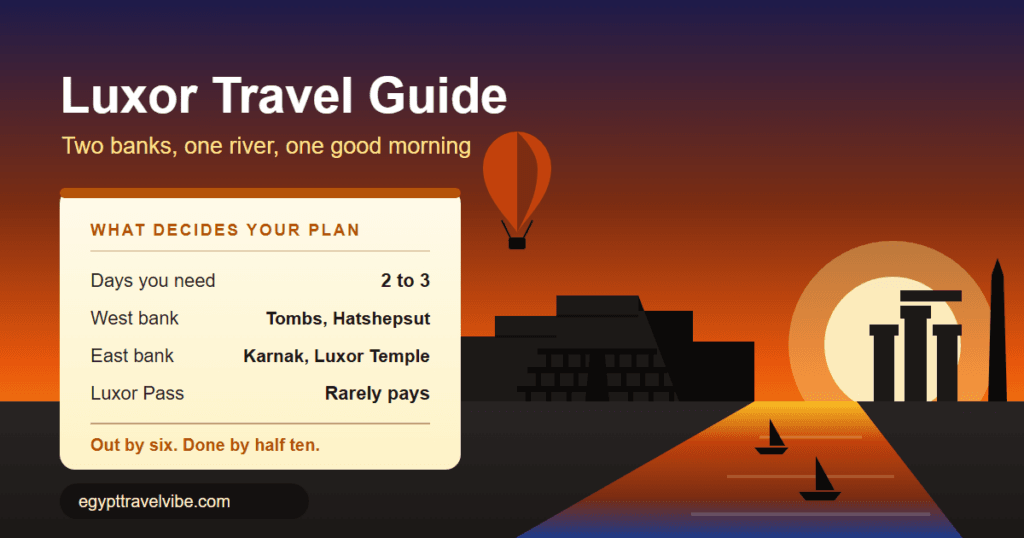
Two full days is the floor, and three is the number I’d book. West Bank sites open at 06:00, with Hatshepsut running until 17:00 from October to April and 18:00 from May to September (Egypt Day Tours, 2026). That early opening is the whole planning constraint, because it’s also when the heat lets you work.
Here’s how the days fall. Day one is the West Bank from six in the morning: Valley of the Kings, Hatshepsut, Medinet Habu, back across the river by lunch. Day two is the East Bank: Karnak early, the Luxor Museum through the worst of the afternoon, Luxor Temple after dark. Day three, if you have it, buys the Ramesseum, Deir el-Medina, the Valley of the Queens, or a balloon.
Laid out against the clock, the days look like this.
| Day | Morning, 6am to 11am | Afternoon and evening |
|---|---|---|
| 1 | West Bank tombs and temples | Rest, then Luxor Temple lit after dark |
| 2 | Karnak at opening | Luxor Museum, then the corniche |
| 3 | Balloon, then the smaller West Bank sites | Souq, or Karnak a second time |
One day is possible and it’s what a Nile cruise itinerary gives you. It buys Karnak and a compressed Valley of the Kings, and you’ll leave knowing you saw a fraction. The day trip from Hurghada is worse: four to five hours of road each way for roughly three hours on site.
A balloon morning doesn’t replace a day. Flights launch between 05:30 and 07:30 and you’re back on the ground by breakfast, so it stacks on top of a West Bank day rather than costing you one. If you’re still sizing the whole trip, compare the three itinerary lengths before you lock Luxor in.
Should You Stay on the East Bank or the West Bank?
The East Bank, for a first visit. It holds the hotels, the restaurants, the train station, the airport road and both great temples. Sleeping west means crossing the river every time you want dinner, and the cheap version of that crossing still leaves you a 300 EGP taxi at the far end (Into the Wild Unknown, 2026).
The West Bank holds the tombs, the villages and the view back across the water, plus roughly a tenth of the places to eat.
The trade is real, though, and it isn’t only about convenience. West Bank guesthouses sit quieter, usually include breakfast, and put you 10 to 15 minutes from a 6am start at the valley, against about 25 from the town centre. They don’t cost less: in my October 2026 basket the typical night was $49 on the West Bank and $51 on the East. If you’re staying three nights or more and you care more about mornings than menus, sleep west. For two nights, sleep east. I weigh East Bank convenience against West Bank character with the minutes counted.
Here’s the framing that fixed Luxor for me. Every guide you’ll read organises the city by site: temples here, tombs there, museums somewhere in the middle. Organise it by the clock instead. Luxor is a city with an eleven o’clock deadline for most of the year, and once you accept that, the itinerary writes itself. You get one good outdoor block a day, from six until about half past ten. Everything else fits around it.
That’s why the bank you sleep on matters more than the hotel you pick. Every minute of the crossing comes out of the only block of time that works.
How Do You Cross the Nile and Get Around the West Bank?
Cheaply, if you only count the boat. The public ferry leaves from in front of the Luxor Museum every half hour or so and takes about ten minutes. Foreigners pay 15 to 25 EGP in recent reports, against about 5 for locals (Wikivoyage, October 2025). Then you land, and the real bill arrives.
Because the ferry doesn’t go to the Valley of the Kings. Nothing does. From the West Bank landing you still need a taxi, and that leg runs around 300 EGP, more than ten times what the crossing cost you (Into the Wild Unknown, 2026). There are two alternatives. A private motorboat runs 80 to 100 EGP. A taxi by road costs 200 to 300 EGP for the car. Since the North Luxor bridge opened in May 2024, the fastest drive from Luxor Temple to the Valley of the Kings heads north over it, about 25 minutes on empty roads. The old bridge, seven kilometres south of town, is the long way round.
Nobody prices these routes door to door, so here they are. These are my own figures from repeated crossings and agreed fares, not a survey, so treat them as planning numbers.
So take the ferry for the ferry, which is a genuinely good ten minutes on the water. Don’t take it to save money. If you’re seeing three or four West Bank sites, agree a driver for the whole morning before you cross and you’ll pay less than the sum of the hops.
Two warnings, both of which will find you. Ferry ticket sellers quote 10 or 20 EGP for a 5 EGP ticket, and calèche drivers agree a price and then declare it was per person at the end. Neither is dangerous, both are tedious, and our guide to how the common overcharge setups work breaks down the same plays across the country. Small notes solve most of it, and what counts as normal baksheesh covers the rest.
This is the one way Luxor is harder than Cairo, and it’s worth naming. In a city of nineteen million you can disappear. In Luxor you’re visibly a visitor on every street, so the attention per person is simply higher. It isn’t threatening, it’s constant, and “la, shukran” plus continuing to walk handles nearly all of it. For the country-level picture, our honest read on the advisory zones covers where the flagged areas actually are, and what solo women report is worth reading if you’re travelling alone.
Which West Bank Tombs and Temples Are Worth It?
The base ticket, mostly. The Valley of the Kings costs 750 EGP for foreign adults and includes three tombs of your choice from whichever are open that day, with students at 375 (egymonuments.com, Valley of the Kings booking, September 2026). Four tombs sit outside it as add-ons: Ay at 200 EGP, Ramesses V and VI at 220, Tutankhamun at 700 and Seti I at 2,000. Only two of them are real decisions.
Tutankhamun’s tomb is 700 EGP on top. It’s the smallest and plainest room in the valley, and its fame is entirely about what came out of it, all of which is now in a museum in Giza. Pay it if standing there means something to you. Skip it if you want painting, because you’ll see better in the free three.
Seti I is 2,000 EGP and is the finest painted tomb in Egypt, no argument. It’s also close to 40% of a two-day ticket budget for one room. My call on a first visit is to skip it and spend the money on a third day, which buys you four more sites. On a second visit, pay it without hesitating.
The best value in the valley is Ramesses V and VI at 220 EGP, and it isn’t close. It’s deep, enormous, and the ceiling is the one people stand under with their mouths open. I’ve paid it every time and never once regretted it.
Now the correction that matters most, because a lot of pages still get it wrong. Nefertari’s tomb in the Valley of the Queens has been closed since March 2024, with conservation work addressing humidity from visitors’ breath and no reopening announced as of August 26, 2026. If you find an enthusiastic “worth every penny” write-up, check its date. Several of the reopening articles still circulating date from 2016, when it reopened after a much older closure.
Beyond the valley, Hatshepsut at 440 EGP is the one everyone photographs and the one that punishes a late start, because the cliff behind it turns the terraces into an oven. Medinet Habu at 220 EGP has the best surviving colour on the West Bank and a fraction of the crowds. The Colossi of Memnon are free and take five minutes on the way past. If you want the full tomb-by-tomb argument, which tombs justify the extra tickets goes deeper than I can here.
One more thing worth saying plainly. The tomb of Thutmose II was identified west of the valley in February 2025, the first Eighteenth Dynasty royal tomb found since Tutankhamun in 1922, and it was named among the year’s top ten discoveries (Egyptian Streets, 2025). It is not open to visitors, whatever the tour listings imply.
What Should You See on the East Bank?
Two temples carry it, and they want opposite times of day. Karnak costs 600 EGP and Luxor Temple 500 (Nile Empire, updated April 2026). Karnak wants the early morning before the coaches arrive from the cruise dock. Luxor Temple wants the dark.
Karnak needs two hours, not the forty minutes a tour allots. The Great Hypostyle Hall alone holds 134 columns in sixteen rows, the tallest around 24 metres, and walking it slowly is the entire point. Go at opening and you’ll have twenty minutes of it nearly to yourself.
Luxor Temple after sunset is the best thing in town. It’s lit, it’s central, and the crowds have gone back to their boats. Spend your one evening there rather than on the sound and light show, which costs 960 EGP, roughly Karnak plus the museum plus dinner.
The Luxor Museum at 400 EGP is the right answer to the dead middle of the day. Small, air conditioned, beautifully lit, and far better curated than its size suggests. Going between noon and four isn’t a compromise, it’s the schedule working. For what the carvings actually say, my guide to reading an Egyptian temple walks Karnak, Edfu and Kom Ombo room by room.
Is the Luxor Pass Worth It?
For almost nobody, and the arithmetic isn’t close. The standard Luxor Pass costs $130 for adults and $70 for students, runs five days, and covers the sites on both banks with the tombs of Seti I and Nefertari excluded (Explore Luxor, 2026). At August’s rate of about 50.5 EGP to the dollar, that’s roughly 6,565 EGP you need to spend on tickets before it pays for itself.
Here’s what people actually spend. A one-day visit doing Karnak, the Valley of the Kings and Hatshepsut comes to 1,790 EGP. A standard two-day visit adding Luxor Temple, Tutankhamun and Medinet Habu reaches 3,210. A heavy three-day visit that adds the Queens, the Ramesseum, Deir el-Medina, the museum and Ramesses V and VI hits 4,490. Five days visiting essentially everything on both banks lands near 5,550.
The Premium pass at $250 is worse, not better. The extra $120 buys Seti I, which costs 2,000 EGP on its own, and Nefertari, which is shut. You are paying roughly 6,060 EGP for about 2,000 EGP of tomb.
Students don’t escape it either, and I expected them to. The student pass is $70, a 46% discount, while student tickets run about half price at every site, so the individual route stays marginally ahead. A student doing that heavy three-day list spends around 2,245 EGP against a 3,535 EGP pass.
Two honest caveats. Sources disagree on whether Tutankhamun’s tomb is inside the standard pass, and I’ve counted it as included, which is the generous reading; the strict reading makes the pass look worse still. And the pass does buy something real that isn’t money. West Bank tickets are sold at a central inspectorate office rather than at each gate, so the pass saves you that stop and the queue with it. If your time is worth more than about 1,000 EGP, that’s a defensible reason to buy it. Saving money isn’t.
The full trip picture sits in my itemised Egypt budget, which prices the Cairo, Luxor and Aswan circuit end to end.
Do Luxor’s Sites Take Cash?
No, and this catches people out weekly. Egypt began restricting archaeological sites to bank cards in May 2023. The Valley of the Kings then got the country’s first self-service ticket machines in January 2024, card only, in a first phase covering 40 machines across 20 sites (Egypt Independent, 2024). Arrive at the gate with a pocket full of pounds and you don’t get in.
Now hold that next to the previous section, because the combination is genuinely absurd. Site gates take cards and refuse cash. The Luxor Pass takes cash and refuses cards, in clean US dollars or euros, with a passport copy and a passport photo. So the single most expensive ticket decision in the city is the one thing your card cannot buy, and the notes have to be new enough that a torn twenty gets waved away.
The practical answer is to carry both. A card that your bank knows is going to Egypt, because these transactions get flagged, plus small EGP notes for the ferry, the tips, the taxis and the tea. Everything informal is still cash. Everything official is not.
Is the Hot Air Balloon Worth It, and Is It Safe?
Yes to both, with context. Flights launch over the West Bank between 05:30 and 07:30 and cost roughly $40 to $150 a person depending on whether you book locally or through an agency. The Egyptian Civil Aviation Authority licenses every pilot, requires onboard cameras and GPS tracking, and grounds all flights when wind exceeds 8 knots (Nile Empire, 2026).
That regime exists for a reason, and I’d rather say so than dance around it. Luxor’s ballooning rules were rebuilt after a fatal accident in 2013, and the result is one of the most heavily monitored ballooning operations anywhere. The 8-knot rule is the one that matters to you, because it means cancellations are common and you should book it for your first morning, not your last. Summer is the other catch: the fleet most often stands down between June and August, and in 2019 it was grounded for 80 days.
Expect company up there. On a peak-season morning as many as 45 to 70 balloons are airborne at once, carrying well over a thousand people (Wikipedia, 2026). That sounds like it should ruin the thing. It doesn’t, quite, because the other balloons turn out to be the best part of your photographs. The cheap end of the price range usually means a bigger basket, a later slot and a longer wait. The balloon safety record, the season and how to book covers the operator differences properly. the balloon safety record and how to book covers the operator differences properly.
When Should You Visit Luxor?
October to April, and it isn’t a close call. Luxor averages a 41°C high in July against 23°C in January, with summer nights that barely drop below 24°C and effectively no rain in any month (Climates to Travel, climate normals). Those two numbers decide your whole itinerary.
November through February is the sweet spot, with March and October as workable shoulders. Come in summer and the trip still functions, it just runs on the schedule in the first chart: out by six, done by half ten, museum and pool through the afternoon, Luxor Temple after dark.
Two things nobody warns you about. The tombs are hotter inside than out, because they’re unventilated rock full of people, so the Valley of the Kings in August is not the cool refuge it sounds like. And Hatshepsut faces a cliff that reflects heat straight back at the terraces, which is why it should be your first stop of the morning or your last of the trip. Month-by-month heat and crowds covers the whole country, and the season-by-season packing list covers what to bring for it.
How Do You Get to Luxor?
Fly if you want the day, take the sleeper if you want the night. The flight from Cairo runs about 70 minutes. The sleeper takes roughly ten hours and, since October 2024, leaves from Bashtil, also called Upper Egypt Station, not Ramses, where hotel staff will still send you (Seat61, 2026).
Departures run between about 19:20 and 21:10 and reach Luxor between 05:15 and 07:45, which lands you in exactly the right window for a West Bank morning. Fares swing by cabin and booking route: expect around $60 for a berth in a shared cabin, and $110 to $130 each for a twin taken as a couple, dinner and breakfast included. Flights, sleeper trains and Nile cruises compared prices every option door to door, and our Cairo guide covers the city you’re leaving. Luxor Airport is 7 km out, with about 63 arrivals a week, so plenty of visitors now skip Cairo entirely.
Going on to Aswan? Most first-timers take the boat, and that deserves its own thinking: standard boat, dahabiya or Lake Nasser prices the options honestly, and Aswan and the slower stretch of the Nile covers what waits at the other end.
Luxor Travel Guide FAQs
How many days do you need in Luxor?
Two full days minimum, three if you want the smaller West Bank sites or a balloon morning. Day one is the West Bank from 6am, when sites open. Day two is Karnak early, the Luxor Museum through the afternoon heat, and Luxor Temple after dark. One day is what a cruise itinerary gives you and it shows.
Should you stay on the East Bank or the West Bank in Luxor?
The East Bank for a first visit. It holds the hotels, restaurants, train station and both major temples, and you’ll want to be there in the evening. The West Bank is quieter, usually includes breakfast and is 10 to 15 minutes from a 6am start, which makes it the better choice on a stay of three nights or more.
Is the Luxor Pass worth it?
Rarely. The standard pass costs $130, about 6,565 EGP at August 2026 rates, but even five days visiting everything on both banks comes to roughly 5,550 EGP in individual tickets. Premium at $250 buys Seti I plus Nefertari, and Nefertari has been closed since March 2024. Buy it for the queue, not the savings.
Which Valley of the Kings tombs are worth the extra ticket?
The 750 EGP base ticket covers three tombs and is enough for most people. Ramesses V and VI at 220 EGP is the best value in the valley. Tutankhamun at 700 EGP is small and plain, and its treasures are in Giza. Seti I at 2,000 EGP is extraordinary and worth saving for a second visit.
Do Luxor’s sites take cash?
No. Egypt restricted archaeological sites to bank cards from May 2023, and the Valley of the Kings has had card-only self-service machines since January 2024. The one exception runs the other way: the Luxor Pass is sold for cash in clean US dollars or euros only. Carry a card and small EGP notes.
Is the Luxor hot air balloon safe?
It’s tightly regulated. The Egyptian Civil Aviation Authority licenses every pilot, mandates onboard cameras and GPS tracking, and grounds all flights above 8 knots of wind. The rules were rebuilt after a fatal accident in 2013. Book your first morning rather than your last, because weather cancellations are common.
The Bottom Line
Luxor rewards people who plan around the clock instead of the map. Five decisions carry the whole visit:
- Two full days, not one. Three if you want the smaller sites or a balloon.
- Sleep east, start at six. The crossing comes out of the only hours that work.
- Take the base tomb ticket. Add Ramesses V and VI, skip Seti I until your second trip.
- Skip the pass unless you’re buying time. The maths doesn’t reach it, even over five days.
- Carry a card and clean dollars. The gates refuse cash and the pass refuses cards.
Everything in this Luxor travel guide comes back to a single constraint: you get one good outdoor block a day for most of the year, and the river sits between you and half the sites.
I’ve published the pass arithmetic and the Nefertari closure precisely because they cost someone a sale. Where sources disagreed, as they do on whether Tutankhamun’s tomb sits inside the standard pass, I’ve counted it the way that flatters the pass and said so rather than quietly picking the number that suited my conclusion.
Marco re-checked every fee, fare and rule on this page against source on August 26, 2026.
Once Luxor is settled, the rest follows. Compare 7, 10 and 14-day plans to see how many nights it earns, then work out how to move between Cairo, Luxor and Aswan. If you’re still costing the trip, my itemised Egypt budget has the full ticket bill, and the region-by-region guide to where to go puts the Nile Valley next to the alternatives. Before you cross to the West Bank, read the primer that makes the temples make sense.