
Last verified: September 13, 2026. Gate fees come from the ministry’s site pages and the museum’s portal, while cruise, balloon and dive prices come from dated operator pages and my own guides. I re-check this page monthly and update the date each time.
In 2025, Egypt took a record 19 million visitors. Foreign visitors logged 18.6 million entries at its sites and museums, not even counting the Grand Egyptian Museum (Egypt State Information Service, 2025 tourism results, January 3, 2026). Most of them did the same dozen things, and they were right to. The best things to do in Egypt really are that dozen.
Disclosure: Some links in this guide may earn us a commission, at no extra cost to you. It never changes what we recommend.
What the lists leave out is everything you need to plan them. Few of them tell you that going inside the Great Pyramid costs twice the plateau ticket, that the museum everyone flies in for has no ticket office, or that a balloon booked for your last morning is a coin toss.
So here are twelve things to do in Egypt, each with the gate price, the time it takes, the months it works, how to book it and my verdict. Then the famous ones I’d skip, and how the rest fit a 7, 10 or 14-day trip.
Still deciding which parts of the country to cover? Where these sit on the map, region by region is the companion to this page.
Key Takeaways
- Four of the best evenings come with trivial tickets. Luxor Temple after dark is 500 EGP and al-Muizz Street at dusk is free to walk. A felucca hour in Aswan runs 200 to 300 EGP for the whole boat, and in the desert the tour is the cost, not the ticket.
- The priciest hour is inside the Great Pyramid, with Tutankhamun’s tomb close behind. The interior ticket is 1,500 EGP on top of the 700 EGP plateau for well under an hour inside, and Tut’s tomb is a 700 EGP add-on for a short look.
- Booking is the new filter. The Grand Egyptian Museum sells timed tickets online only and adds $5 for foreign visitors on November 1, 2026. Luxor balloons are grounded above 8 knots of wind, and Nile cruises peak from October to April.
- Bring a card and cash. The ticket machines at 110 sites take bank cards only (Egypt Independent, June 2025). Tips, taxis, feluccas and desert camps still want small notes.
Table of Contents
How I Picked and Priced These Things to Do in Egypt
Three tests decided which things to do in Egypt made this list. Each experience had to be a reason people book the trip, doable by a normal traveller without a special permit, and priced at a gate or counter I could date. Fees come from the Ministry of Tourism and Antiquities’ own site pages (egymonuments.gov.eg) and the museum’s ticketing portal, checked September 13, 2026, at about 51 EGP to the dollar.
The payment rule matters before any of the prices do. In June 2025, Egypt Independent reported self-service ticket machines at 110 museums and sites, and they take bank cards only (Egypt Independent, digital ticketing across 110 sites, June 13, 2025). The list includes Giza, Karnak, the Valley of the Kings and Abu Simbel. Carry a card your bank knows is travelling. Carry small notes for everything else.
The audit below prices all twelve things to do in Egypt, using my own estimates of time on site, not counting the drive there.
| Experience | Gate price | Time on site |
|---|---|---|
| Giza Pyramids | 700 EGP, interior +1,500 | 3 to 4 hours |
| Grand Egyptian Museum | 1,500 EGP | 4 to 5 hours |
| Saqqara and Dahshur | 600 + 200 EGP | 4 to 5 hours |
| Islamic Cairo at dusk | free to 180 EGP | 3 hours |
| Valley of the Kings | 750 EGP | 3 hours |
| Karnak and Luxor Temple | 600 + 500 EGP | 3.5 hours |
| Luxor balloon | $40 to $150 | back by breakfast |
| Nile cruise or felucca | from $120 a night | 3 nights, or 1 hour |
| Abu Simbel | about 822 EGP | 2 hours, plus the road |
| Red Sea diving | 70 euros, 2 dives, own gear | a day |
| Mount Sinai sunrise | sold as a tour | one night |
| A desert night | about 250 EGP park fee | 1 to 3 nights |
One dot sits alone at the top left, and it’s the most expensive hour on the chart. The Great Pyramid’s interior works out near 3,000 EGP an hour. Tutankhamun’s tomb runs it close at 700 EGP for about a quarter of an hour, and it’s left off only because it’s an add-on inside the Valley of the Kings.
Everything else lands between about 60 and 410 EGP an hour, and the best evening in Cairo, al-Muizz Street at dusk, is the dot at the bottom. The whole trip, budgeted in EGP and USD turns these tickets into a full budget.
Is Going Inside the Great Pyramid Worth It?
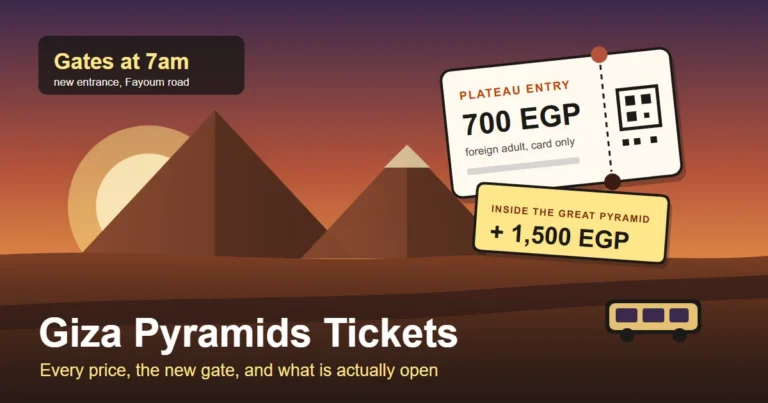
Once in your life, yes. In 2026 the Giza Plateau costs 700 EGP for foreign adults, and the gates open at 7am with last entry at 4pm (egymonuments.com, Giza plateau booking, September 2026). The ministry’s information page still prints 8am to 4pm. The Great Pyramid’s interior has cost another 1,500 EGP since January 1, 2025 (Egypt Independent, Khufu Pyramid ticket prices, December 4, 2024). What you buy is a steep, hot climb to a granite room with an empty sarcophagus in it.
The plateau works differently from the photos in older guides. The main entrance moved to a visitor centre on the Cairo to Fayoum road. Private cars and tour buses no longer drive up, and included electric shuttles stop at the Panorama viewpoint, Khafre and Menkaure (Ahram Online, new entry and transport rules, April 9, 2025). Budget three to four hours and arrive for the 7am opening, before the heat and the coaches. Tickets, the Great Pyramid interior and the new entrance, gate by gate covers the mechanics.
I’ve been inside once and wouldn’t pay for it again. The Grand Gallery, a tall sloping corridor that looks far too precise for its age, is worth the ticket on its own. The King’s Chamber at the top is granite walls, an empty sarcophagus and a queue. If you’re choosing between the interior and Saqqara, choose Saqqara.
Hassle comes with most things to do in Egypt, and at Giza the camel ride is where most of it lives. The ride isn’t a scam by nature. The trouble is the price after you’ve mounted, which can pass 1,000 EGP against the 200 to 400 you’d agree standing on the ground. How the Giza touts actually work is worth ten minutes before you go.
One new thing is on its way. In late August 2026 the tourism minister inspected a tethered helium balloon about 2 km from the pyramids. It rises 150 metres for a 15-minute ride (Egyptian Streets, fixed balloon project at Giza, August 31, 2026). No opening date or price has been announced, so don’t plan around it yet.
Is the Grand Egyptian Museum Worth Most of a Day?
Yes: four to five hours, ideally on a late-opening evening, and it’s the one ticket here you can’t buy at the gate. Since December 1, 2025 the Grand Egyptian Museum has sold timed tickets online only, with on-site sales suspended (Egypt State Information Service, GEM timed ticketing, November 14, 2025). By September 11, 2026 it had recorded more than 6.5 million visitors since opening (Cairoscene, September 11, 2026).
The ministry set foreign adult entry at 1,450 EGP when the museum opened, and the official checkout now charges 1,500 EGP, about $29 (Egypt State Information Service, GEM opens to the public, November 4, 2025). The official checkout at tickets.gem.eg, where visit-gem.com sends you, totals in pounds. On November 1, 2026 foreign tickets rise by $5 and Egyptian adult tickets by 20 EGP (Ahram Online, GEM ticket prices, April 15, 2026; Egypt Independent, April 16, 2026). An October visit is the last one at the current price.
The Tutankhamun galleries are the reason it ranks among the best things to do in Egypt, with the tomb’s collection shown together in one place for the first time. Give them two hours on their own. The Grand Staircase, lined with royal statues, is the part people underestimate. The second of Khufu’s boats is being restored in public view, a job that started in December 2025 and should take about four years (Arab News, 2025).
The galleries open 9am to 6pm, and until 9pm on Wednesdays and Saturdays, with last entry an hour before closing (the museum’s official ticketing site, checked September 13, 2026). Those two late nights are the ones I’d book. Do Giza that morning, rest through the afternoon heat, and walk into the museum as the day-trippers leave. How GEM booking works, step by step covers every price tier, the entry windows and the terms.
Two things are no longer where old guides put them. The royal mummies are at the National Museum of Egyptian Civilization in Fustat, 550 EGP with the mummies hall included (egymonuments.gov.eg, NMEC). The Tanis treasures and the Narmer Palette are still in the old Egyptian Museum on Tahrir Square, also 550 EGP (egymonuments.gov.eg, Egyptian Museum).
Why Does Saqqara Beat a Second Morning at Giza?
Because the crowd is a fraction of Giza’s and the variety is far wider. Saqqara’s site ticket is 600 EGP and Dahshur’s 200 EGP (egymonuments.gov.eg, Saqqara; Dahshur). For that you get the Step Pyramid of Djoser, painted Old Kingdom tombs you can walk into, and the Bent and Red Pyramids down the road.
Which extras earn their ticket? They’re priced separately, and they add up fast. Going inside Djoser’s pyramid is 280 EGP, the Serapeum’s underground bull galleries 340, the tomb of Mereruka 200, and an all-in Saqqara ticket 1,400. My pick is the site ticket plus the Serapeum. Mereruka’s carvings of everyday life are the ones I’d add third.
Of every Cairo morning I’ve spent, Saqqara is the one I enjoyed most, and the one I very nearly cut to save time. Like several things to do in Egypt, it has no public transport worth using, so it’s a half day with a driver. When a private driver makes sense covers what that costs and how to book one.
Islamic Cairo and Khan el-Khalili at Dusk
This is the cheapest great evening in Cairo, and one of the few things to do in Egypt that costs almost nothing. Al-Muizz Street costs nothing to walk, and a combined ticket for the Qalawun complex and seven other monuments runs about 180 EGP. Most individual mosques ask 20 to 100 EGP, as the full Cairo guide priced it in August. Go at dusk, when the medieval facades light up.
Walk it north to south and let it end in Khan el-Khalili. That order puts the market last, when the lamps are on and you’ve earned a mint tea. After dark Egyptian families outnumber tour groups on the street, and the mood is the opposite of Giza’s.
Haggling in the Khan is a conversation, not a fight. Ask the price, offer well under it, and be ready to walk, because the walk usually settles it. Carry small notes, since nobody has change for a 200, and how baksheesh works, with real amounts covers the rest. Dress modestly if you step into Al-Azhar, and women should carry a scarf.
The Citadel of Saladin, up on its ridge, is the daytime half of this part of town. It costs 550 EGP for the Muhammad Ali Mosque and three museums, 8am to 5pm (egymonuments.gov.eg, Cairo Citadel). It’s also one of the sites Egypt Independent named with card-only ticket machines.
Which Valley of the Kings Tombs Are Worth the Extra Tickets?
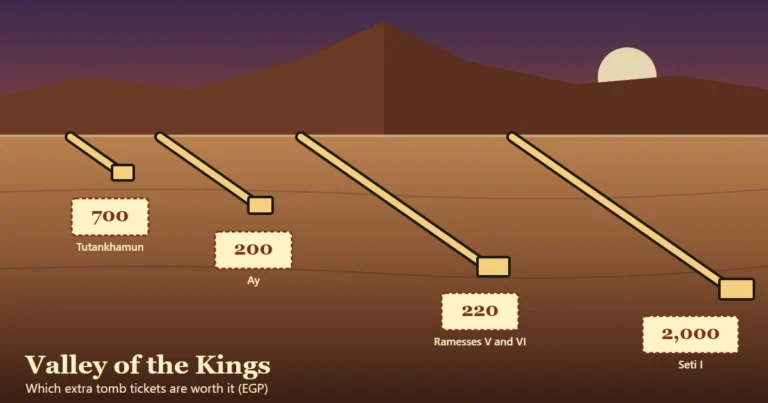
The Valley of the Kings costs 750 EGP for foreign adults and opens at 6am, with last entry at 5pm in summer and 4pm in winter (egymonuments.com, Valley of the Kings booking). That covers three tombs of your choice from those open that day. Tutankhamun is 700 EGP extra (egymonuments.gov.eg, KV62) and Ramesses VI 220 EGP (egymonuments.gov.eg, KV9). Arrive at 6am, ahead of the cruise coaches and the heat, which is the rule for most outdoor things to do in Egypt.
Ramesses VI is the best-value ticket in Egypt. For 220 EGP you walk down a long corridor into a burial hall under a painted ceiling that stops people mid-sentence. I’ve paid it every time. Tutankhamun’s tomb is the opposite: small, with one painted chamber and the king’s mummy still inside, while the treasures that made it famous are now at the museum in Giza.
Seti I, at 2,000 EGP, is one of the longest tombs in the valley, the finest painted one in it, and a second-trip splurge. On a first visit that money buys a whole third day in Luxor. I priced every add-on against what you actually get in which Valley of the Kings tombs justify the extra tickets.
Nefertari’s tomb in the Valley of the Queens has been closed since March 2024. No reopening had been announced when I checked in September 2026, so ignore any listing still selling it. The two-day Luxor plan, bank by bank puts Hatshepsut and Medinet Habu on the same West Bank morning.
Karnak by Morning, Luxor Temple After Dark
See Karnak at the 6am opening and Luxor Temple after dark, because they reward opposite hours. Karnak costs 600 EGP and Luxor Temple 500 EGP, with Luxor Temple open until 8pm (egymonuments.gov.eg, Karnak; Luxor Temple). After dark Luxor Temple is lit, and the cruise crowds have gone back to their boats.
Karnak needs two hours, not the forty minutes a tour allots. The Great Hypostyle Hall alone holds 134 columns, and walking it slowly is the whole point. Get there at opening and you’ll have it close to yourself for twenty minutes.
What most lists miss is that several of the best things to do in Egypt depend on the hour more than the ticket. Luxor Temple lit up at night is the best evening in the city. It also costs less than the sound and light show at Karnak, which is $20 a head on the official show operator’s page. Spend the evening in the temple instead.
Is the Luxor Hot Air Balloon Safe, and Worth It?
Yes to both, with context. Flights launch over Luxor’s West Bank between 05:30 and 07:30 and cost roughly $40 to $150 a person. The Egyptian Civil Aviation Authority grounds every balloon when the wind passes 8 knots, as my Luxor guide sets out. That rule is why you book your first Luxor morning, never your last, and ask up front what happens if the wind cancels it.
The record is worth knowing plainly, because few things to do in Egypt draw this many safety questions. In February 2013 a gas fire on one balloon killed 19 people (CNN, February 26, 2013). In January 2018 a hard landing in strong wind killed one tourist (Ahram Online, January 2018). In January 2025 a sudden wind change forced an emergency landing with 24 tourists aboard and no injuries (Egypt Independent, January 29, 2025). I found no incident so far in 2026.
Add it up and you get a tightly watched operation in which a cancellation is the risk you’ll actually meet. On a peak morning dozens of balloons are up at once, and they turn out to be the best part of the photographs.
A balloon morning doesn’t cost you a sightseeing day. You’re back on the ground by breakfast with the West Bank tombs right there, so I stack it onto the Valley of the Kings day. In my experience the cheap end of the price range means a bigger basket and a later slot. The one mistake I won’t repeat is a non-refundable booking, because the wind decides. The balloon safety record, the season and how to book goes through the operators properly.
Cruise, Dahabiya or Felucca on the Nile
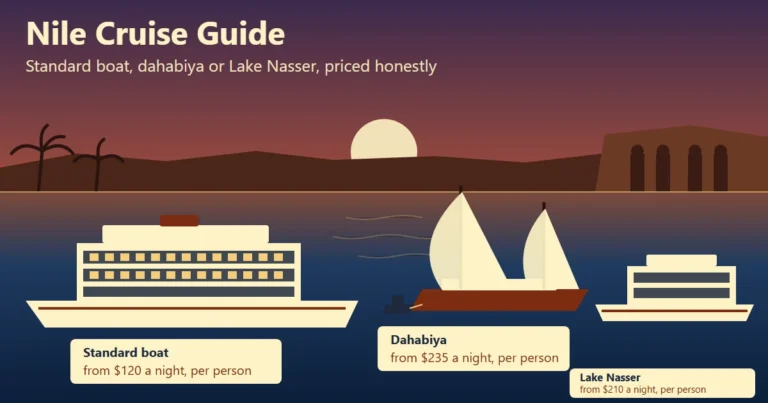
Take a standard cruise for efficiency, a dahabiya for slowness, and a felucca for the best cheap hour on the river. Luxor to Aswan cruises run three to four nights, with the high season from October to April (Egyptian Streets, Egypt’s new wave of luxury Nile cruises, August 18, 2026).
A standard five-star boat starts near $120 a person a night at the cheapest from-prices, with $180 to $220 more typical in high season. A dahabiya runs about $235 to $315 on most sailings, from $160 on the longest ones, and a felucca in Aswan 200 to 300 EGP an hour for the whole boat.
Those cruise and dahabiya figures are operator prices from one 2026 cruise guide, so treat them as a floor, not a quote (Semi Elegant Voyage, Nile cruise guide, 2026). The felucca figure comes from Aswan’s felucca prices, per boat. Being quoted per head is the most common way visitors overpay on the river.
Of the river-based things to do in Egypt, a standard cruise is the efficient choice. The boat is your hotel and your transport. It stops at the temples of Edfu and Kom Ombo on the way, with entry extra unless your package includes it. A dahabiya is the slow version, under sail with far fewer cabins and mooring spots the big boats can’t reach. The felucca hour is the cheap one, and it’s the best sunset on the river.
If I could keep only one Nile experience, it’d be the felucca. An hour around Elephantine Island as the light goes, with the whole boat for roughly 250 EGP split between everyone aboard, beats most of the paid things on this page.
For the boat decision itself, standard boat, dahabiya or Lake Nasser, priced honestly is the full comparison.
Is Abu Simbel Worth the 4am Start?
Every time. In July 2026 the official checkout charged about 822 EGP for a foreign adult, against 750 EGP on the ministry’s information page (egymonuments.gov.eg, Abu Simbel). On the two Sun Festival days it charged about 1,272 EGP. The temples sit about 280 km south of Aswan, so the real cost is the road.
It’s three to four hours each way by road, or a short flight, and flight, road convoy or Lake Nasser cruise compares all three with the timings. Two hours on site is enough. The facade of the Great Temple is the photograph. The interior, reassembled with the rest of the complex when it was moved in the 1960s, is the surprise.
The next Sun Festival falls on October 22, 2026, when the dawn sun reaches the inner sanctuary. No official programme had been announced when I checked on September 13. Expect crowds, the festival price and a start even earlier than 4am.
Pair it with Philae back in Aswan. The island temple costs 550 EGP plus a shared boat (egymonuments.gov.eg, Philae), and its sound and light show is $20 on the official operator’s Philae page. My Aswan guide fits both into two unhurried days.
Where Is the Best Diving and Snorkelling in the Red Sea?
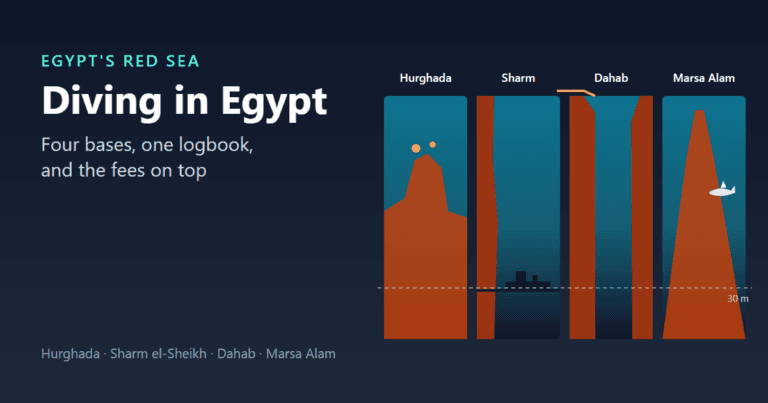
Dahab for shore diving, Marsa Alam for turtles and remote reefs, and Hurghada or Sharm for easy boat days. Egypt’s Red Sea counts more than 200 coral species and around 1,200 kinds of fish (DIVE Magazine, Egypt marine life, checked September 2026). The water sits near 21 to 23°C in winter and 28 to 29°C by late summer (Climates to Travel, climate normals). With the museum, it’s one of two things to do in Egypt here that work in every month.
Each base suits a different trip. Hurghada is the easy boat day for families and first-timers. Sharm el-Sheikh is the gateway to Ras Mohammed National Park, where dive operators add a 7 euro park fee to each trip (Circle Divers, checked September 2026). Dahab is shore diving, where two guided dives with your own gear ran 70 euros at both centres I priced in August 2026. Marsa Alam has the turtles at Abu Dabbab and the remote offshore reefs.
Which Red Sea resort fits your trip settles the first choice. Dahab’s shore dives and the Blue Hole, honestly explains why the Blue Hole’s frightening reputation belongs to one deep tunnel, not to the dive most people do.
Snorkellers heading south should read turtles, dugongs and the rules at Abu Dabbab first. A guaranteed dugong sighting is a red flag, not a selling point. Hurghada, Sharm, Dahab and Marsa Alam compared underwater sets all four bases side by side.
Can You Still Climb Mount Sinai for Sunrise?
Yes, the night climb still runs from St Catherine’s Monastery to the 2,285-metre summit. You go either up the gentler camel path, about 2.5 hours on foot, or the 3,750 Steps of Repentance (Wikipedia, Mount Sinai, checked September 2026). It’s the only climb among these things to do in Egypt, and the only sunrise you have to earn.
The monastery at the foot of it is the uncertain part. In May 2025 an Egyptian appeal court classed its land as state property with the monks holding usage rights, and the gates closed for about ten days in protest. The cassation appeals due on August 23, 2026 produced no ruling and no new hearing date, and settlement talks continue (Coptic Solidarity, what next for St Catherine’s, August 26, 2026).
So confirm monastery entry with your operator the week before, and don’t assume a package listing it can deliver it. The climb itself doesn’t hang on the case.
The FCDO updated its advice on August 4, 2026. It advises against all but essential travel to the northern part of South Sinai beyond the St Catherine to Nuweibaa road, “except for the coastal areas along the west and east of the peninsula” (GOV.UK, 2026). St Catherine is where that road begins, and North Sinai, where the FCDO advises against all travel, is a separate region. The honest read on the advisory zones maps the rest.
Pack for cold. The summit at dawn is far colder than anywhere else on this list, even when the coast below is warm. Most people climb on an overnight tour from Dahab or Sharm and sleep through the drive back.
A Night in the Desert: White Desert or Siwa?
The White Desert overnight from Cairo carries a park fee of about 250 EGP (as of May 2026). Siwa is a 9.5 to 10-hour night bus from Cairo, with a three-night minimum to make it worthwhile. In both, the ticket is trivial and the trip is the cost. That makes the desert the odd one out among the things to do in Egypt here, and for some people the best part of the whole trip.
The White Desert is the short version, an overnight tour of about 34 hours door to door from Cairo. You get a 4×4 across the chalk, dinner on a rug and a silence you won’t find anywhere on the Nile. The hour-by-hour White Desert overnight prices it and dates the fee. Siwa is the long version, an Amazigh oasis with salt pools you float in, and the full Siwa guide covers the bus and the safaris.
Both belong on a second trip for most people, or on a 14-day first trip in place of Sinai. The second-trip list, priced and timed sets them beside eight other detours. Winter desert nights get properly cold, and the cold desert nights nobody packs for has the list.
Which Famous Things to Do in Egypt Would I Skip?
Four, plus one to save for a second trip, one to do only once, and one that isn’t possible right now. The Seti I tomb at about 2,000 EGP and Karnak’s $20 sound and light show both lose, on a first trip, to cheaper things a short walk away.
| Experience | Verdict | Why |
|---|---|---|
| Great Pyramid interior | Once in your life | Hot, cramped, 1,500 EGP |
| Tahrir museum, short trip | Skip | Tut and the mummies moved |
| Seti I tomb, first visit | Second trip | About 2,000 EGP, save it |
| Karnak sound and light | Skip | Luxor Temple at night instead |
| Aswan High Dam | Skip | A long view of water |
| Unpriced camel ride | Skip | Agree the price first |
| Nefertari’s tomb | Not now | Closed since March 2024 |
So why put them on the page at all? None of these is a scam, and all of them have fans. The Tahrir museum, in particular, is atmospheric and cluttered in a way I genuinely like. The point is order: on a short trip, the best things to do in Egypt should come first. On a first trip of a week or less, each one costs time or money that something better on this list would use.
How Do These Experiences Fit a 7, 10 or 14-Day Trip?
Seven days fits the Cairo and Nile experiences, ten adds the Red Sea, and fourteen adds Sinai or the desert, but not both. Heat decides the rest. Luxor averages a 41°C high in July against 23°C in January (Climates to Travel, climate normals), so most of these things to do in Egypt are an October to April plan.
Read the grid by row. The museum and the Red Sea work in every month. From May to September the ancient sites become opening-time visits, cruise sailings thin out, and the desert turns into a winter-only trip. Ramadan 2027 is expected to begin around February 8 (Gulf News, checked September 2026). Month-by-month heat and crowds covers what changes that month.
For one person doing the core things to do in Egypt on a ten-day trip, the eight main gate tickets come to about 6,020 EGP, roughly $118. Three nights on a standard cruise add around $360, which makes the boat most of the experience budget. The balloon and the Great Pyramid’s interior together add about $89, and a Red Sea dive day adds about 70 euros more.
The tickets are the part people argue about, and they’re about a quarter of the bill. Where each fits in 7, 10 and 14 days lays out the days, so you can see which of these your trip length actually has room for.
Things to Do in Egypt FAQs
What is Egypt most famous for?
The pyramids of Giza, the Nile, and the temples and tombs of Luxor. Egypt drew a record 19 million visitors in 2025, according to the Egypt State Information Service, and those sights are why most of them come. Tutankhamun’s treasures, now shown together at the Grand Egyptian Museum, belong on the same list. So does the Red Sea: Hurghada’s airport alone handled 12.35 million passengers in 2025 (Hurghada International Airport, passenger statistics).
What is the number one thing to do in Egypt?
Giza and the Grand Egyptian Museum, the two things to do in Egypt that share a side of Cairo. The plateau costs 700 EGP and opens at 8am. The museum sells timed tickets online only, now 1,500 EGP for foreign adults at the official checkout, with a $5 rise for foreign visitors on November 1, 2026. Book a Wednesday or Saturday, when the galleries stay open until 9pm, and do both.
Is going inside the Great Pyramid worth it?
Once in your life. The interior costs 1,500 EGP on top of the 700 EGP plateau ticket, a price in force since January 2025. You climb a steep, hot passage through the Grand Gallery to a granite chamber with an empty sarcophagus. If you’d rather keep the money, Dahshur’s site ticket is 200 EGP and its pyramids see a fraction of the crowd.
Is Abu Simbel worth the trip from Aswan?
Yes, even with a 4am start. It sits about 280 km from Aswan, three to four hours each way by road or a short flight. The official checkout charged about 822 EGP for a foreign adult in July 2026. The price rises to roughly 1,272 EGP on the February 22 and October 22 Sun Festival days. Two hours on site is enough.
Do Egyptian tourist sites accept cash?
Plan on card only at the big sites. In June 2025 Egypt Independent reported that the ticket machines at 110 museums and sites take bank cards only. Those include Giza, Karnak, the Valley of the Kings and Abu Simbel, and Luxor’s sites have taken only cards since 2023 (Egypt Independent, Luxor’s first ticket machines, 2024). Tips, taxis, feluccas, market stalls and desert camps still run on cash, so carry both.
Is the Luxor hot air balloon safe?
Yes, within a tightly monitored system. Flights are grounded when wind passes 8 knots, which is why cancellations are common. The worst accident, a gas fire in February 2013, killed 19 people, and the most recent incident, in January 2025, was an emergency landing with no injuries. Book your first Luxor morning and expect $40 to $150 a person.
How many days do you need to do the main things in Egypt?
Ten days covers most of these things to do in Egypt comfortably. Seven fits the Cairo and Nile experiences with no slack, flying both long legs. Ten adds three nights on the Red Sea by road from Luxor. Fourteen adds either the Mount Sinai sunrise climb or a desert night, not both. From May to September, plan the ancient sites for opening time.
The Bottom Line
The best things to do in Egypt are mostly the famous ones, done at the right hour and booked the right way. The whole page, in four lines:
- Protect three if the trip gets cut in half: Saqqara over a second Giza morning, Luxor Temple after dark, and a felucca hour in Aswan.
- Book two before you fly: the Grand Egyptian Museum, and your cruise if you’re travelling October to April.
- Confirm one the week before: St Catherine’s Monastery, while its court case stays open.
- Carry a card and cash: the card for the gates, small notes for everything else.
Which would I give up first if I had to? The Great Pyramid’s interior, once you’ve been inside it. I’d put that 1,500 EGP toward a third Luxor day. All twelve things to do in Egypt here sit inside a bigger plan: the practical side of planning Egypt covers visas, safety and timing, and the region-by-region guide shows which of these twelve your route passes.