
Last verified: September 19, 2026. Every temple ticket here was read off the official checkout that day, and every cruise price comes from boats I priced myself on the same date. Fares move with the season, so I re-check this page monthly.
Every Nile cruise brochure has the same line: entrance fees included. I added up what that line is worth. On the official checkout, the seven stops on a classic three-night sailing cost 3,840 EGP, about $74. That’s a third of one standard cruise night at the top of the band, and well over half at the bottom.
Disclosure: Some links in this guide may earn us a commission, at no extra cost to you. It never changes what we recommend.
That’s the problem with shopping for a Nile cruise. Three very different products share one name. The prices are published almost entirely by the people selling them. And nobody in the business will tell you what happened on the river last October.
So this Nile cruise guide does the arithmetic the brochures skip. What a fare contains. A fair price per night in each class, from boats I priced on one day. Three nights against four, and a straight safety section. The boat is one piece of the experiences worth planning an Egypt trip around, and it’s the piece most people overpay for.
Key Takeaways
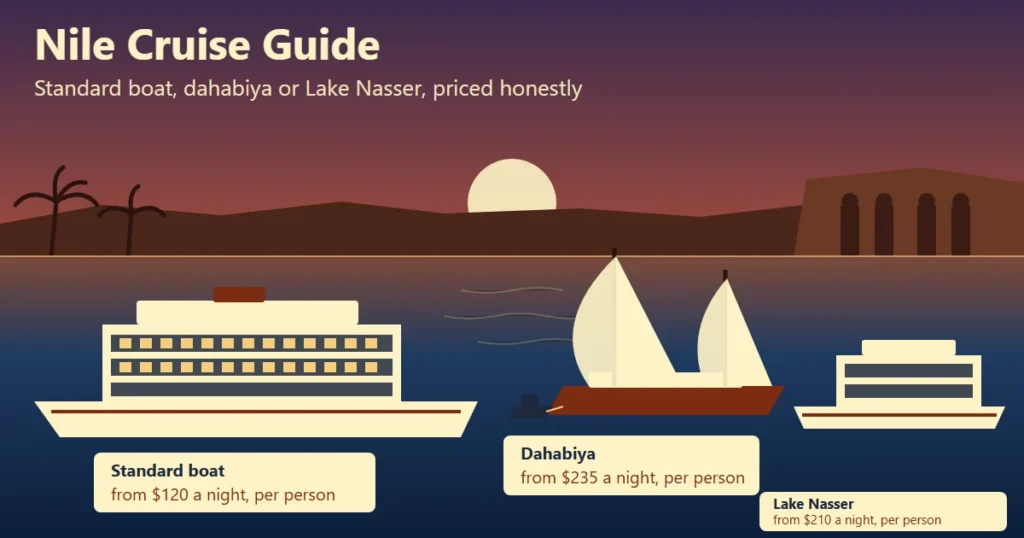
- Three products, not one. A standard boat is a floating hotel on a schedule, a dahabiya is an eight-to-twelve-cabin sailing boat, and a Lake Nasser cruise is the only boat that moors beneath Abu Simbel.
- The “included” tickets are worth 3,840 EGP, about $74. That’s what “fees included” is worth over a fare that leaves them out, and not a dollar beyond it.
- Per night, from the boats I priced on September 19: standard $120 to $215, dahabiya $235 to $315, Lake Nasser $210 to $310, premium five-star $220 to $390.
- Sail Aswan to Luxor, add a night at both ends, and book a named vessel, never “a five-star boat”.
Table of Contents
What Does a Nile Cruise Fare Actually Include?
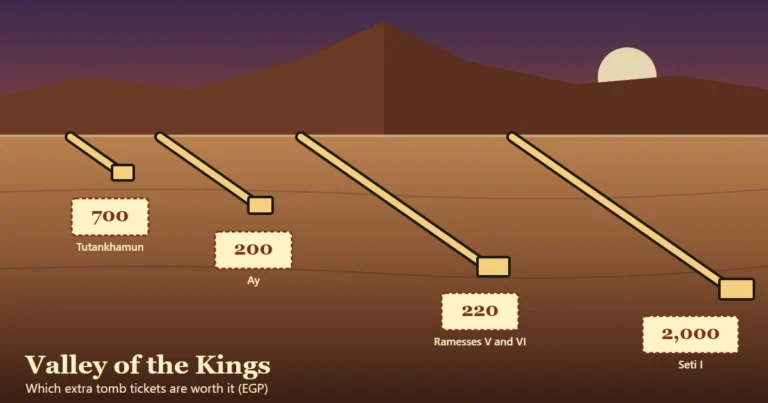
Your cabin, three meals a day, the sailing between Luxor and Aswan, and on most packaged fares a guide and the temple tickets for the stops. In September 2026 those tickets came to 3,840 EGP on the official checkout for the classic seven stops (egymonuments.com, Valley of the Kings booking and sibling pages, read September 19). Drinks, the crew kitty, Abu Simbel and the premium tombs are the usual extras.
Here’s the complete ticket list, read off the checkout on September 19. No page selling cruises publishes it.
| Stop | Foreign adult | Foreign student | On which sailings |
|---|---|---|---|
| Valley of the Kings (three tombs) | 750 EGP | 375 EGP | All |
| Karnak | 600 EGP | 300 EGP | All |
| Edfu, Temple of Horus | 550 EGP | 275 EGP | All |
| Philae | 550 EGP | 275 EGP | All |
| Luxor Temple | 500 EGP | 250 EGP | All |
| Kom Ombo | 450 EGP | 225 EGP | All |
| Hatshepsut | 440 EGP | 220 EGP | All |
| Esna | 200 EGP | 100 EGP | Four-night sailings |
| Three-night total | 3,840 EGP | 1,920 EGP | |
| Four-night total | 4,040 EGP | 2,020 EGP |
At the Central Bank’s September 17 rate of 52.19 EGP to the dollar (Central Bank of Egypt), that’s about $74 for three nights and $77 for four. Some boats add the Philae Panorama ticket at 200 EGP or the Unfinished Obelisk at 220. Most don’t.
Two things follow. First, “fees included” is worth about $74 a person over a fare that leaves them out. If an included fare costs hundreds more, the tickets aren’t what you’re paying for. Second, it isn’t the saving the brochures imply: a third of a cruise night at the top of the standard band, more than half at the bottom.
Then there’s the kitty. On every standard boat I’ve sailed, the envelope has come round on the last evening and the guide has named a figure. The fare doesn’t include it, so I budget it as the price of the crew’s week, not a tip. I’ll print a figure once I’ve collected three sailings’ worth; how baksheesh works on a boat covers the amounts for now.
Since June 2025 the gates at 110 sites have been card-only (Egypt Independent, June 2025), so a fare that excludes tickets means tapping a card at every gate. Where the cruise sits in a full Egypt budget puts all of this against the rest of the trip.
Standard Boat, Dahabiya or Lake Nasser: Which Nile Cruise Fits You?
A standard boat if you want the classic circuit done efficiently with a pool and a schedule. A dahabiya if the river is the point and you can give it four or five nights. Lake Nasser if Abu Simbel matters more to you than Karnak. The season for all three runs October to April (Egyptian Streets, Egypt’s new wave of luxury Nile cruises, August 18, 2026).
A standard boat carries forty to over a hundred passengers and does Luxor to Aswan in three or four nights. A dahabiya has eight to twelve cabins, sails, and a tug for when the wind drops. A Lake Nasser cruise sails the reservoir above the High Dam to Abu Simbel, past the temples rescued from the rising water.
The choice comes down to the trip. First trip, ten days: the standard boat. It’s the cheapest way to see the whole circuit with a guide, and the pool matters more than you think in March. Second trip, or you’d rather see one village than a fourth temple: the dahabiya. You’d cross Egypt for Abu Simbel alone: the lake.
What none of these are is a felucca, the one-hour sail in Aswan for 200 to 300 EGP for the whole boat. It’s a lovely hour and a different thing entirely. If the boat against the train and the flight is still an open question, how the cruise compares with the train and the flight settles it first.
What a Nile Cruise Costs per Night in 2026
From the boats I priced on September 19, 2026, standard boats run about $120 to $215 per person per night, twin share, land only. Premium five-star hulls run $220 to $390, luxury boats $515 to $910, dahabiyas $235 to $315, and Lake Nasser $210 to $310. Summer takes 30 to 50% off the standard boats (Egypt Tours Plus, updated July 2025).
Why price them myself? Because cruise prices online come almost entirely from the people selling cruises, which is why my budget guide prints ranges rather than quotes. So on one morning I read the season “from” prices for 35 named boats across four agency lists and divided each by its nights.
| Class | Boats priced | Fare read, per person | Per night |
|---|---|---|---|
| Standard five-star | 14 | $390 to $640 (3 nights); $480 to $780 (4 nights); one list from $640 | $120 to $215 |
| Premium five-star | 5 | $829 to $1,159 for 3 nights; $889 to $1,409 for 4 | $220 to $390 |
| Luxury | 6 | $1,639 to $2,729 for 3 nights; $2,069 for 4 | $515 to $910 |
| Dahabiya | 8 | $940 to $1,250 (4 nights), one at $2,300; a schedule at 890 euros | $235 to $315, one at $575 |
| Lake Nasser | 2 | $919 for 3 nights; from 470 pounds sterling for 3 | $210 to $310 |
The names, for anyone who wants to check my reading. Standard: A Sara, Princess Sarah, Radamis II, Royal Ruby, Nile Dolphin and nine more on one agency list. Premium: Sonesta Moon Goddess, Sonesta Star Goddess, Mövenpick Hamees, Mövenpick Royal Lily and Sun Goddess. Luxury: Historia, Farah, Sanctuary Sun Boat IV, Oberoi Zahra, Oberoi Philae and Mövenpick SS Misr. Dahabiya: Noor El Din, Pyramids, Queen Nefer, Akhnaton, Turquoise, Zahra (the dahabiya, not Oberoi’s), Iris and Hathor. Lake Nasser: Mövenpick Prince Abbas and Steigenberger Omar El Khayam.
Three caveats about that table. These are “from” prices for the coming season, not quotes for a week. The one dahabiya schedule that printed its seasons charged 890 euros for four nights as standard and 1,025 from December 23 to January 10 and over Easter, a 15% uplift. And the big boats move further around Christmas; what each month does to cruise prices covers the calendar side.
Single travellers pay a supplement of 50 to 100% of the twin rate (Egypt Tours Plus, July 2025).
Don’t read much into the stars. Nearly every big boat on the river calls itself five-star, hulls from 2006 and hulls from 2024 alike, and the label tells you little about the cabin you’ll get. The vessel’s name is the useful information. Look it up before you pay, and get it written on the booking. The one thing I’d pay more for next time isn’t a star: it’s a smaller group at the temples.
Three Nights Aswan to Luxor, Plus a Night at Each End
Three nights Aswan to Luxor is the efficient classic. Four nights Luxor to Aswan adds Esna and a slower first day. Sail south to north where you can choose, so the trip ends in Luxor, where the sites are densest. The single biggest ticket, the Valley of the Kings at 750 EGP (egymonuments.com, September 2026), is then still ahead of you.
On the boats I’ve sailed and priced, the pattern is fixed enough to plan around. Most big boats leave Luxor on a Monday or Saturday for four nights and Aswan on a Friday or Wednesday for three. Confirm the day with the vessel. The stops are the same either way: Esna on the longer sailing, then Edfu, Kom Ombo and Philae.
Look at what that chart does to Luxor. On a three-night sailing you get one West Bank morning, usually the Valley of the Kings and Hatshepsut, and the coaches from the dock reach the valley just as the queues form. Karnak gets an hour or two. Luxor Temple, best after dark, gets an evening hour if you’re lucky and a daylight rush if not. The two-day Luxor plan the cruise doesn’t give you shows how much is left over.
Aswan does no better. One night buys Philae and the High Dam, and the boat leaves before the town has shown you anything. What Aswan needs beyond one night is two full days, and I’d add at least one of them.
So the honest advice is three nights on the boat, plus a hotel night in Aswan before and one in Luxor after. At a mid-range hotel that costs less than a fourth cruise night, and it buys you both cities properly. The Valley of the Kings wants you at the gate at 6am, and what a cruise day in the valley actually gives you is a compressed version of that. If you want a dawn balloon from the cruise dock, it is the hardest slot on the river to arrange.
The temples themselves, Esna at 200 EGP, Edfu at 550, Kom Ombo at 450 and Philae at 550, are some of the best-preserved Ptolemaic and Roman buildings in Egypt, and a guide earns the fee at Edfu more than anywhere. What the walls are saying is a subject of its own.
What Is a Dahabiya Really Like?
A two-masted sailing boat with roughly eight to twelve cabins, pushed by a tug when the wind drops. It moors at islands and villages the big boats can’t reach, over four or five nights between Esna and Aswan. The top end is expanding fast: Oberoi launches two new seven-suite dahabiyas, Melouk and Malekat, in late 2026 (Egyptian Streets, August 18, 2026).
Most dahabiyas don’t start in Luxor. They start at Esna, about 50 km south, and you reach them by road in about an hour. That’s because of the Esna lock, which sits between Luxor and everything upstream.
Why does a lock matter to a sailing boat? Because passing it costs time and money, and a ten-cabin boat can’t absorb either. So the dahabiya fleet lives above the lock and lets a minibus do the Luxor leg. The lock shaped the big boats’ timetables too: Esna is where four-night sailings stop and where boats queue. A second lock was built between October 2001 and April 2004 (ACE Consulting Engineers, Additional Esna Navigation Lock). That is why the annual closure that old forum threads still warn about is no longer the risk it was.
What you get for the slower pace is the river as it is. Dahabiyas moor at Gebel el-Silsila, where the sandstone for the temples was quarried, at el-Kab, and at islands with nobody on them. Dinner is on deck. There’s no pool, no gym, no evening show, and the Luxor temples happen before or after, not from the boat.
Prices from my basket ran $235 to $315 per person per night for the mid-market boats, with the Hathor at $575. That’s above a standard cruise and level with the premium five-stars, for a completely different product.
Is a Lake Nasser Cruise Worth It?
Yes if Abu Simbel is why you came, because it’s the only one of the three that puts you at the temples at sunset and sunrise. No if temples per day is the measure. The lake has four small ones, and on the official checkout they’re cheap: Kalabsha 200 EGP, Wadi el-Sebua 150 and Amada 150, all with last entry at 3pm (egymonuments.com, read September 19, 2026).
Three of them were moved uphill in the 1960s, ahead of the water rising behind the High Dam. Kalabsha, the biggest, a Roman-era temple to a Nubian god, and Wadi el-Sebua, with its avenue of sphinxes, were taken apart and rebuilt. Amada, the oldest, went whole, on rails, which is why its painted reliefs survived. Qasr Ibrim stayed put and became an island; you see the fort from the deck.
And then Abu Simbel. Every day-trip route, by road or by air, gives you about two hours at Ramesses II’s temples in the middle of the morning, with everyone else. The lake boats moor beneath them. You walk up at sunset when the coaches have gone, and again at sunrise. Every way to reach Abu Simbel, priced door to door covers the alternatives.
The fleet is tiny, a handful of boats, so dates are fixed and cabins go early. The pattern is four nights from Aswan on Mondays and three from Abu Simbel on Fridays. I found it at about $705 to $895 per person on Orbital Travel’s Lake Nasser listing in August 2026. My September basket, on a different agency’s list, put the same boats at $210 to $310 a night.
It suits second-visit travellers who’ve done the Luxor circuit, birders, and anyone allergic to coaches. It’s not for a first-timer with ten days, who should spend those nights on the Luxor circuit.
Are Nile Cruises Safe?
For the traveller, yes, in the sense that matters. The tourist corridor from Cairo to Aswan sits under a Level 2 advisory, refreshed July 15, 2026 (US State Department, July 2026). The elevated-risk zones are North Sinai, the Libyan border and parts of the Western Desert, none of them on the river. Incidents on the boats themselves are rare. They’re not zero, and the ones that have happened are mostly fires, on older hulls.
The recent one was the Iberotel Crown Empress. On October 28, 2025, at about 6:15 in the evening, on the first night of a sailing out of Luxor, a fire started in the galley near Esna. All 220 passengers were taken off by other boats. Three crew were hospitalised with injuries that weren’t life-threatening, and no passengers were hurt. The Luxor prosecutor’s early finding was an electrical short in the kitchen (The Maritime Executive, October 30, 2025).
It wasn’t the first fire on the river. A 2007 fire on the M/S Aurora killed five crew, as The Maritime Executive recalls in the same report. The other recent deaths weren’t a fire. In August 2023 the Tivoli, a floating hotel out of service since 2010 with a lapsed licence, tipped over at its Luxor mooring during a refit. Two workers were killed (Ahram Online, August 30, 2023). The tourism ministry and the River Transport Authority license and inspect the boats, but publish no fleet list a traveller can check.
So here’s what I do, and it takes five minutes. I book a named vessel, never “a five-star boat”, and I look the name up. On board, I find the exit from my cabin before I unpack and count the doors to it. I keep my passport and a card by the bed. And if nobody has shown me a muster point by the time we sail, I ask why, because a boat that skips the drill is telling you something.
None of that should put you off. It should make you choose the boat with a little more care. Everything off the water is in the honest Egypt safety picture.
Booking Windows and the Six Questions to Ask
Book December to March sailings two to three months out, shoulder months a few weeks out, and summer whenever you like. Demand is the reason. Egypt received roughly 12.8 million tourists between January and September 2026, the tourism minister said on September 17, and expects around 20 million by year end (Ahram Online, Egypt expects 20 mln tourists by year-end, September 17, 2026).
That’s on top of a record 2025, when arrivals reached about 19 million, up 20.5% on 2024 (Egypt State Information Service, May 2026). The good boats in the good weeks go first, and the top end is adding hulls to meet it, Oberoi’s two new dahabiyas among them.
Before you pay anyone, ask six questions, the same six this Nile cruise guide is built around. Get the answers in writing, because a verbal yes is worth nothing at the dock.
- Which vessel, by name? Not the class. The name.
- Which deck? Lower decks sit at water level, where docked boats raft up against each other.
- Are the temple tickets inside the fare? If not, expect about $74 less, and bring a card.
- Is the crew kitty inside the fare? On most standard boats it isn’t.
- How big is the group for the temple visits? I’ve been in a group of forty at Edfu and a group of fifteen. They’re different mornings.
- Who meets you at each end? The transfer to a dahabiya at Esna is an hour by road. Make sure it’s in the booking.
I’ll re-price the basket in May, when the summer rates land, and update this page.
Nile Cruise Guide FAQs
Is a Nile cruise worth it?
Yes on a ten-day trip. The fare replaces your hotel, meals and transport between Luxor and Aswan, and on most packaged fares it includes temple tickets worth about 3,840 EGP, around $74, at September 2026 gate prices. It isn’t worth forcing into seven days, where flying between the cities works better.
How much does a Nile cruise cost per night?
Standard boats about $120 to $215 per person per night twin share, premium five-star $220 to $390, luxury $515 to $910, dahabiyas $235 to $315 and Lake Nasser $210 to $310, from the 35 boats I priced on September 19, 2026. Those are season “from” prices. Summer runs 30 to 50% cheaper and Christmas costs more.
Are entrance fees included in a Nile cruise?
On most packaged fares, yes. On budget fares, often not. The seven classic stops cost 3,840 EGP at the gate, about $74, so “fees included” is worth about $74 a person over a fare that leaves them out. Esna adds 200 EGP on four-night sailings. The gates take cards only.
Should I cruise Luxor to Aswan or Aswan to Luxor?
Aswan to Luxor where you can choose. It’s the shorter three-night sailing, and it ends at the denser sightseeing, with the Valley of the Kings and Karnak ahead of you rather than behind. Add a hotel night in Aswan before and one in Luxor after, because the boat gives each city less than a day.
What is a dahabiya?
A sailing boat with eight to twelve cabins and a tug for calm days, doing four or five nights between Esna and Aswan at a pace the big boats can’t match. Most board at Esna, an hour by road from Luxor, because of the lock. Expect $235 to $315 per person per night.
Are Nile cruises safe?
Incidents are rare, and the serious ones have mostly been fires on older boats. The last was the Iberotel Crown Empress on October 28, 2025, when 220 passengers were evacuated to other boats and no passenger was hurt. Book a named vessel, find the exit from your cabin, and expect a muster briefing before you sail.
The Bottom Line
This Nile cruise guide comes down to arithmetic and one rule. The whole page, in six lines:
- Three products. Standard boat for the circuit, dahabiya for the river, Lake Nasser for Abu Simbel.
- The ticket line is worth 3,840 EGP, about $74. That’s all “fees included” is worth.
- Fair per-night prices this season: standard $120 to $215, dahabiya $235 to $315, Lake Nasser $210 to $310, premium five-star $220 to $390.
- Three nights Aswan to Luxor, plus a hotel night at each end.
- Dahabiyas start at Esna. Make sure the Luxor transfer is in the booking.
- Ask the six questions, starting with the name of the vessel.
Next, place the boat inside the trip with where a cruise fits in 7, 10 and 14 days, then read the Luxor guide and the Aswan guide for the nights on either side.