
Last verified: August 19, 2026. Advisory wording, the prevalence figures and the Law 141/2021 penalties were checked against source on the date above. No dataset measuring harassment of foreign women in Egypt exists, and none is implied here. I re-check this page monthly.
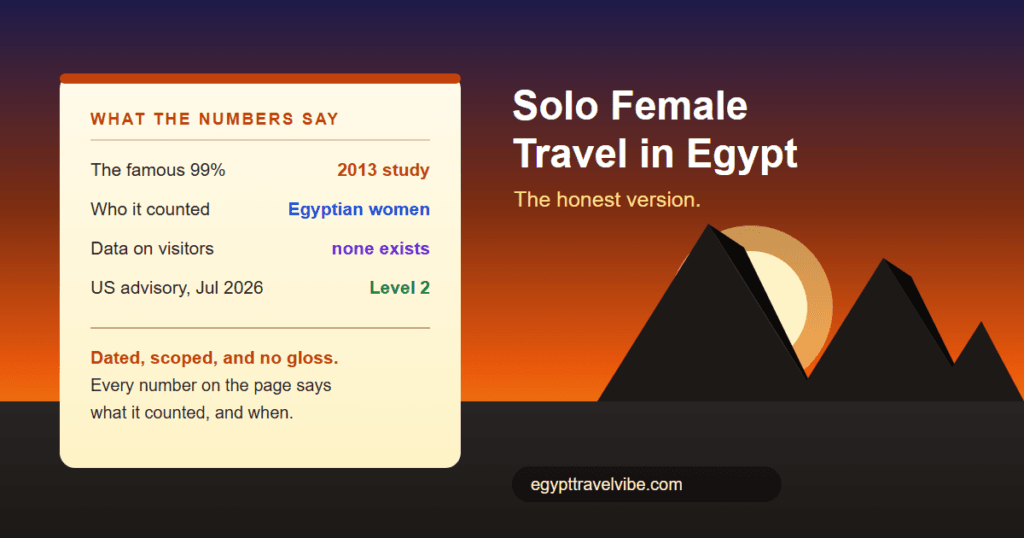
You’ve probably already met the number. Ninety-nine percent of women in Egypt have experienced sexual harassment, quoted flat, with no date and no explanation of who was counted. It comes from a real study, published by UN Women in 2013, and it measured the lifetime experience of Egyptian women living their daily lives. It was never a measurement of what visitors meet.
Disclosure: Some links in this guide may earn us a commission, at no extra cost to you. It never changes what we recommend.
Here’s my position before you read further. This isn’t a solo female travel diary, because I can’t write one honestly. What I can do is date every number on this page and say what each one actually counted. I can put named women’s published accounts beside them instead of speaking for anyone. And I can be precise about the parts of Egypt I’ve watched myself.
So this guide covers what the data supports and what Egyptian law says. It shows where women who went disagree with each other, and why. Then it gets to the practical layer that actually cuts the friction. If you want the wider risk picture first, our honest safety guide separates hassle from danger, and the first-trip planning guide covers the rest of the trip.
Key Takeaways
- The statistic everyone quotes is real, dated 2013, and measured Egyptian women’s lifetime experience. It was never about visitors, and no comparable dataset for foreign women exists.
- What visitors report is overwhelmingly commercial: constant selling, staring, and catcalling. The US advisory held at Level 2 on July 15, 2026, the same tier as France.
- Egypt made sexual harassment a crime in 2014 and raised the floor sharply in 2021. The minimum is now two years and a 100,000-200,000 EGP fine, rising to seven years where the harasser held power over the victim.
- Little of the playbook is female-specific. Fixed prices, ride-hailing, dawn starts and a booked guide remove most of the friction. The genuinely gendered part is a short list.
Table of Contents
Is Egypt Safe for Solo Female Travelers?
Safe enough for a great many women, with conditions worth stating precisely. The US State Department refreshed its Egypt advisory on July 15, 2026 and held it at Level 2, the same tier as France. Its do-not-travel guidance covers three areas only: North Sinai, the Libya border strip, and parts of the Western Desert. The UK’s advisory describes most crime against foreigners as opportunistic pickpocketing (GOV.UK, 2026).
Several guides currently ranking for this question say the advisory reads “reconsider travel.” That isn’t the current wording. Check the date on any guide that tells you otherwise, because the tier is the one thing in this niche that changes without warning.
The best crowd data comes from TravelLadies. It rates Egypt 3.8 out of 5 for travel safety, drawn from 117 women travelers’ reports. Its women’s safety index sits at 3.7, from 122 local women, against a crime index of 2 (TravelLadies, retrieved August 2026). Those are small, self-selected samples. They’re also more than anyone else in this niche is working with.
What Does the 99% Statistic Actually Measure?
Egyptian women’s lifetime experience, in 2013. That’s the whole scope of it. The figure comes from a UN Women study published that year, and it counted some form of sexual harassment across a lifetime, among women living in Egypt. Every part of that sentence matters, and almost nobody quoting the number keeps any of it.
Here’s every prevalence figure in circulation, with what it counted and when. As far as I can find, nobody else in this search result publishes this table, which is the reason it’s here.
| The figure | What it counted | Who | When |
|---|---|---|---|
| About 99% | Some form of sexual harassment, over a lifetime | Egyptian women | 2013 (UN Women) |
| 63% | Harassment, verbal or physical, in the previous 12 months | Egyptian women | 2020 (Arab Barometer, wave 5) |
| Nearly 90% | The same measure, among women aged 18 to 29 | Egyptian women | 2020 (Arab Barometer, wave 5) |
| A slight increase | Sexual violence in the private sphere | Egyptian women | 2022 (Egyptian Family Health Survey) |
| 3.8 / 3.7 out of 5 | Perceived safety, self-reported | Women travelers, local women | Retrieved 2026 (TravelLadies) |
| No figure exists | Harassment of foreign women visiting Egypt | Visitors | Never measured |
Those first four are the only comprehensive prevalence sources available across the twelve years since the original study, per a 2025 review by Egyptian Streets. Note the 63% and 90% figures are from 2020, not from last year, whatever the summaries say.
One more figure gets recycled in this niche: a 2017 poll that named Cairo the worst megacity in the world for women. It was an opinion survey of experts, it’s nine years old, and it keeps getting quoted as though it counted incidents. It didn’t.
What Will You Actually Encounter?
Three things, at very different frequencies. Constant commercial approach at monument sites and in markets. Common staring, comments and catcalling in city streets. Rare physical contact, most often in crowds. The published accounts vary a lot on the middle tier and agree closely on the first and last.
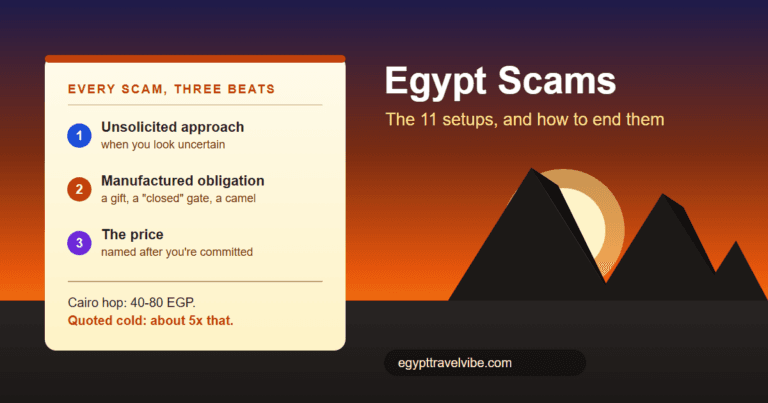
Here’s the connection I’d argue for, having watched the approach economy work at Giza and Luxor for years. Most of what women describe is commercial pressure wearing a gendered costume. The tout at the pyramid. The driver quoting four times the fare. The man who just wants to show you something. All of it runs the same three beats our scams guide documents: an unsolicited approach, a manufactured obligation, then a price revealed once you’re committed. A woman alone gets read as a softer mark, so she gets more of it. Not a different kind of it, more of it.
That reframing has a practical payoff, which is why it’s here rather than in a comment section. The tools that shut down commercial pressure also shut down most of its gendered version.
Now the disagreement, because flattening it would be dishonest. Katie Caf traveled with friends instead of alone, calls Egypt the hardest country she’s met for unwanted attention while also naming it one of her favorites, and says she wouldn’t go back on her own (Katie Caf Travel, updated 2024). Jackie Rezk is an Egyptian American who has gone solo many times and speaks the language. She reports a far easier trip, and says plainly that her Arabic is part of why. Her verdict is that Egypt is “not for the new or inexperienced solo traveller” (jou jou travels, updated January 2026).
Both are telling the truth. So which account should you weight? Neither, exactly. What separates them is experience, language, and whether anyone else is standing next to you.
What Does Egyptian Law Say If You Report It?
More than almost any travel guide mentions. Egypt criminalized sexual harassment in 2014, and in 2021 raised the penalties sharply. Law 141/2021 was ratified on August 19, 2021. It set a floor of two years in prison plus a fine of 100,000 to 200,000 EGP. That floor rises to five years if the act sought sexual benefit. It rises to seven if the harasser held power over the victim at work, at home, or in education (UN Women Egypt, 2021; Library of Congress, 2021). The same law added online harassment to the definition.
The practical layer matters more than the statute. The tourist police number published across Egypt travel resources is 126, and hotels and licensed guides escalate quickly when asked directly, because tourism complaints reach them fast. Be realistic too: enforcement is uneven, and formally reporting takes hours you may not want to give up mid-trip. Treat the law as leverage that exists rather than as protection that arrives automatically. Almost nobody writing about Egypt tells you it exists at all.
What Should You Wear, and What Is That Actually For?
The same three tiers our season-by-season packing list sets out. Required inside mosques, meaning hair covered and shoulders and knees covered. Recommended in towns and at sites, meaning shoulders to knees and loose over tight. Irrelevant at Red Sea resorts, pools and cruise decks, where ordinary swimwear is ordinary. The Egyptian culture guide explains where each tier comes from.
Now the part that needs saying in both directions. Dressing to blend in does reduce attention, and published accounts broadly agree on that. It is also not a moral obligation, and it is not a shield. Harassment isn’t caused by clothing, and covering up guarantees nothing. It’s one lever among several, and how you use it is your call, not a rule you owe anyone.
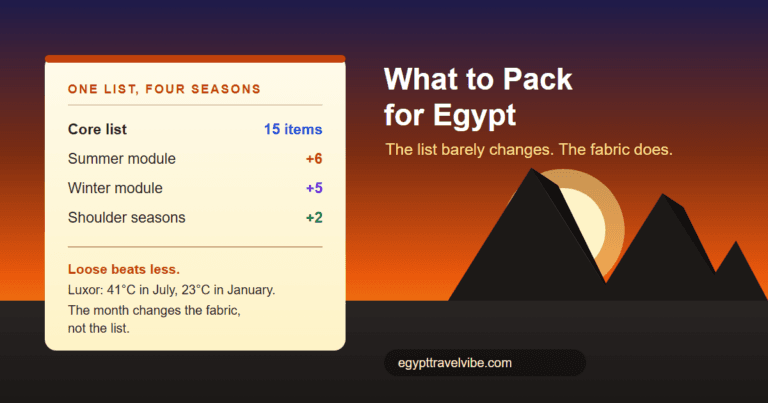
The heat argument quietly settles the practical side. Luxor averages 41°C in July against 23°C in January. At those temperatures, loose long cotton beats shorts on comfort alone. So the month you choose tends to push you toward covered clothing anyway.
Where Is Egypt Easiest, and Where Is Hardest?
The geography is real, and almost nobody maps it. Dahab and the Red Sea towns are the softest landing in the country for women arriving alone, Cairo and Giza the most intense, with Luxor and Aswan somewhere between the two and their hassle bunched tightly around the monuments instead of spread through the streets. That ranking comes from the consensus of published accounts, not from measurement, and I’d sooner label it plainly than dress it up.
Dahab earns its reputation. Dive-shop rhythms and long-stay backpacker habits set the tone there, women eat alone in cafés without anyone treating it as an event, and a fair number of visitors turn up for four days and drift out three weeks later.
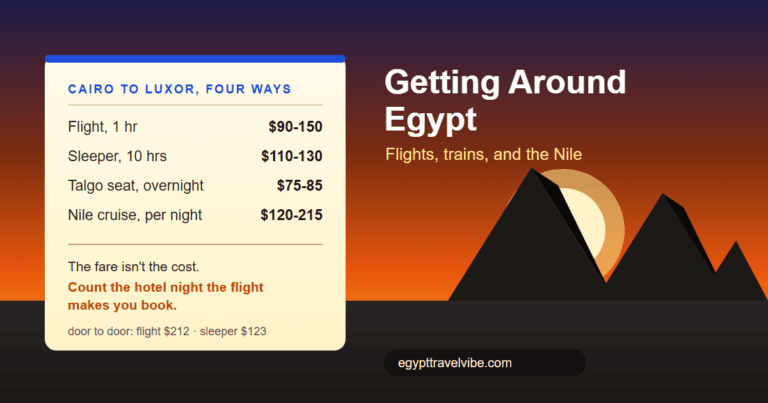
Transport does a lot of the work. Ride-hailing apps beat street taxis outright, because the fare is fixed before anyone moves and the ride is tracked. The Cairo metro runs women-only carriages. Sleeper trains between Cairo and Upper Egypt sell cabins you can book as a single, which several accounts prefer to a night bus. Our transport comparison prices all of it.
Do You Need a Tour, a Guide, or Neither?
Neither a full tour nor going it entirely alone, for the majority of visitors. Book independently, then hire licensed guides by the site. A guide at Giza absorbs the bulk of the approach pressure before it ever reaches you, which is worth more to a woman traveling by herself than to anyone else, and it costs a fraction of a packaged tour.
Women-only group trips are a real and growing third option. In a March 2026 survey by Solo Female Travelers, 21% of respondents planned a women-only trip that year. Another 16% planned a mixed group trip. Both figures rose for a third year running (Solo Female Travelers, 2026). That’s not a recommendation, it’s an option with a number attached.
Two things I tell every woman who asks me about Egypt, for what a fellow traveler’s view is worth. First, book the opening two days tightly, airport transfer and a guide for your first morning at Giza included. That’s where bad first impressions get made. Second, treat every price conversation as the whole interaction. Once the number is agreed, the pressure mostly stops. Neither of those is female-specific advice, which is more or less the point of this whole page. Egypt Travel Vibe sells no tours and takes no booking commission, so I have nothing riding on which way you go.
Frequently Asked Questions
Is Egypt safe for solo female travelers?
For many women, yes, with preparation. The US advisory held at Level 2 on July 15, 2026, the same tier as France, and TravelLadies rates Egypt 3.8 out of 5 from 117 women travelers. Expect persistent commercial hassle rather than danger, and plan for it.
How bad is the harassment in Egypt, really?
Accounts vary widely. Staring and catcalling in cities are commonly reported, physical contact rarely. The famous 99% figure is from a 2013 study of Egyptian women’s lifetime experience, not of visitors, and no dataset measuring foreign women in Egypt exists at all.
What should a woman wear in Egypt?
Shoulders to knees covered and loose in towns and at sites, hair covered only inside mosques, and normal swimwear at Red Sea resorts. It reduces attention and it’s the cooler option at 41°C, but it isn’t an obligation and it isn’t a guarantee.
Is Cairo safe for a woman alone at night?
Cairo is the most intense city in Egypt for unwanted attention, and busy areas stay busy late. Use ride-hailing rather than street taxis so the fare is fixed and the route tracked, and arrange hotel pickup after dark rather than walking unfamiliar streets.
Should I book a tour as a solo woman in Egypt?
Not necessarily. Booking independently and hiring licensed guides by the site removes most site-level pressure at a fraction of a tour’s cost. Women-only group trips are the growing alternative, planned by 21% of respondents to a March 2026 Solo Female Travelers survey.
What do I do if someone harasses me in Egypt?
Be loud and public, which draws attention fast and usually ends it. The tourist police number is 126, and hotels and licensed guides escalate quickly. Since 2021, sexual harassment carries a minimum two-year sentence and a 100,000-200,000 EGP fine.
The Bottom Line
The numbers in this niche are real and almost always misused. The 99% figure counted Egyptian women’s lifetimes in 2013. The 63% and 90% figures counted a twelve-month window in 2020. Nobody has ever measured what foreign women experience in Egypt, and any guide quoting a rate for that invented it.
What’s left is more useful anyway. Nearly all of what you’ll meet is selling pressure, and it gets heavier for a woman on her own. It also responds to fixed prices, ride-hailing apps, dawn starts and a guide for the hard mornings. The genuinely gendered layer is a short list: dress tiers, night transport, and knowing that 126 exists.
I’m not going to tell you whether to go. That’s a judgment about your own tolerance, and you’re better placed to make it than I am. What I can do is make sure the inputs are dated and honest.
Read the honest safety guide for the full risk picture. The 15 things worth knowing on a first trip covers the general playbook this sits on top of. Then use the first-trip planning guide to build the rest. I re-check the figures on this page monthly.