
Last verified: August 14, 2026. Vodafone and Orange pricing, eSIM price bands and SIM registration rules were checked against published 2026 roundups on the date above; the widely repeated fingerprint requirement is not supported. I re-check this page monthly and update the date each time.
Getting online in Egypt is cheap. Most visitors still overpay for it, and there’s a structural reason why. Search for an eSIM for Egypt, and nearly every result on the first page is published by a company that sells eSIMs.
Disclosure: Some links in this guide may earn us a commission, at no extra cost to you. It never changes what we recommend.
This guide prices both paths with the date attached, works out where the break-even actually falls, and walks through the setup for each. We don’t sell SIM cards, eSIMs, or anything else. That’s why this page can tell you the local SIM is usually the cheaper option. Every conversion uses a working rate of 50 EGP to the dollar, tracking a market rate near 50.2 in mid-August 2026 (Central Bank of Egypt, 2026). For the wider trip budget, our full Egypt cost breakdown prices everything the same way, and the first-trip planning guide covers the rest.
Key Takeaways
- A local Egyptian SIM is far cheaper. A Vodafone SIM plus a 20GB bundle runs about 335 EGP ($7), against $9.50-25.50 for a typical eSIM.
- You’re not paying for data, you’re paying for time. The eSIM premium of roughly $8-15 buys you out of the arrivals counter on landing day.
- Skip the “tourist” SIM. Vodafone’s tourist-branded pack costs around 500 EGP for 20GB, while the standard prepaid route gets you the same data for about a third less.
- You need your passport to buy a local SIM, but not a fingerprint, despite what several guides claim.
Table of Contents
Should You Get an eSIM for Egypt or a Local SIM Card?
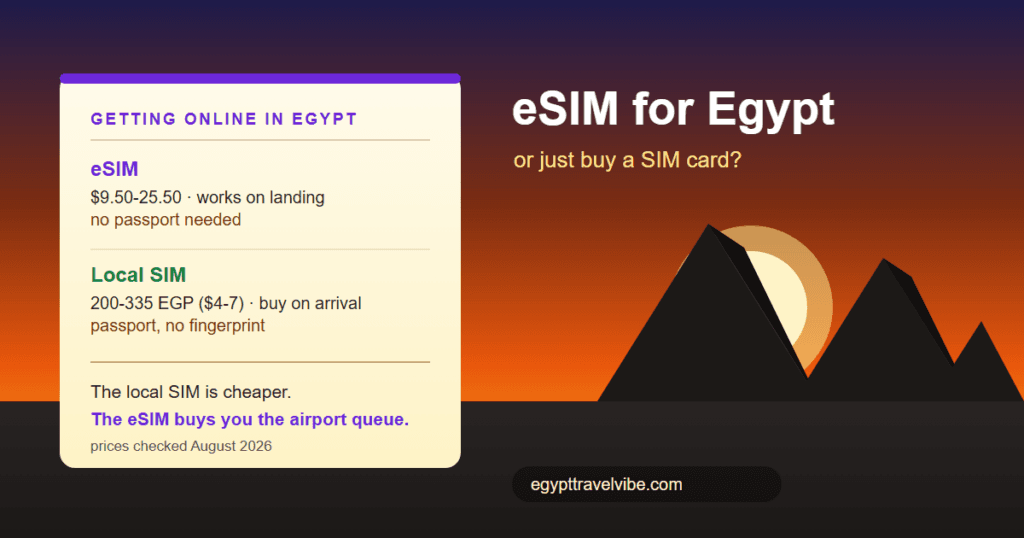
Take the eSIM if you want data working the moment you land and your trip is short. Take the local SIM if you want the cheaper option and don’t mind ten minutes at a counter. In 2026 the price gap is real: eSIM packages run $9.50-25.50, while a local SIM with a solid data bundle lands between about 200 and 335 EGP, roughly $4-7.
| eSIM for Egypt | Local SIM card | |
|---|---|---|
| Typical 2026 cost | $9.50-25.50 | 200-335 EGP ($4-7) |
| Working on landing | Yes, set up before you fly | No, buy after immigration |
| Passport needed | No | Yes, with your entry stamp |
| Best coverage | Depends on host network | Vodafone widest outside cities |
| Best for | Short trips, instant setup | Longer stays, heavy data, value |
Worth naming the reason this comparison is hard to find. The pages that rank for an eSIM for Egypt are largely published by eSIM companies. That isn’t dishonest, but it does explain why the cheaper local option tends to get a thin paragraph. We have nothing to sell here, so the summary is simple. Buy the local SIM if you’re staying a while. Buy the eSIM if arriving connected is worth about ten dollars to you.
How Much Does a SIM Card Cost in Egypt?
A Vodafone prepaid SIM costs about 85 EGP on its own, or 120-150 EGP bundled with a first package (MobileMasr, 2026). Add a data bundle at 150 EGP for 10GB or 250 EGP for 20GB, and a fortnight of comfortable data lands around 235-335 EGP, which is roughly $5-7.
Orange runs the other plan worth knowing. Orange Holidays gives about 20GB plus 120 local minutes for around 200 EGP, with a larger 47GB version near 450 EGP (Saily’s Egypt SIM roundup, 2026). That 200 EGP tier is the single best value on this page, if the coverage suits your route.
A note on where these numbers come from. Operator tariff pages are awkward to check from abroad, so the figures above come from published 2026 price roundups rather than a fetched operator quote. Confirm the current price at the counter or on Vodafone Egypt and Orange Egypt before you rely on it, since bundles change more often than guides get updated.
Here’s the trap. Vodafone also sells a “tourist” SIM at roughly 500 EGP for about 20GB, and it’s the one most visitors are steered toward at the airport. Compare it to the standard route above and you’re paying around 500 EGP for data you could have had for 335. The tourist label costs you about a third more for the same allowance. Ask for a standard prepaid SIM and a data bundle instead.
Which network? Vodafone has the widest coverage outside major cities. Orange is strong across Cairo and urban areas, and Etisalat generally trails both once you leave the big centres. For the classic Cairo-Luxor-Aswan circuit any of them works. For desert routes, take Vodafone.
How Much Does an eSIM for Egypt Cost?
Typical eSIM packages for Egypt run $9.50-25.50 depending on data volume and validity, with unlimited-data plans sitting above that band. The spread comes from plan shape rather than brand: a 5GB week and a 30-day unlimited plan are different products at different prices, sold side by side.
Per gigabyte, it isn’t close. A local bundle runs somewhere near 20 to 50 US cents per GB, while a mid-range eSIM plan works out closer to three dollars. That gap doesn’t make eSIMs a bad buy, but it does mean the case for one has nothing to do with data value.
One honest caveat on “unlimited” eSIM plans: most throttle speeds after a daily or total threshold, so read the fair-use line before assuming unlimited means unlimited.
Where’s the Break-Even Point for an eSIM for Egypt?
There isn’t one on price. The local SIM is cheaper at every trip length, and the gap widens the longer you stay. So the useful question isn’t which is cheaper, it’s what the premium buys.
Put a number on it. The eSIM premium runs roughly $8-15 over the local route on a typical two-week trip. What it buys is arrival-day time. No hunting for the counter with your luggage, no queue behind three other flights, no paperwork before you can call your hotel. If you land at 2am after a long-haul flight, that’s a defensible ten dollars.
What it doesn’t buy is better coverage, more data, or a cheaper trip.
How Do You Buy a SIM Card at Cairo Airport?
Counters sit after immigration and before you exit into arrivals, so you can’t miss them on the way through. Bring your passport with the entry stamp, since Egyptian SIM registration requires linking the line to verified ID. The whole thing usually takes a couple of minutes at the desk.
The steps, in order:
- Clear immigration and look for the Vodafone and Orange counters in the arrivals area.
- Ask for a standard prepaid SIM plus a data bundle, rather than the tourist pack.
- Hand over your passport. Staff photograph or copy it along with your entry stamp.
- Wait for activation, which happens on the spot.
- Test data before you walk away, and load a map or open a ride-hailing app to confirm.
What surprised me: several guides claim you need a fingerprint scan to register an Egyptian SIM. I didn’t, and the consistent first-hand reporting says passport and entry stamp are the whole requirement (Traveltomtom, 2026). The genuine friction is queueing, not paperwork. Arrive on a bank of three long-haul flights and a two-minute process becomes a twenty-minute wait.
Prices at the airport counter run slightly above city shops, but not enough to be worth deferring if you want data immediately. What is worth avoiding is the tourist-branded pack, for the reason in the pricing section above.
How Do You Set Up an eSIM Before You Fly?
Buy and install at home, then activate on landing. The install is the part people get wrong. An eSIM installed but not configured leaves you standing in arrivals with no signal and no way to fix it.
- Check your phone supports eSIM first. Most flagships since about 2019 do, but a few carrier-locked handsets block it.
- Buy the plan and scan the QR code, or install through the provider’s app.
- Label the line clearly, so you can tell it from your home SIM.
- Set the eSIM as your data line, and keep your home number active for calls and texts.
- Turn data roaming off on your home line. This is the step that prevents an unexpected bill.
- Toggle the eSIM on when you land.
If your phone doesn’t support eSIM, that decides the question for you, and the local SIM is a better buy anyway.
Does Coverage Hold Up Outside Cairo?
Yes across the tourist corridor, with real gaps once you leave it. Vodafone’s wider rural footprint is the reason to pick it over Orange if your route goes beyond the classic circuit.
Two practical notes from the road. On the Nile between Luxor and Aswan the signal follows the settlements, so a cruise boat drifts in and out of coverage rather than losing it entirely. And in the Western Desert, plan for no data at all rather than hoping, which means offline maps downloaded before you leave.
Do You Even Need Data in Egypt?
Yes, and the strongest reason is ride-hailing. Uber and Careem fix the fare before the car moves, and a central Cairo hop runs just 40-80 EGP. That’s the practical answer to the taxi haggling covered in our guide to Egypt’s tourist scams. Without data, you’re back to negotiating on the pavement.
Hotel and café wifi is widely available and generally fine for messaging. What it can’t do is summon a car outside your hotel, or load a map when a driver takes an unfamiliar turn. Our guide to getting around Egypt leans on apps for exactly this reason.
Connectivity is one of several things worth sorting before you fly. Our season-by-season packing list covers the rest, including the adapter for Egypt’s two-pin sockets.
Frequently Asked Questions
Is an eSIM or local SIM better in Egypt?
The local SIM is cheaper and the eSIM is faster to start. A Vodafone SIM plus 20GB costs about 335 EGP ($7) in 2026, while eSIM packages run $9.50-25.50. Choose the eSIM if landing connected matters more than saving roughly ten dollars.
How much does a SIM card cost in Egypt?
A Vodafone prepaid SIM is about 85 EGP alone, or 120-150 EGP with a first package. Data bundles run 150 EGP for 10GB and 250 EGP for 20GB. Orange Holidays offers around 20GB plus 120 minutes for about 200 EGP.
Do you need a passport to buy a SIM card in Egypt?
Yes. Egyptian rules require every SIM to be registered to verified ID, so bring your passport with the entry stamp. You do not need a fingerprint scan, despite claims in several guides, and registration usually takes a couple of minutes.
Which network has the best coverage in Egypt?
Vodafone has the widest reach outside major cities, which matters for the Nile corridor, the Abu Simbel road, and desert routes. Orange is strong across Cairo and urban areas, and Etisalat generally trails both once you leave the big centres.
Is the tourist SIM worth buying at the airport?
Usually not. Vodafone’s tourist-branded pack runs around 500 EGP for about 20GB, while a standard prepaid SIM with a 20GB bundle costs closer to 335 EGP for the same allowance. Ask for the standard option instead.
The Bottom Line
Buying an eSIM for Egypt is the right call when you want data live the second the wheels touch down. It’s worth about $10 to skip an arrivals counter. What it isn’t is the cheaper option, and no amount of vendor content changes that.
Staying more than a few days? Walk to the Vodafone or Orange desk, ask for a standard prepaid SIM and a data bundle, and hand over your passport. You’ll pay about a third of what the tourist pack costs. Either way, get connected before you leave the airport, because ride-hailing is what makes the rest of the trip simpler.
Next: our full Egypt cost breakdown prices the rest of the trip with a date on every figure, and the guide to getting around Egypt covers flights, trains and the Nile. I re-check operator pricing monthly.