
Last verified: August 22, 2026. The visa fee and advisory status were checked against GOV.UK and Travel.State.Gov, and the GEM booking rules against current ticketing coverage, on the date above. I re-check this page monthly and update the date each time.
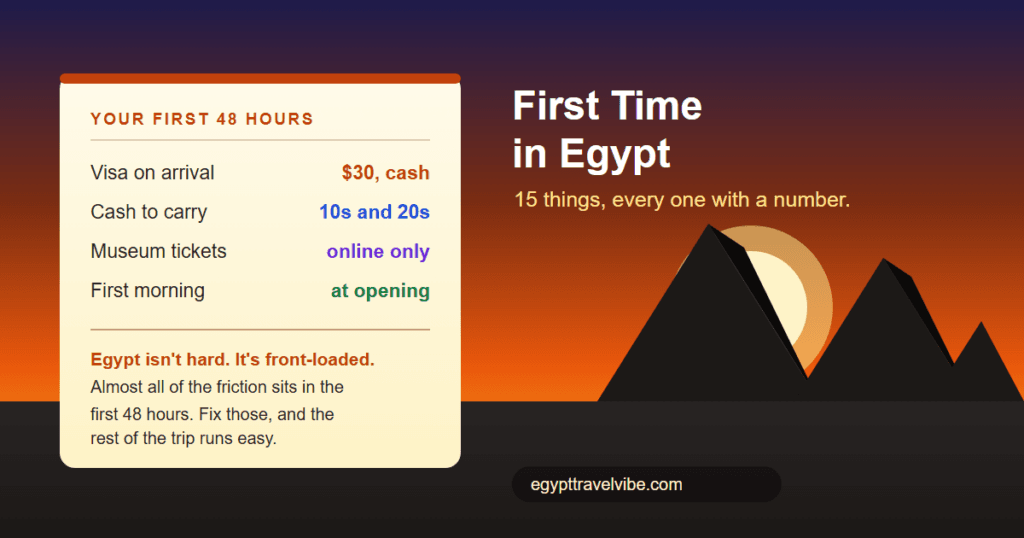
Egypt isn’t a hard country to travel. It’s a front-loaded one. Almost everything that goes wrong on a first trip goes wrong in the first 48 hours. The $30 visa you needed in cash. The airport ATM that only hands out 200-pound notes. The first morning at the Pyramids that started three hours too late. Sort those and the remaining twelve days run easy.
Disclosure: Some links in this guide may earn us a commission, at no extra cost to you. It never changes what we recommend.
Nobody says that part out loud, which is why so many “Egypt was exhausting” write-ups are really reviews of day one. In 2026 the country is heading for another record year, with 6.1 million arrivals in the first four months alone, up 7% on the same stretch of 2025 (Ahram Online, 2026). Most of those visitors had a good time. The ones who didn’t usually lost the trip in the arrivals hall.
So here are 15 things I wish someone had told me before my first time in Egypt, each carrying a real number instead of a vague warning. Every figure below comes off a guide on this site that I re-verified in August 2026, and each item links to the long version if you want the depth. Starting from zero? The first-trip planning guide is the place to begin.
Key Takeaways
- Egypt is front-loaded, not hard. Nearly all the friction sits in the first 48 hours: $30 in cash for the visa, getting small notes, and your first morning at Giza. After that it runs easy.
- The three things that actually spoil first trips are heat timing, cash denominations, and over-scheduling. Scams and safety, the two things everyone researches, come further down the list.
- Egypt is cheap to live in and expensive to see. The full Cairo, Luxor and Aswan circuit costs about 10,210 EGP ($204) per person in entry tickets alone, before a single hotel night.
- Two habits cover most of the rest: agree every price before the service starts, and be at the gate when it opens.
Your first time in Egypt, in the numbers that actually decide the trip:
| What | The number, August 2026 | Where it comes from |
|---|---|---|
| Visa on arrival | $30 USD, in cash, at the airport bank | Visa guide |
| Working exchange rate | About 50 EGP to $1 | Central Bank of Egypt |
| Entry tickets, full circuit | About 10,210 EGP ($204) per person | Cost guide |
| Grand Egyptian Museum | 1,500 EGP adult, online only, +$5 from November 1 | Ahram Online |
| Cairo ride-hail hop | 40-80 EGP ($0.80-1.60) | Scams guide |
| Ten days of tips | 1,450-3,100 EGP ($29-62) | Tipping guide |
| Local SIM plus 20GB | About 335 EGP ($7) | eSIM guide |
| Mid-range daily spend | $85-130, excluding international flights | Cost guide |
Table of Contents
What Should You Sort Before You Land?
Three things decide how your first day feels, and all three get settled at home. Visa route, connectivity, and the denomination of your cash. None of them is difficult. All of them are miserable to fix while jet-lagged in a queue at 2am.
1. The visa is $30, and it has to be cash
Visa on arrival rose from $25 to $30 on March 1, 2026, payable in US dollars at a bank window before immigration (GOV.UK, Egypt travel advice, 2026). Bring clean notes. A digital version with card payment, running about $36 all in, started piloting at Cairo Airport on August 1, 2026, but it’s a pilot, so carry the cash anyway. Our visa requirements guide covers who needs an e-visa instead, plus the copycat sites that charge triple.
2. Sort your data before the arrivals hall
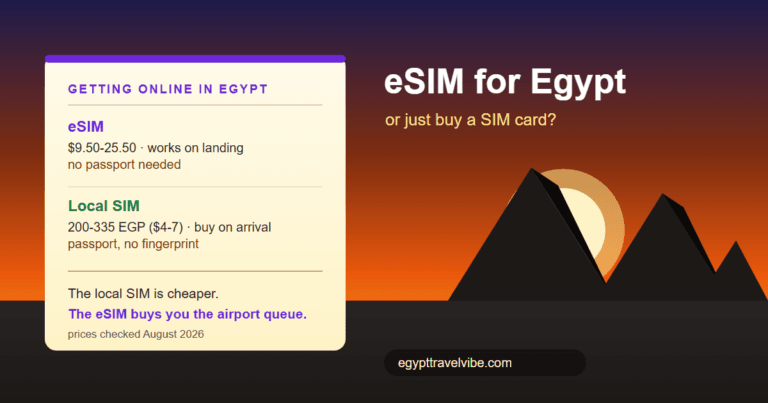
A Vodafone SIM with a 20GB bundle runs about 335 EGP ($7), against $9.50 to $25.50 for a typical travel eSIM. You’re not paying for data, you’re paying to walk straight past the counter on landing day. Both work. Our eSIM and SIM card guide prices the tradeoff properly, including why the “tourist” packs are the worst value on the shelf.
3. Small notes are the preparation nobody mentions
My own first mistake, and it cost me two days of awkwardness. Airport ATMs dispense 200s. Egypt runs its everyday courtesies on 10s and 20s, so every tip I gave was either absurdly large or quietly skipped, and skipping felt worse. Buy water at a busy supermarket on day one and ask for change. Our guide to real baksheesh amounts has the full ladder.
What Will Actually Cost You Money?
Egypt is cheap to live in and expensive to see. Food and local transport are genuinely inexpensive. Antiquities access isn’t, and it tracks the dollar rather than the pound, which is why the ticket line keeps rising while everything else feels like a bargain. So which line item catches people out? Not the hotels.
4. Entry tickets are the line item you’re under-budgeting
The full Cairo, Luxor and Aswan circuit costs roughly 10,210 EGP, about $204 per person, in entry fees alone. That’s before a single hotel night. Skip the two big optional add-ons and it drops to about 8,010 EGP ($160). Most people build a whole budget without that number, which makes it the most common money shock of a first time in Egypt. Our full cost breakdown prices every ticket and hotel tier the same way.
5. Book the Grand Egyptian Museum before anything else in Cairo
The Grand Egyptian Museum, or GEM, sells tickets online only at tickets.gem.eg. On-site ticketing closed on December 1, 2025, and entry now runs on timed slots. The museum is built for about 15,000 visitors a day and Egypt’s Cabinet reported it averaging roughly that figure (Egypt Today, 2025). Tour-operator pages also quote caps of 8,000 and 14,000, neither of which I can trace to a primary source. Either way, peak-season slots go early. Foreign adult entry is 1,500 EGP and rises by $5 on November 1, 2026. Turning up without a booking doesn’t get you a queue. It gets you a taxi back.
6. Cards at the sites, cash everywhere else
Most major antiquities sites now expect card payment, while taxis, tips, markets and small cafés stay firmly on cash. Carry both, every single day. Travelers who bring one or the other get caught out within 24 hours, usually at the least convenient gate.
7. The first price is rarely the price
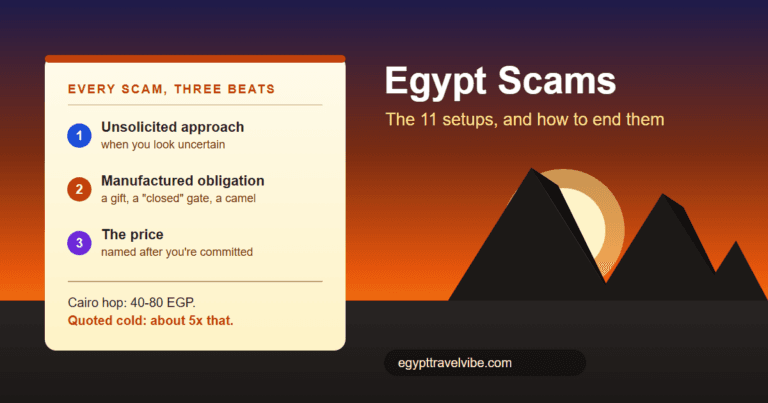
A central Cairo ride-hail hop runs 40-80 EGP ($0.80-1.60) in 2026. A cold quote to an obvious tourist routinely opens several times higher. The gap is the tell, not the insult. Agree the number before anyone moves, or use an app that fixes it for you. Our guide to how the touts actually work breaks down the 11 setups you’ll meet.
What Do First-Timers Get Wrong About the Days Themselves?
The schedule ruins more first trips than any tout does. Egypt rewards early starts and punishes ambitious afternoons, and that’s a fact about daylight rather than stamina. Luxor averages a 41°C high in July against 23°C in January, per climate normals via Weather & Climate. The heat decides your day whether you plan around it or not.
8. Be at the gate when it opens
By our own calculation from those normals, Luxor gives roughly 12 comfortable sightseeing hours a day in March against about 5 in June, July and August. Summer doesn’t cancel Egypt. It removes the afternoon. A 6am start is worth more than any ticket upgrade you can buy, in every month of the year. Our month-by-month guide shows how the window opens and closes.
9. Two sites a day, not four
Distances and traffic eat the map. Cairo alone can swallow a morning between two stops, and the temple you rushed is the one you won’t remember a year later. Build days around one anchor and one extra, then treat anything else as a bonus.
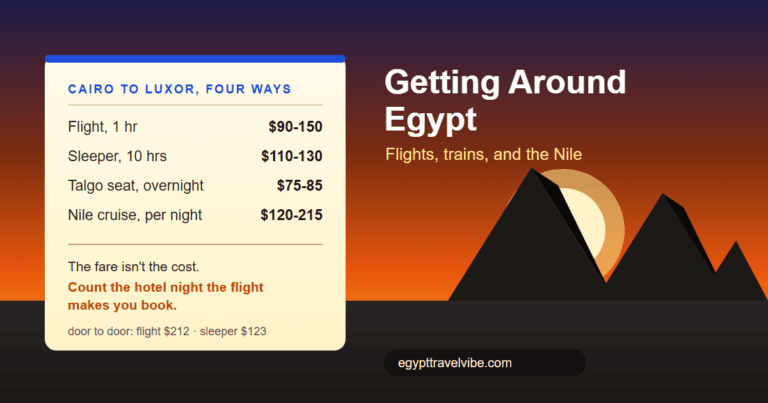
Between cities it’s worse than the map suggests. A Cairo to Luxor flight takes an hour, plus a hotel night and two airport transfers that nobody counts when they compare it to the sleeper train. Our transport comparison prices flights, trains and cruise legs against each other honestly.
10. Ten days is the trip people wish they’d booked
Seven days works only if you skip the Nile cruise and fly between cities. Ten covers Cairo, a 3 to 4 night cruise and Abu Simbel without sprinting, at $1,100-1,600 per person for a mid-range package including domestic flights. Fourteen buys the Red Sea or the Western Desert, not more temples. Our 7, 10 and 14-day comparison lays the three side by side.
11. Fridays and prayer times move the schedule
Opening hours shift around Friday prayers, including at GEM, which runs a shortened Friday window in low season. Mosques close to visitors during prayer. None of this is an obstacle if you check the day as carefully as you check the site.
What About the Things You’re Actually Nervous About?
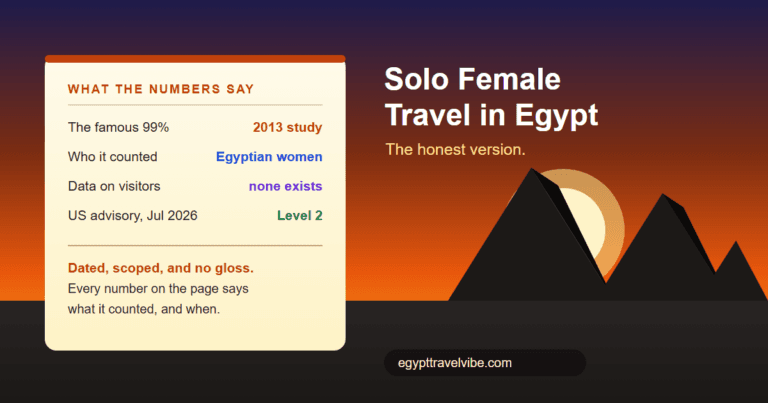
Safety and scams dominate pre-trip research and deserve maybe a third of the attention they get. The US advisory was refreshed on July 15, 2026 and held at Level 2, the same tier as France (Travel.State.Gov, 2026). The zones every advisory flags are real, and the nearest one sits 286 km from the Pyramids by our calculation.
12. The hassle is commercial, not criminal
Nearly every setup follows three beats: an unsolicited approach, a manufactured obligation, then a price revealed only after you’re committed. Once you see the pattern you can handle versions nobody has written up yet. What’s tiring at Giza is being sold to continuously, not being in danger, and my honest safety guide separates the two properly. A few words of Egyptian Arabic help as well, starting with the polite no and the other phrases that actually get used.
13. Tipping is a system, not a shakedown
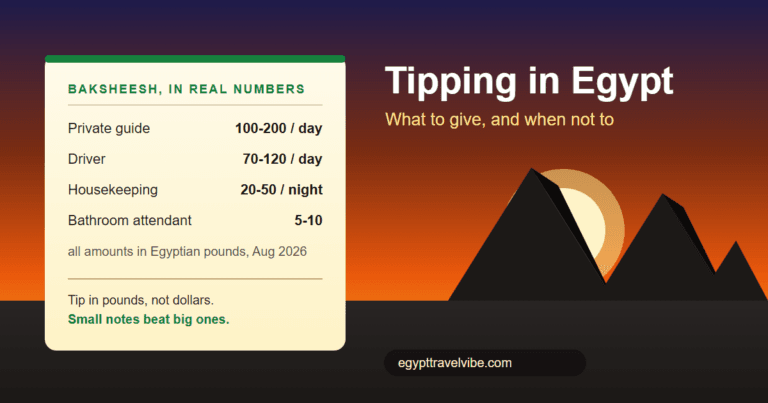
Typical 2026 amounts: 100-200 EGP a day for a private guide, 70-120 for a driver, 20-50 a night for housekeeping, 5-10 for a bathroom attendant. Across ten days that lands near 1,450-3,100 EGP ($29-62), roughly 3 to 6% of a mid-range trip’s on-the-ground spending. Knowing the numbers turns the most stressful part of a first trip into arithmetic.
14. The dress code is three tiers, not one rule
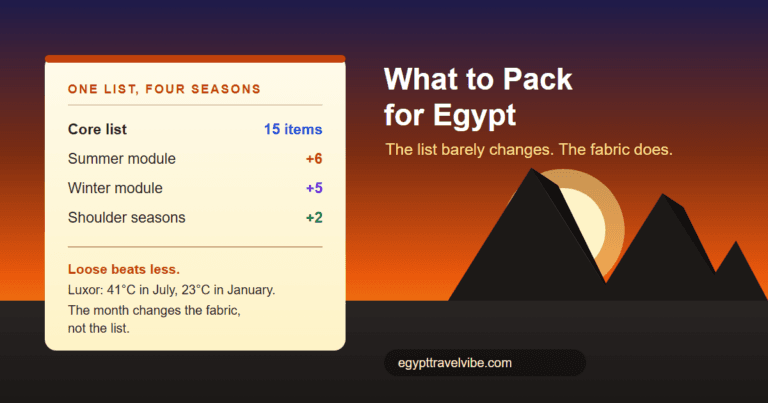
Required inside mosques, recommended in towns and at sites, and irrelevant at Red Sea resorts, where ordinary swimwear is ordinary. Loose long layers also beat shorts at 41°C, so the respectful choice and the comfortable one turn out to be the same choice. Our season-by-season packing list has the full three-tier breakdown, and the guide to Egyptian etiquette, faith and daily life in depth covers the rest.
What Nobody Tells You Until You Get Back
One pattern only shows up in hindsight, and it explains why first-trip reports contradict each other so violently. Egypt’s difficulty curve is steep and short.
15. Egypt is front-loaded
My first 48 hours went wrong in three specific ways. I landed without dollars for the visa, drew nothing but 200s, and started a Cairo day at ten in the morning in June. Days three through twelve went beautifully, and I’d have told you Egypt was hard if you’d asked me on day two. That’s the shape of it, and it’s the honest reason so many first-trip reviews contradict each other. Prepare one 48-hour window and you skip the version of Egypt that people complain about. It’s also why the reversal genre exists, the “we had this country completely wrong” videos that keep appearing. Those are people describing the far side of the same curve.
Worth saying plainly, since Marco Delgado writes every guide here: Egypt Travel Vibe sells no tours, no tickets and no cruises, and takes no booking commission on this page. That’s why this list can tell you to hire a guide for a morning at the Valley of the Kings and skip one everywhere else.
Frequently Asked Questions
What should I know before going to Egypt for the first time?
Three things, all settled before you land. Carry $30 in US cash for the visa on arrival, and get small Egyptian notes on day one, because ATMs dispense 200s. Book the Grand Egyptian Museum online in advance too. On-site ticketing closed in December 2025, entry runs on timed slots, and peak-season slots sell out.
What is the biggest mistake first-time visitors make in Egypt?
Starting the day late. By our calculation from published climate normals, Luxor offers about 12 comfortable sightseeing hours a day in March and roughly 5 in July. A late start in summer costs you the site itself, not just comfort, because the usable window closes before lunch.
How much cash should I carry in Egypt?
Enough small notes to cover tipping, which runs 1,450-3,100 EGP ($29-62) across a ten-day trip, plus cash for taxis and markets. Most major antiquities sites now expect card payment, so carry both. The denomination matters more than the total: 10s and 20s, not 200s.
Is Egypt difficult to travel independently for the first time?
No, and it’s cheaper than a package. The real tradeoff isn’t safety, it’s hassle tolerance and how much of your holiday you want to spend arranging things. The US advisory sat at Level 2 as of July 15, 2026, the same tier as France, with mainstream tourist corridors operating normally.
Do you need a guided tour for your first trip to Egypt?
Not for the whole trip. Book independently, then hire licensed guides by the site: a morning in the Valley of the Kings, a half-day at Karnak. You get the expertise where it changes the experience, without paying for fixed schedules and shopping stops the rest of the time.
Can you drink the tap water in Egypt?
Stick to bottled or filtered water, and use it for ice and for brushing your teeth too. With Luxor summer highs around 41°C you’ll get through far more than you expect, so carry a bottle from the first morning. Most first-trip stomach trouble traces back to water, or to food left sitting warm.
The Bottom Line
A first time in Egypt goes well or badly for reasons that are almost entirely preparable. Bring $30 in cash and a stack of small notes. Book GEM before you book dinner. Be at the gate when it opens, take two sites a day rather than four, and treat the first price as an opening position.
Do that and the country stops testing you somewhere around hour 50, which is when most people fall for it completely.
Build the plan with the first-trip planning guide, price it honestly with the full cost breakdown, and pick your month with the month-by-month guide. I re-check the figures on this page monthly.