
Last verified: October 16, 2026. Ticket prices were read from the official checkout that evening, and opening hours from official temple pages where they exist. Egypt changes both often, so I re-check this page monthly.
By the third temple on a Nile cruise, most people stop looking up. The columns blur, the guide talks fast, and every wall seems to show the same man handing the same god the same thing. The fix isn’t more history. It’s knowing how to read an Egyptian temple, because almost every one is built on the same floor plan.
Disclosure: Some links in this guide may earn us a commission, at no extra cost to you. It never changes what we recommend.
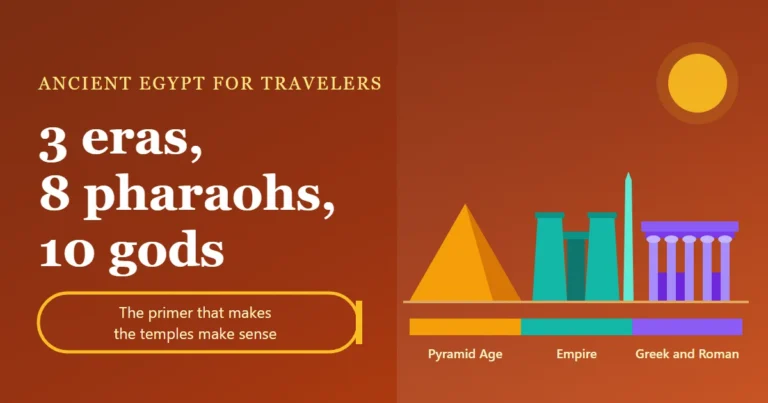
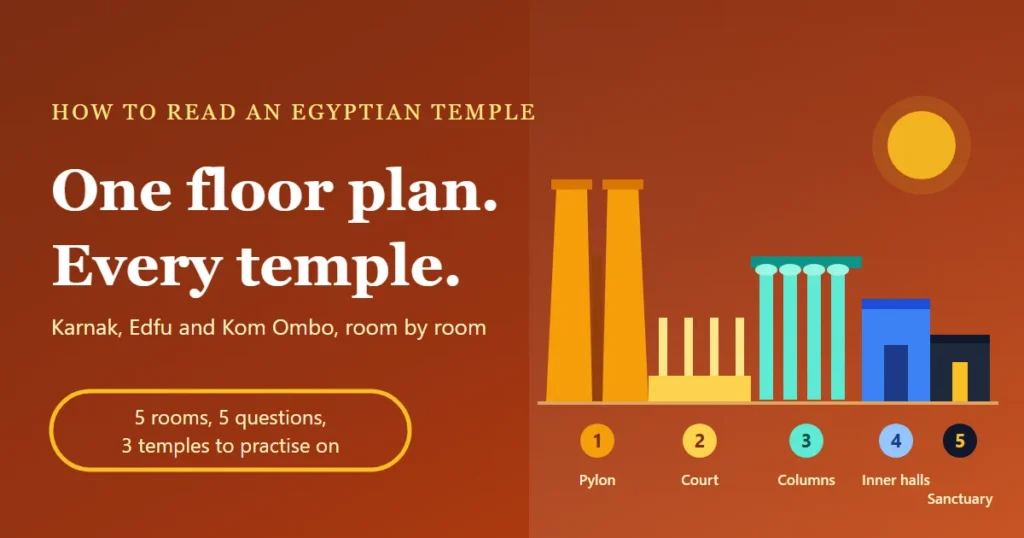
Five rooms, five questions, and three temples to practise on. Learn the plan once and Karnak, Edfu and Kom Ombo stop being a blur. If you want the eras and the gods first, read the primer that sorts out the eras and gods. For the living country around the ruins, see my guide to Egyptian culture.
Key Takeaways
- Almost every temple is the same five rooms: a gateway, an open court, a hall of columns, smaller inner halls and a dark sanctuary where the god’s statue lived.
- Learn the plan at Edfu. It was built to one design between 237 and 57 BCE (Egypt’s Ministry of Tourism and Antiquities), so every room is where it should be.
- Karnak is the exam. About 30 kings added to it over some 1,900 years, so read it as a stack of temples.
- Kom Ombo is the plan built twice, side by side, for two gods.
- The eight temples in my ledger cost 200 to 600 EGP each for a foreign adult on my October 16, 2026 reading.
Table of Contents
What Is an Egyptian Temple Actually For?
An Egyptian temple was a house for a god, not a hall for worshippers. The god lived in a statue in the back room. Priests woke it, dressed it and fed it every morning, and most ordinary Egyptians rarely got past the gateway, except perhaps into the court on festival days. You’re walking into a home, uninvited, more than 1,500 years after the owner moved out.
The morning routine explains a lot of what’s on the walls. Each morning the high priest, standing in for the king, opened the shrine and greeted the statue with bows and hymns. He dressed it in fine cloth and jewellery, offered it food and put it back, sweeping away his footprints on the way out. The leftover food went to the priests as part of their pay (Egypt Exploration Society). The kitchens, storerooms and offering tables you walk past were part of a working household.
The king was the official host. In theory he did every ritual himself, which is why he’s on nearly every wall. In practice, priests stood in for him. His real job was keeping ma’at, the order of the world, and the temple was where that work happened (Egypt Exploration Society).
One distinction saves confusion in Luxor. Cult temples like Karnak and Luxor Temple housed gods, on the east bank. Mortuary temples like Medinet Habu and Hatshepsut’s kept a dead king’s cult going, on the west bank near the tombs. The primer explains why the tombs are on the west bank, and my Valley of the Kings guide covers the tombs themselves. Medinet Habu uses the same five rooms. Hatshepsut’s terraced temple stretches the plan up a cliff, but you still walk inward toward a sanctuary cut into the rock.
What Are the Five Parts of an Egyptian Temple?
The five parts are the pylon, the open court, the hypostyle hall, the inner halls and the sanctuary. They sit on one straight line, the axis, and each is smaller and darker than the one before, with a higher floor and a lower ceiling. The University of California’s Digital Karnak project lists the same core plan: gateway, open court, columned hall and a rear sanctuary with side rooms around a central shrine (UCSC Digital Karnak).
| Room | What it was for | Who got in | What’s on the walls | Where to stand |
|---|---|---|---|---|
| 1. Pylon | The gateway, with slots for tall flagpoles | Everyone saw it | The king striking his enemies | Far enough back to see both towers |
| 2. Open court | Festivals and big gatherings | Perhaps as far as most people got, on festival days | Processions and offerings | In the centre, looking back at the pylon |
| 3. Hypostyle hall | A roofed forest of stone plant columns | Priests and the king | Rituals, with plants at the bottom and stars on the ceiling | Between two columns, looking up |
| 4. Inner halls | Offering tables, storerooms, the god’s boat | Priests only | Offerings and the god’s barque | At the doorway, comparing the light |
| 5. Sanctuary | The god’s shrine, holding the statue | The high priest or the king | The king face to face with the god | On the axis, looking back out |
Egyptologists read the plan as a model of creation. Egyptians believed the world began as a mound of earth rising out of dark water. So each doorway steps you up a little, and the ceiling closes in over your head. The papyrus columns may evoke the marshes around that first land, the ceilings carry stars, and the sanctuary recreates the mound itself, with the god standing on it (Egypt Exploration Society).
Some readings are less certain than guides make them sound. The pylon’s two towers look like the hieroglyph for horizon, with the sun rising between them, and the Egypt Exploration Society says it probably symbolises the horizon. Probably, not certainly. I’d hold it that loosely.
The axis could even be aimed at the sun. At Abu Simbel, Ramesses II’s temple was cut so the rising sun reaches the sanctuary twice a year, around February 22 and October 22, and the date can shift by a day. On October 22, 2025, the light lit three of the four statues, including Ramesses, for 22 minutes, from 06:54 to 07:16. Ptah stayed in shadow (Egypt Independent). My guide covers how to get to Abu Simbel.
The outer bits matter too. A high mud-brick wall enclosed the whole estate. Inside it you’ll often find a sacred lake where priests purified themselves, a small birth house called a mammisi for the god’s child, and a nilometer for measuring the flood. Some big temples, like Karnak and Luxor Temple, were joined by avenues of sphinxes. Once you know the five rooms, these are easy to place.
Reading the Walls: Giver, Gift and God
Most temple scenes show one transaction. The king gives a god something, and the god gives the king life, power and a long reign back. Find the giver, the gift and the god, and you’ve read the wall. The king is usually the one facing inward with an offering: bread, wine, incense, or a tiny figure of the goddess Maat, which stands for order itself.
Walls read in strips, called registers, like a comic book stacked upward. Plants run along the bottom, the king’s rituals fill the middle, and stars cover the ceiling (Egypt Exploration Society). If a hieroglyph faces left, read from the left. My primer shows how to find the cartouche that names the king, and which of the ten common gods is which.
Then look at how the carving was cut. Raised relief stands out from the wall. It’s subtle and slow to carve, so it’s usually found indoors. Sunk relief is cut into the wall, which throws hard shadows in bright sun and is quicker, so it’s common outdoors.
Karnak’s Great Hypostyle Hall shows both, and a story. Ramesses II began carving its south wing in the same fine raised relief as his father, Seti I, then switched to sunk relief and recut earlier work to match (University of Memphis Hypostyle Hall Project). Look for the ghost outlines where a raised figure was cut back.
One more tell: Ptolemaic walls are crowded. The Greek-era temples at Edfu and Kom Ombo pack in more text, some of it in deliberately puzzling spellings (Wikipedia, citing Finnestad).
These are the five questions I’d ask in any temple:
- Whose house is this? Look toward the sanctuary end. The god who appears most often there owns the temple.
- Which way does the axis run? Stand in a doorway and look straight through. Everything lines up on it.
- Which room am I in? Count the gateways you’ve passed and check the light.
- Who paid for this wall? Find the cartouche nearest the scene. That king is taking the credit.
- Who damaged it, and why? Most scratched faces and smoke stains came much later. More on that below.
Why Start With Edfu, Even If You See It Last?
Because Edfu is the temple that matches the textbook. Ptolemy III began it in 237 BCE and it was finished in 57 BCE under Ptolemy XII, 180 years later (Egypt’s Ministry of Tourism and Antiquities). It took a long time, but it was built as one design from start to finish, so every room is where the plan says it should be.
Walk it in order. Two granite falcons of Horus, the temple’s god, guard the pylon. On the towers Ptolemy XII strikes his enemies and worships the gods. Next comes a court lined with columns topped by stone flowers. Then two hypostyle halls, the first showing the temple’s founding, the second showing Horus travelling by boat with the goddess Hathor. Beyond them is a crosswise hall, then the sanctuary.
That boat matters. Every year Hathor’s statue sailed upriver from her temple at Dendera to visit Horus at Edfu, and the meeting was a major festival (Wikipedia, citing Stadler). Gods travelled in a portable boat-shaped shrine called a barque, carried on priests’ shoulders. At festivals, people could even put questions to it: if the barque rocked forward the answer was yes (Egypt Exploration Society). When you see a boat carved on a wall deep inside a temple, it’s a festival.
Don’t skip the corridor between the temple and its outer wall. Its long reliefs tell the fight between Horus and his uncle Seth, one of the myths at the heart of Edfu. Edfu also survived because it was buried under a later town. The archaeologist Auguste Mariette started clearing it in 1860 (same ministry page).
Practical notes. Entry is 550 EGP for a foreign adult. The ministry lists opening at 07:00 most days and 06:00 on two days a week, closing at 17:00. Cruise boats arrive at the same time, so expect a crowd. I’ve done Edfu in a group of forty and in a group of fifteen, and the fifteen was a different temple. A guide earns the fee here as much as at Karnak.
If your boat reaches Karnak first, read this section the night before and use Luxor Temple as your practice run. My Nile cruise guide shows which temples sit inside a cruise fare.
Why Does Kom Ombo Have Two of Everything?
Because it’s two temples sharing one building. Sobek, the crocodile god, owns the south half. Haroeris, an elder form of Horus, owns the north half. Two gateways lead into two parallel axes through the halls (Egypt’s Ministry of Tourism and Antiquities). At the back, the two sanctuaries sit side by side, with a scene of both gods carved on the wall between them.
Once you know the five rooms, Kom Ombo is a quick read. It’s the plan you learned at Edfu, doubled. Notice how the doorways come in pairs, how the two processional routes never cross, and how each god keeps his own family.
The ministry dates the present temple to the Greek and Roman period. The earliest king named in it is Ptolemy VI, who ruled 180 to 145 BCE, and most of the decoration was finished under Ptolemy XII. A wall calendar lists the temple’s festival dates.
The famous “surgical instruments” relief is a Roman scene from the 2nd century CE. The ministry’s own wording is that it is believed to show surgical tools. Guides often present it as proof of a hospital. Enjoy it, but hold that loosely.
Next door, the Crocodile Museum, opened in February 2012, shows 22 mummified crocodiles (Ahram Online). They make Sobek very real.
Entry is 450 EGP, and the ministry lists Kom Ombo as open from 07:00 to 21:00 every day. That makes it one of two temples on the route you can walk after dark on a normal ticket. Many cruise boats stop there in the late afternoon. If you’re travelling by road, my Aswan guide covers the stops between Aswan and Edfu.
How Do You Read Karnak Without Getting Lost?
Treat Karnak as a stack of temples, not one. Building began under Senusret I, who reigned from 1971 to 1926 BCE. It carried on into the Ptolemaic period, and about 30 kings added to it (Wikipedia, Karnak). Each new king tended to add a new gateway in front of the last one. So along the main axis, from the river to the old Middle Kingdom court, the nearer you are to the river, the younger the stone.
Read it in that order. The first pylon, by the entrance, was the last big addition on the main axis. It was built under Nectanebo I of the 30th Dynasty, in the 300s BCE. Walk inward and you walk backward in time, until you reach that central court. Behind it, Thutmose III’s Festival Hall is younger again. That reverses everything Edfu taught you, which is exactly why Edfu is the better place to learn.
The heart of it is the Great Hypostyle Hall. It holds 134 sandstone columns shaped like papyrus stalks. The 12 in the central aisle are over 20 metres tall with open flower tops. The other 122 are shorter with closed buds (University of Memphis). The taller middle columns lifted the roof so that stone window grilles could let light in along the centre. Stand in the side aisles and look toward that strip of light.
Beyond the hall, look for Hatshepsut’s standing obelisk, then Thutmose III’s Festival Hall at the back. Its columns still carry painted Christian saints from the centuries when it was used as a church (Wikipedia, Karnak). Most visitors only see the great precinct of Amun. The temple of Mut, to the south, has its own 200 EGP ticket (Egypt’s Ministry of Tourism and Antiquities), and the Montu precinct to the north is closed.
Then follow the axis south. Every year Amun’s statue left Karnak in procession for Luxor Temple, nearly 3 km away, in the Opet festival. That’s why Luxor Temple faces Karnak instead of the river (Egypt’s Ministry of Tourism and Antiquities). The 2.7 km avenue of sphinxes between them reopened to visitors on November 25, 2021 (NBC News).
Luxor Temple is the evening read. Amenhotep III built its core around 1390 to 1352 BCE, Ramesses II added the front court, the pylon and two obelisks, and Romans later turned an inner room into a shrine for their emperors. A mosque still sits on top of its court. It’s open 06:00 to 20:00, so you can walk it after the tour buses leave.
Karnak costs 600 EGP and Luxor Temple 500. Give Karnak two hours at opening, not the forty minutes many tours allow. My Luxor travel guide shows how to split Luxor’s two banks across your days.
Scratched Faces, Soot and Graffiti: Who Did It
Most of the damage came after the temples closed. As Christianity spread, carvings of the old gods were defaced, and temples were turned into churches. Philae’s hypostyle hall and Dendera’s birth house both became churches (Wikipedia, citing Dijkstra). Scratching out a face, hands or feet was meant to take the power out of an image. Some erasures are ancient, though: at Karnak, figures of Hatshepsut were cut out after her death.
Philae held out longest. The last known hieroglyphic inscription there dates to AD 394, and the last in the later Demotic script to AD 452 (same source). After that, the temples became homes, stables and quarries. The black ceilings you see in some halls are mostly soot from later cooking fires. At Esna, restorers cleaned that soot away and found the original colours underneath, as the primer describes.
Then came collectors, treasure hunters and 19th-century travellers who carved their names into the stone. You’ll spot some, with dates, high on the columns.
So when you find a scratched face, you’re looking at question five on the list: a later chapter of the same building. The Christian Egypt that came after the temples is a story of its own, and Karnak’s painted saints are a good place to meet it.
The Temple Ledger: Time, Money and Hours
My ledger covers the temples on the river route. Prices are the foreign adult rates I read from the official checkout on October 16, 2026. Hours come from the ministry’s temple pages where it publishes them; Medinet Habu and Philae come from travel guides. The time column is my recommendation, not an official figure.
| Temple | Foreign adult (EGP) | Hours | Time I’d give it | Best time |
|---|---|---|---|---|
| Karnak | 600 | 06:00 to 17:00 | 2 hours | At opening |
| Luxor Temple | 500 | 06:00 to 20:00 | 1 hour | After dark |
| Medinet Habu | 220 | 06:00 (widely reported) | 1 hour | Early morning |
| Dendera | 300 | Not on ministry page | 2 hours | Day trip from Luxor |
| Esna | 200 | Not on ministry page | 45 minutes | Any time |
| Edfu | 550 | 07:00 to 17:00 (06:00 on two days) | 1.5 hours | First in, or late afternoon |
| Kom Ombo | 450 | 07:00 to 21:00 | 1 hour | After dark |
| Philae | 550, plus the boat | 07:00 to 16:00 (reported) | 1.5 hours | Morning |
All eight cost 3,370 EGP together, about $64 at the Central Bank’s mid-October rate of about 53 EGP to the dollar. A typical four-night cruise can cover up to six of these eight, worth 2,850 EGP, and usually skips Dendera and Medinet Habu. The Valley of the Kings and Hatshepsut come on top. Every price matched my October 15 reading.
Two temples stand out on that chart. Luxor Temple and Kom Ombo are the only two you can walk after dark on a standard day ticket, and both are better for it. Lit from below, the carvings throw hard shadows much as they do in full sun. If your itinerary allows one change, make it an evening at one of them. My Egypt itinerary shows where the free evenings fall.
Do You Need a Guide to Read a Temple?
No, but it depends on the wall. The five rooms and five questions tell you where you are in any temple on the river. What they can’t give you is the myth behind each scene or a reading of the inscriptions, and that is what a licensed guide adds. At Edfu, where the corridor reliefs tell a whole story, that matters most.
On a cruise the guide usually comes with the fare, so the question to ask before booking is group size, not whether there’s a guide. For the evening temples, Luxor Temple and Kom Ombo, I’d go back alone with this page and take my time.
How to Read an Egyptian Temple: FAQs
What are the parts of an Egyptian temple?
Five, in a straight line: the pylon or gateway, an open court, a hypostyle hall full of columns, smaller inner halls, and the sanctuary where the god’s statue lived. Each room is smaller and darker, with a higher floor and a lower roof. Around them sit an outer wall, often a sacred lake, and sometimes a birth house.
What is a hypostyle hall?
A roofed hall packed with columns, usually carved as papyrus or lotus plants. It stands for the marsh where the Egyptians believed the world began. Karnak’s Great Hypostyle Hall is the most famous: 134 sandstone columns, the central 12 over 20 metres tall (University of Memphis Hypostyle Hall Project).
Why are the faces scratched out on Egyptian temples?
Mostly later reuse. As Christianity spread, images of the old gods were defaced and temples became churches, including Philae’s hypostyle hall and Dendera’s birth house. Later fires blackened ceilings with soot, and 19th-century travellers carved their names. The damage is a later chapter, not part of the original design.
Why does Kom Ombo have two sanctuaries?
It is a double temple for two gods. Sobek, the crocodile god, has the south half and Haroeris, an elder form of Horus, the north half. Each has its own gateway, its own axis through the halls and its own sanctuary. Most of it was built under the Ptolemies, from about 180 BCE.
Is Edfu or Karnak better if I only have time for one?
Edfu for understanding, Karnak for scale. Edfu was built to one plan between 237 and 57 BCE, so every room is in order and the roof survives. Karnak grew for about 1,900 years and is far bigger but harder to read. If you’re seeing both, learn the plan at Edfu first, or read the Edfu section before Karnak.
How long do I need at Karnak?
Two hours, arriving at the 06:00 opening. Many tours allow forty minutes, which covers the Great Hypostyle Hall and little else. Entry was 600 EGP for a foreign adult on October 16, 2026. Save Luxor Temple, 500 EGP and open until 20:00, for the evening.
The Bottom Line
Learning how to read an Egyptian temple takes one plan, not a history degree. Five rooms, one axis, and walls that mostly show a king trading gifts with a god.
- Pylon, court, hall of columns, inner halls, sanctuary. Almost every temple on the river uses them.
- Learn it at Edfu, where the plan survives whole, then use it on Kom Ombo’s double version.
- Read Karnak mostly backward. On the main axis, the gateways get older as you walk in from the river, with a few exceptions.
- Go back after dark to Luxor Temple or Kom Ombo, when floodlights make the carving stand out.
Next, read the primer on ancient Egypt for travelers for the eras and gods, my Nile cruise guide to pick a boat, and the Luxor travel guide to plan the days around Karnak.
I’m Marco Delgado, and I write every guide on Egypt Travel Vibe. I read every ticket price on this page myself on the evening of October 16, 2026, from the official checkout, and the opening hours from the ministry’s own temple pages for Karnak, Luxor Temple, Edfu and Kom Ombo. Medinet Habu and Philae hours come from travel guides. Where scholars hedge, like the pylon as a horizon or Kom Ombo’s “surgical” scene, I’ve said so. I re-check this page monthly.