
Last verified: October 23, 2026. English scores come from the 2025 EF English Proficiency Index, and prices from the Cairo Metro’s March 2026 fares, a dated menu and an official ticket checkout. I re-check this page monthly.
In a Cairo hotel, English gets you everything. In Aswan, the felucca captain, the koshary counter and the microbus driver often won’t have much of it. That gap is the best reason to learn a few Egyptian Arabic phrases, and it’s the spoken Egyptian kind you want, not textbook Arabic.
Disclosure: Some links in this guide may earn us a commission, at no extra cost to you. It never changes what we recommend.
Below are 40 phrases grouped by the moment you’ll need them, the one rule for talking to a woman, the ten digits on every price board, and five phrases you only need to recognize. For the manners behind the words, see my guide to Egyptian culture.
Key Takeaways
- English thins out as you go south. EF’s 2025 index scores Cairo at 478 and Aswan at 413, against Egypt’s 458.
- Learn the spoken Egyptian forms: “fein” for where, “bikam” for how much, “la’, shukran” for no thanks.
- Learn the ten Arabic digits. Local menu boards and microbuses often print them alone.
- Change the ending for a woman: izzayak to a man, izzayik to a woman.
Table of Contents
Do You Need Arabic in Egypt at All?
Not to get through a guided tour. But Egypt scored 458 in the 2025 EF English Proficiency Index, 89th of 123 countries and below the global average of 488 (EF EPI Egypt fact sheet, November 2025).
The national number hides the route. EF scores the city of Cairo at 478 and Alexandria at 480. Hurghada drops to 449, Luxor to 419 and Aswan to 413. So English carries you through the capital and thins out exactly where the temples are.
That matches what you’ll meet. Hotels, ticket gates, the big museums and licensed guides nearly always work in English. Taxis, local food counters, markets in the south and microbuses often don’t. A few dozen Egyptian Arabic phrases won’t let you hold a conversation. They buy goodwill, though, and goodwill shortens a haggle. My culture guide has the skill-by-skill scores if you want the detail.
Why Learn Egyptian Arabic, Not Textbook Arabic?
Egyptian Arabic, which Egyptians call Masri, is the everyday spoken Arabic of Egypt. Egyptians write Modern Standard Arabic and speak Egyptian Arabic, which the UK government’s naming authority calls “quite distinct from any other Arabic dialect” (UK Egypt Toponymic Factfile, 2026). Thanks to Egyptian film and television, it’s also widely understood across the Arab world. A textbook “ayna?” for where will be understood. “Fein?” is what you’ll hear back.
Two sounds give Cairo away. The letter ج is a hard “g”, as in get, which is why the city is Giza and not Jiza. The letter ق is often said as a catch in the throat, the factfile notes, so qahwa, coffee, becomes ‘ahwa. In Upper Egypt, ق often comes back as a “g” (Lisaan Masry dictionary), so you may hear gahwa in Luxor.
I checked five popular English-language Egyptian phrase lists against ten everyday words on October 23, 2026. Only one leaned on textbook forms, giving “ayna”, “kam” and “shukran jaziilan”. Another slipped in a Levantine “shukran kteer”. The bigger problem was gaps. Just over half of the 50 answers were missing, and not one list taught mafeesh, “there isn’t”, which you’ll hear at every counter that has run out of something.
A note on spelling. Arabic has sounds English lacks, so I use one simple scheme: an apostrophe marks either the throat catch or the deeper ‘ayn sound, “kh” is the Scottish “loch”, and “gh” is a gargled r. Every phrase below also has the Arabic script, so you can show your screen when your accent fails. Where a phrase changes for a woman, I give both forms: to a man first, to a woman second.
Which Greetings and Courtesies Should You Learn First?
Of all the Egyptian Arabic phrases here, salamu ‘alaykum, shukran and la’, shukran do the most work. The first opens almost any exchange, the second closes it, and the third gets you past every tout without a scene.
| Say it | Arabic | Means | Use it when |
|---|---|---|---|
| Salamu ‘alaykum | السلام عليكم | Peace be upon you | Hello to anyone; the reply is wa ‘alaykum es-salam |
| Ahlan | أهلاً | Hi | Casual hello; the reply is ahlan bik / biki |
| Sabah el-kheir | صباح الخير | Good morning | Until midday; the reply is sabah en-nur. Evening is masa’ el-kheir |
| Izzayak? / Izzayik? | إزيك؟ | How are you? | After hello, before business |
| Kwayyis / kwayyisa, el-hamdulillah | كويس / كويسة، الحمد لله | Fine, thank God | The answer to izzayak; kwayyisa if you’re a woman |
| Tasharrafna | تشرفنا | Nice to meet you | Meeting a guide, a host, a driver |
| Ma’a s-salama | مع السلامة | Goodbye | Leaving anywhere |
| Shukran | شكراً | Thank you | All day; shukran awi is thanks a lot |
| La’, shukran | لأ، شكراً | No, thank you | Declining anything offered |
| Min fadlak / min fadlik | من فضلك | Please | Asking for something |
| Law samaht / law samahti | لو سمحت / لو سمحتي | Excuse me | Getting a waiter’s or stranger’s attention |
| ‘Afwan | عفواً | You’re welcome | The reply to shukran |
| Ana asif / asfa | أنا آسف / آسفة | I’m sorry | Bumping into someone; asfa if you’re a woman |
| Mumkin…? | ممكن؟ | Can I…? | Mumkin asawwar? means may I take a photo? |
The ending rule is simple. Speaking to a man, use the first form: izzayak, min fadlak. Speaking to a woman, use the second: izzayik, min fadlik. When you describe yourself, the form follows you, the speaker: a woman says kwayyisa, asfa, fahma and ta’bana. Get it wrong and people will smile and understand you anyway.
“La’, shukran” has a technique as well as words: a hand on your heart, no explanation and no slowing down. My scams guide covers how to say no and keep walking.
What Do You Say When You Don’t Understand?
“Mish fahem” (or “mish fahma” if you’re a woman) and a smile, then ask whether they speak English. Many Egyptians switch to English the moment you stumble. That’s kindness. Your Arabic still did its job.
| Say it | Arabic | Means | Use it when |
|---|---|---|---|
| Aywa | أيوه | Yes | Agreeing; no is la’ |
| Mish fahem / mish fahma | مش فاهم / فاهمة | I don’t understand | Fahma if you’re a woman |
| Bititkallim / bititkallimi inglizi? | بتتكلم / بتتكلمي إنجليزي؟ | Do you speak English? | Before a longer question |
| Ya’ni eh? | يعني إيه؟ | What does that mean? | When you catch a word but not its sense |
“Ya’ni” on its own is the filler you’ll hear in every sentence, the Egyptian “like” or “I mean”. Saying “ya’ni eh?” back is a good way to learn a new word a day.
How Do You Ask Prices and Pay?
Start with “bikam?”, how much. It gets the first price, “akher kalam?” gets the real one, and “mafeesh fakka” protects the small notes you need for tips.
| Say it | Arabic | Means | Use it when |
|---|---|---|---|
| Bikam? | بكام؟ | How much? | Pointing at anything; bikam da? is how much is this? |
| Ghali awi | غالي أوي | Too expensive | The first reply to a first price |
| Akher kalam? | آخر كلام؟ | Final price? | Literally “last word?” |
| Ma’ak fakka? / Ma’aki fakka? | معاك / معاكي فكة؟ | Do you have change? | Before handing over a big note |
| Mafeesh fakka | مفيش فكة | There’s no change, I have none | Keeping your small notes |
| El-hisab, law samaht | الحساب لو سمحت | The bill, please | In any café or restaurant |
| Khalas | خلاص | Done, enough, deal | Ending a haggle, or a conversation |
Fakka is small change, and it often runs short. You need it for tips, which work as a system here, so hold on to your 10 and 20 pound notes. The order of a haggle, from first price to walking away, lives in my guide to how haggling goes at the Khan.
Reading Prices Written in Arabic Numbers
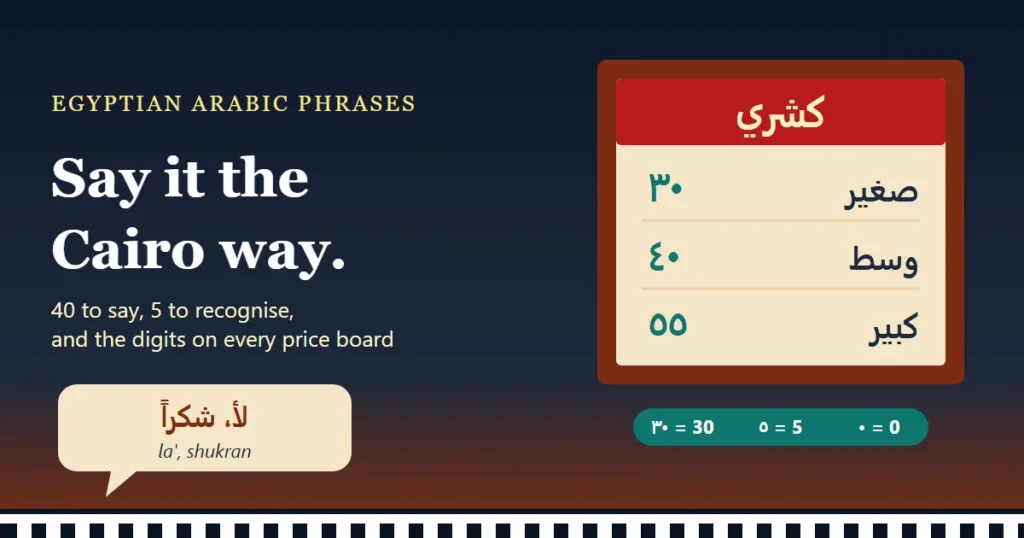
Learn ten shapes. Egypt prints numbers two ways, and on the menu boards, microbus fronts and market tags I’ve met, the Eastern Arabic digits often stand alone. The traps are two: ٠ is zero, written as a dot, and ٥ is five, though it looks like a Western zero. So ٥٠ is 50.
The good news is that the digits run left to right, like Western numbers, even inside Arabic text. A small box of koshary at Koshary Abou Tarek was ٣٠, or 30 EGP (about $0.54), on its elmenus menu on October 23, 2026. A Cairo Metro ride of up to nine stations costs ١٠, or 10 EGP (about $0.18), since fares rose on March 27, 2026 (Egyptian Streets).
Spoken numbers help too, because a driver will say the fare before you see anything written. One to ten runs wahid, itnein, talata, arba’a, khamsa, sitta, sab’a, tamanya, tis’a, ‘ashara. My guide to getting around covers the metro, taxis and ride apps.
What Should You Say in a Taxi or on the Street?
“Fein…?” to ask where, “ya usta” to the driver and “hena, law samaht” to stop. Ride apps make most of this optional in Cairo. In Aswan and Luxor, where you’re likelier to flag a street taxi, it earns its keep.
| Say it | Arabic | Means | Use it when |
|---|---|---|---|
| Fein…? | فين؟ | Where is…? | Fein el-hammam? is where’s the toilet? |
| Ya usta | يا أسطى | Driver! | Addressing any driver, politely |
| ‘Ala tool | على طول | Straight on | Giving directions |
| Yemin / shimal | يمين / شمال | Right / left | Giving directions |
| Hena, law samaht | هنا لو سمحت | Here, please | Stopping the car |
| Shaghghal el-‘addad | شغل العداد | Turn on the meter | Before the taxi moves |
| Bi-shweesh | بشويش | Slowly | To a fast driver, or a fast talker |
Usta means master craftsman, and it’s what Egyptians call a driver or a mechanic. Ask for the meter before the car moves. If the meter is “broken”, agree a fare or get out, as the broken-meter scam explains.
What Should You Say at a Table, and When Things Go Wrong?
A café needs only water, tea and the bill: “mayya”, “shai, min gheir sukkar” and “el-hisab, law samaht”. “El-ha’ni” is the word for a bad moment you’ll most likely never have.
| Say it | Arabic | Means | Use it when |
|---|---|---|---|
| Mayya | مية | Water | Bottled is mayya ma’daniyya |
| Shai, sukkar khafeef / min gheir sukkar | شاي، سكر خفيف / من غير سكر | Tea, light sugar / no sugar | Tea comes very sweet unless you say so |
| Min gheir lahma | من غير لحمة | Without meat | Ordering as a vegetarian |
| Helw awi | حلو أوي | Really good | Praising the food, the view, anything |
| Yalla | يلا | Let’s go, come on | Leaving, hurrying, agreeing to go |
| Tamam | تمام | OK, fine, perfect | Agreeing to anything |
| El-ha’ni! | الحقني | Help! | An emergency |
| Ana ta’ban / ta’bana | أنا تعبان / تعبانة | I’m unwell, I’m tired | At a pharmacy or with a host; ta’bana if you’re a woman |
Two nouns are worth adding. A pharmacy is a saydaliyya, and there’s one on most busy streets. The tourist police are shortet es-siyaha, and the number published across Egypt travel resources is 126. If you eat no meat, many of the best dishes are already meat-free, as my Egyptian food guide shows.
That makes 40: 14 courtesies, 4 for not understanding, 7 for money, 7 for the street and 8 for the table and the rare emergency.
Which Phrases Will You Hear but Not Need to Say?
Inshallah, el-hamdulillah and ma’lesh, plus “ya basha” from anyone selling something. Recognizing them helps more than saying them, and a few carry meanings a phrasebook won’t give you.
| You’ll hear | Arabic | Means | What it tells you |
|---|---|---|---|
| Inshallah | إن شاء الله | God willing | Yes, maybe or no, depending on the tone |
| El-hamdulillah | الحمد لله | Praise God | The usual answer to how are you |
| Ma’lesh | معلش | Never mind | Sorry, it happens, let it go |
| Ya basha / ya madam | يا باشا / يا مدام | Sir / madam | A sales register; flattery before a pitch |
| Ahlan wa sahlan | أهلاً وسهلاً | Welcome | At every shop door; a smile is answer enough |
“Inshallah” is the one to understand. A flat no sounds harsh in Egyptian Arabic, so it often stands in for one, and my culture guide explains how Egyptians say no. In Ramadan, add “Ramadan Kareem” to the list, the greeting you’ll hear all month. If you head to Aswan, Nubian families speak their own languages at home, and visiting a Nubian village as a guest is where a few words of Arabic go furthest.
Egyptian Arabic Phrases: FAQs
Do people in Egypt speak English?
In hotels, at major sites and with licensed guides, yes. Beyond them it thins fast. Egypt scored 458 in the 2025 EF English Proficiency Index, below the global average of 488, and the city scores fall from 478 in Cairo to 419 in Luxor and 413 in Aswan. The further south you go, the more a few Arabic words help.
Is Egyptian Arabic different from standard Arabic?
Yes, in speech. Egyptians write Modern Standard Arabic but speak Egyptian Arabic, with its own words and sounds. “Where” is fein, not ayna. “How much” is bikam, not kam. And ج is a hard “g”, which is why the city is Giza. Standard Arabic will be understood, but you’ll hear Egyptian back.
How do you say thank you and no thank you in Egyptian Arabic?
Thank you is “shukran”, and thanks a lot is “shukran awi”. No thank you is “la’, shukran”. Say it with a hand on your heart and keep walking when a tout approaches. The reply you’ll hear to your shukran is “‘afwan”, you’re welcome.
What does yalla mean?
“Yalla” means let’s go, come on or hurry up, depending on the tone. You’ll hear it all day: a driver ready to leave, a guide moving a group, a friend agreeing to a plan. You can use it the same way. “Yalla bina” means come on, let’s go, literally “come on, with us”.
Do I need to learn Arabic numbers for Egypt?
For menu boards, microbuses and market tags, yes. Egypt prints both kinds of digit, and local places often show the Eastern Arabic ones alone. There are just ten shapes. The traps are ٠, zero, written as a dot, and ٥, five, which looks like a Western zero. So ٥٠ is 50.
What are the most useful Egyptian Arabic phrases for travelers?
Five do most of the work: salamu ‘alaykum (hello), shukran (thank you), la’, shukran (no thank you), bikam? (how much?) and fein…? (where is…?). Add the ten digits and the women’s endings, izzayik and min fadlik, and you’ll handle most daily exchanges with a smile.
The Bottom Line
Forty Egyptian Arabic phrases won’t make you fluent. They’ll make your trip smoother, especially south of Cairo, where English thins out.
- Learn the Egyptian forms, fein and bikam, not ayna and kam.
- Say 40, recognize 5. Inshallah and ya basha only need understanding.
- Learn the ten digits. ٠ is a dot, and ٥ is five.
- Change the ending for a woman: izzayik, min fadlik.
Before you go, read what first-timers should know about Egypt, and keep the etiquette behind the words in mind.