
Last verified: August 27, 2026. Entry fees, the Philae boat fares, ferry prices, felucca rates, Abu Simbel logistics, rail times and climate figures were checked against source on the date above. Boat totals and touring-hour estimates are my own, built from repeated trips, not measured data. I re-check this page monthly.
Aswan is the hottest city in Egypt, averaging about 41.7 °C through July and sitting under more than 3,800 hours of sunshine a year (Climates to Travel, 2026). It’s also the stop that first-timers cut to a single night more than any other on the classic route.
Disclosure: Some links in this guide may earn us a commission, at no extra cost to you. It never changes what we recommend.
That’s usually a mistake, and it’s an understandable one. People arrive with a Luxor-shaped plan, find perhaps a third of the monuments, and conclude the city is thin. It isn’t. It just rewards a completely different rhythm, and almost nobody says so out loud.
So this Aswan travel guide starts with the thing every other guide leaves out: the boats. How many nights the city earns, what Philae actually costs once you add the fare, the honest read on the Nubian villages, whether Abu Simbel belongs here, and how to handle the heat. If you’re still deciding where Aswan fits, our region-by-region look at where to go in Egypt covers that first.
Key Takeaways
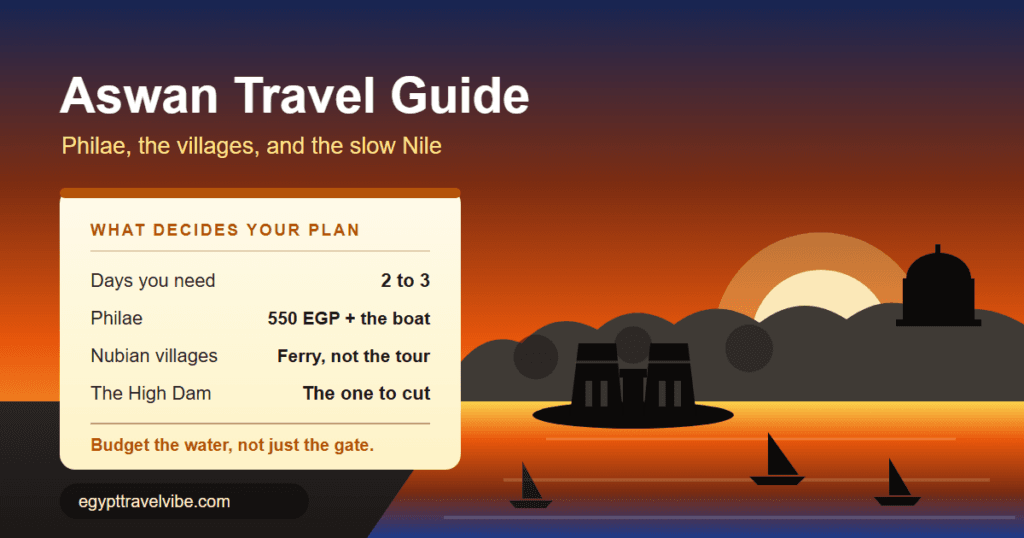
- Give Aswan two full days, three if you’re adding Abu Simbel. It has fewer sights than Luxor and still needs the time.
- Every Aswan sight has a boat fare attached, and almost nobody prices it. Philae is 550 EGP to enter and 150 EGP for the shared boat. Kitchener’s Island costs 50 EGP to enter and roughly five times that to reach.
- Plan Aswan the opposite way round to Luxor. Luxor is a race against the heat across dense monuments. Aswan has fewer sights and a river, so the water is the afternoon rather than the filler.
- The Nubian village tour at Gharb Soheil is heavily staged, and the caged crocodiles are the part the tour pages skip. The public ferry to Elephantine costs 5 to 10 EGP and reaches villages where people actually live.
- Abu Simbel’s police convoy is largely gone, replaced by monitored transit through checkpoints. Guides still describe a rigid 3.30am convoy that no longer runs that way.
Table of Contents
How Many Days Do You Need in Aswan?
Two full days, and a third if you want Abu Simbel. Philae, the sight that anchors day one, opens 07:00 to 16:00 and can only be reached by boat (Time Travel Turtle, 2026). By my count Aswan has about five sights that justify a ticket, against Luxor’s dozen. It still fills two days, because getting to them eats more of the day here than anywhere else in Egypt.
Here’s how the days fall. Day one is the ticketed run: Philae in the morning before the boats stack up, the Unfinished Obelisk on the way back, the High Dam if you insist. Day two is the river: the public ferry to Elephantine, the villages, Kitchener’s Island, and a felucca as the sun drops. Day three, if you have it, is Abu Simbel and nothing else.
Laid out against the clock, it looks like this.
| Day | Morning, 7am to 11am | Afternoon and evening |
|---|---|---|
| 1 | Philae, then the Unfinished Obelisk | Rest, then the souk after dark |
| 2 | Ferry to Elephantine and the villages | Kitchener’s Island, then a felucca at sunset |
| 3 | Abu Simbel, leaving before dawn | Back by early afternoon, rest |
One night is what a Nile cruise gives you, and it buys Philae and very little else. If you’re still sizing the whole trip, compare the three itinerary lengths before you decide what Aswan gets.
Is Aswan Worth It, or Should You Just Do Luxor?
Both, if you have four or five days for Upper Egypt. The Luxor to Aswan train takes just over three hours with departures roughly every three hours (Egypt Railway, 2026), which makes doing both far easier than the choice implies.
If you genuinely have to pick, it isn’t close on monuments. Luxor has the Valley of the Kings and Karnak, and nothing in Aswan competes with either. What Aswan has is everything else: the river as an actual destination, the Nubian south, granite islands, and a pace that Luxor never offers.
Here’s the framing that fixed Aswan for me, and it’s the opposite of the advice that works one stop north. In Luxor you’re racing an eleven o’clock heat deadline across a dense field of monuments, so the whole job is compression. Every guide I read about Aswan ports that same logic straight across, and it produces an itinerary that feels empty by lunchtime on day two.
Aswan needs the inverse. Fewer sights, so stop compressing. The river isn’t what you do when you run out of temples, it’s the reason the city is worth two days at all. Short mornings, long afternoons on the water, and the plan stops feeling thin.
That reframing is also why people who “didn’t get” Aswan usually visited it wrong rather than briefly. If you want the contrast in full, our Luxor guide covers how that city’s two banks actually work.
What Does Philae Temple Cost, and How Do You Reach It?
Entry is 550 EGP for a foreign adult and 275 EGP for a student, and you cannot walk there. Philae sits on Agilkia Island, so a boat is compulsory, and the shared return runs about 150 EGP (Time Travel Turtle, 2026). The temple opens 07:00 to 16:00.
The boat is where this goes wrong for people. There are two products and they get quoted as if they’re the same thing. The shared motorboat leaves when it fills and costs around 150 EGP return. A private hire, which is what you’ll be offered if you arrive alone and look uncertain, gets quoted anywhere from 300 to 500 EGP. Both are legitimate. Only one is what you probably want.
Nobody publishes the fare next to the ticket, so here it is. These totals are mine, built from repeated trips and current quoted rates, and they’re planning numbers rather than guarantees.
Two practical rules follow. Agree the fare and whether it’s shared or private before you step onto anything, because renegotiating from a boat in the middle of a reservoir is a losing position. And carry a card for the gate and cash for the water, because the price-after-the-fact play works best on people who’ve already committed.
What Else Is Actually Worth a Ticket in Aswan?
Philae carries the city, and after that the drop-off is steep. On the official checkout on October 20, 2026, foreign adult entry was 220 EGP at the Unfinished Obelisk and 400 EGP at the Nubian Museum (egymonuments.com). The High Dam runs about 200 EGP and Kitchener’s Island 50 EGP (Nile Empire, 2026). Two of those three tickets are worth it. One really isn’t.
The Unfinished Obelisk is short and better than it sounds. It’s a single abandoned block still attached to the bedrock, cracked and left where it lay, and it explains how the stone was actually worked better than any finished monument does. Half an hour, well spent.
The High Dam is a photo stop on a causeway. It’s a genuinely significant piece of engineering and a genuinely dull visit, and 200 EGP buys you a view of a lot of water and a monument to Soviet-Egyptian friendship. Skip it without guilt unless dams interest you.
The Nubian Museum is the underrated one, and it’s the right preparation for everything in the next section. Go here before you go anywhere near a Nubian village, because it supplies the context that the village tours skip entirely.
Are the Nubian Villages Worth Visiting, and How Do You Do It Right?
Yes, but not the way they’re sold. The standard Gharb Soheil tour is a commercial strip with a boat ride attached, and the alternative is a public ferry that costs 5 to 10 EGP and lands you somewhere people actually live (Paliparan, 2026).
Start with why these communities are where they are, because it changes how you behave when you arrive. When the High Dam’s reservoir filled in the 1960s it drowned 44 villages. Roughly 70,000 Egyptian Nubians were moved between October 1963 and June 1964, to resettlement land at Kom Ombo about 50 km north (New Lines Magazine, 2026).
The government called the new settlement New Nubia. Nubians called it Tahgeer, the place of displacement. Almost every guide sells “the Nubian village” as a colourful photo stop and mentions none of this, which is a strange omission given the dam you photographed that morning is the reason the village exists.
Now the honest part about Gharb Soheil. It’s the version sold on every tour desk in town, and what you get is a row of shops, a tea stop, and a “family home” that groups of twenty rotate through on a schedule. Some houses keep live crocodiles in small tanks for photographs, and a few of the young animals have their snouts taped. I’m not going to soften that. If you’d rather not fund it, don’t, and the reason no tour page will tell you this is that they’re selling the tour.
The version I’d actually do costs almost nothing. Take the public ferry from the pier on the corniche to Elephantine Island, which runs every twenty to thirty minutes and takes about ten minutes. Siou and Koti are ordinary villages: painted houses, narrow lanes, kids, laundry, no ticket booth. Walk slowly, ask before photographing anyone, and buy your tea and lunch there so the money lands locally.
The distinction isn’t authenticity for its own sake. It’s that one version treats you as a customer and the residents as staff, and the other lets you be a visitor in a place. Both are Nubian. Only one is honest about it. For the longer version, with the history and the house rules, see how to visit the Nubian villages respectfully.
Should You Do Abu Simbel From Aswan?
Yes, and it’s the single best reason to give Aswan a third night. Road transfers run about 3 to 3.5 hours each way, and the flight takes 45 to 60 minutes (Earth Trekkers, 2026). Either way you get roughly two hours at the temples.
One correction first, because this trips people constantly. The formal police convoy that every older guide describes has largely been replaced by monitored transit, so you’ll pass through checkpoints rather than travel in a grouped escort (Third Eye Traveller, 2026). The rigid 3.30am and 11.00am departure story is a description of a system that’s mostly gone.
By road, shared transport runs roughly $20 to $50 per person and a private car $100 to $150. Flying costs around $200 to $300 return and turns the whole thing into a half day rather than a full one. The road version means leaving in the dark and getting back exhausted, which is why it belongs on its own day and not bolted onto a sightseeing morning.
Is it worth 8 to 10 hours for two hours on site? For most people, yes. It’s the one Egyptian monument that reliably beats its own photographs. But it deserves its own logistics comparison rather than three paragraphs here.
How Do You Handle Aswan’s Heat?
By moving your sightseeing to the morning and your life to the water. Aswan is Egypt’s hottest city, with July averaging around 41.7 °C and June humidity dropping to roughly 16% (Climates to Travel, 2026). December to February sits at a comfortable 15 to 18 °C by day.
That chart surprised me when I built it, and it’s worth saying plainly: Aswan’s reputation as dramatically hotter than Luxor doesn’t hold up. The gap is about a degree. What genuinely differs is the humidity. It’s low enough that 40 °C in Aswan is more bearable than 38 °C somewhere coastal. And the river is always there as an escape.
So the heat rule here isn’t the Luxor rule. In Luxor the afternoon is dead time you plan around. In Aswan the afternoon is a felucca, and the breeze on the water does most of the work. Pick your month with the month-by-month guide and pack for the season before you commit to summer.
How Do You Get to Aswan, and How Do You Get Around?
Sleeper train from Cairo, a short hop from Luxor, or the boat. The Cairo run takes 13 to 15 hours and leaves from Bashtil, also called Upper Egypt Station, not Ramses, where guides and hotel staff will still send you (Seat61, 2026).
From Luxor, take the train. It’s just over three hours, departures run roughly every three hours, and once you count airport transfers and security the one-hour flight saves you almost nothing. Cabins on the Cairo sleeper come in Standard and Elite, meals included, and Elite is worth the difference if you actually want to sleep.
Aswan International sits about 18 km southwest of the centre, served by EgyptAir, Air Cairo and Nile Air, mostly to Cairo and Abu Simbel (Aswan International Airport, 2026). If you’re coming by cruise, sail south to north where you can choose, because ending in Luxor puts you at the denser end of the sightseeing.
In town you barely need transport. The corniche is walkable, taxis are cheap and negotiable, and the public ferry to Elephantine costs a handful of pounds. For the full picture on moving between cities, our guide to getting around Egypt compares flights, sleepers and the Nile end to end.
What Does a Day in Aswan Cost?
Less than Luxor on tickets and more than you expect on boats. A felucca runs roughly 200 to 300 EGP an hour for the whole boat, not per person (Semi Elegant Voyage, 2026), and being quoted per head is the most common way visitors overpay here.
Day one, priced honestly: Philae at 550 plus 150 for the shared boat, the Unfinished Obelisk at 220, taxis at maybe 200 across the day. Call it 1,120 EGP, roughly $22 at about 50 EGP to the dollar in late August 2026. Day two is dramatically cheaper: ferry at 10, Kitchener’s Island at 50 plus its boat, a felucca hour at 250, lunch and tea. Under 700 EGP if you’re sensible.
The one splurge worth naming is afternoon tea at the Old Cataract, which is no longer a Sofitel and now books as Mandarin Oriental, Old Cataract Aswan. I couldn’t find a current published price, so ask the hotel before you go rather than trusting an old figure. Whether a view of the Nile from that terrace is worth it is genuinely a matter of taste, and I weigh a night against a drink there in my guide to Egypt’s historic hotels. If you’d rather sleep with that view than visit it, Nile-view hotels against Nubian guesthouses prices both sides of the river.
One structural thing to plan for: the gates take cards and the river takes cash. Egypt’s archaeological sites went card-only, with the first self-service machines rolled out in a 40-machine phase across 20 sites from January 2024 (Egypt Independent, 2024). Boatmen, ferries, tea and tips are all cash. Carry both. For the full trip picture, our itemised Egypt budget prices the Cairo, Luxor and Aswan circuit end to end, and the tipping guide covers how much baksheesh is normal.
Aswan Travel Guide FAQs
How many days do you need in Aswan?
Two full days, and 3 if you’re adding Abu Simbel. Aswan has around 5 sights worth a ticket against Luxor’s 12, but boat time between them eats more of the day than people expect. One night, which is what a cruise gives you, buys Philae and very little else.
Is Aswan worth visiting or should you just do Luxor?
Both, if you have 4 or 5 days in Upper Egypt. The train between them takes just over 3 hours, so the choice is rarely necessary. Luxor wins decisively on monuments. Aswan wins on the river, the Nubian south, and pace. If you have 2 days total, pick Luxor.
How much does Philae Temple cost?
Entry is 550 EGP for a foreign adult and 275 EGP for students, plus a compulsory boat to Agilkia Island. The shared return runs about 150 EGP. A private hire gets quoted from 300 to 500. Agree which one you’re buying before boarding. The temple opens 07:00 to 16:00.
Is the Nubian village in Aswan a tourist trap?
The Gharb Soheil version largely is: a shopping row, a scheduled tea stop, and caged crocodiles kept for photographs. The better visit costs 5 to 10 EGP on the public ferry to Elephantine Island, where Siou and Koti are ordinary villages with no ticket booth and people going about their day.
Can you do Abu Simbel as a day trip from Aswan?
Yes, and it’s the best reason to add a third night. Road is 3 to 3.5 hours each way at roughly $20 to $50 shared, and flights take 45 to 60 minutes at around $200 to $300 return. The old police convoy has largely become monitored transit through checkpoints.
When is the best time to visit Aswan?
December to February, when daytime highs sit at a comfortable 15 to 18 °C. July averages about 41.7 °C. Aswan is Egypt’s hottest city, though only by roughly a degree over Luxor, and the very low humidity plus constant river access makes the heat more manageable than the numbers suggest.
The Bottom Line
Aswan is the stop people under-book, and they under-book it because they plan it like Luxor. Five things decide whether your visit works:
- Two days, not one night. Three if Abu Simbel is on the list.
- Price the boat with the ticket. Every sight here has a second fare attached, and at Kitchener’s Island it’s five times the entry.
- Invert the Luxor rhythm. Short mornings on the sights, long afternoons on the water. The river is the point, not the filler.
- Skip the High Dam before you skip the Nubian Museum. One is a causeway view. The other explains everything else you’ll see.
- Take the ferry, not the tour. Ten pounds to Elephantine beats a staged village at any price.
Everything in this Aswan travel guide comes back to one habit: budget the water, not just the gate.
Egypt Travel Vibe carries advertising and partnerships, and discloses them. What it doesn’t do is sell tours, tickets or transfers. That’s why this page can tell you the High Dam is a dull 200 EGP, that the Gharb Soheil crocodiles are kept in tanks for your photograph, and that the boat you’re quoted 400 EGP for costs 150 shared. None of that is comfortable copy for an operator. Where sources disagreed, as they badly did on Aswan’s entry fees, I’ve said so rather than picking the tidier number.
Marco re-checked every fee, fare and rule on this page against source on August 27, 2026.
With Aswan settled, the rest of the Nile Valley follows. Compare 7, 10 and 14-day plans to see how many nights it earns, then read how Luxor’s two banks work for the stop most people pair it with. If you’re still costing the trip, our itemised Egypt budget has the full ticket bill, and the region-by-region guide to where to go puts the Nile Valley next to the alternatives.
If the boat is how you arrive or leave, which kind of Nile cruise to book prices the three options.