
Last verified: August 30, 2026. Every entry fee in this Alexandria travel guide was checked against the Egyptian Ministry of Tourism and Antiquities’ own published schedule, not against tour-operator pages, which get several of them wrong. Train fares, the tram closure and the climate figures were re-checked the same day. I re-check this page monthly.
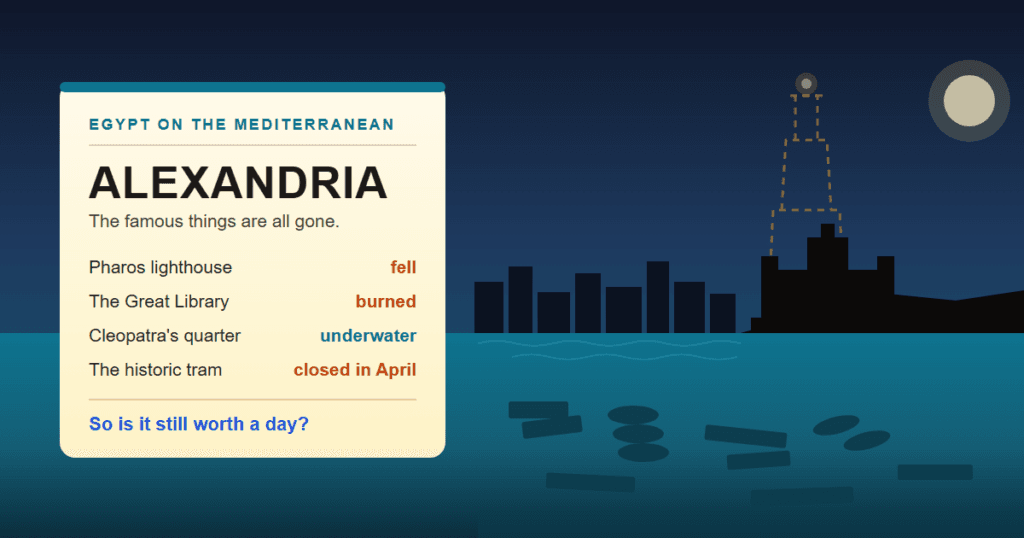
Four things made Alexandria famous, and you can’t see any of them. The Pharos lighthouse fell. The Great Library burned. Cleopatra’s royal quarter is under the harbour. Her tomb has never been found.
Disclosure: Some links in this guide may earn us a commission, at no extra cost to you. It never changes what we recommend.
That’s the honest starting position for anyone planning a day here in Egypt, and it’s not how the guides that rank for this city open. They open on the legend, then quietly hand you a 15th-century fort and a library built in 2002, and hope you don’t notice the swap.
Egypt took 6.1 million arrivals in the first four months of 2026, up 7% on the same period last year and building on a record 19 million in 2025 (State Information Service, 2026). Very little of that reaches Alexandria, and there’s a reason worth understanding before you give the city a day.
So this guide answers six things: what’s actually standing, how you get here, what changed this year, what a day really costs, whether it earns a night, and who should skip it. If you’re still deciding the shape of the trip, where the Mediterranean coast fits against everywhere else is the wider view.
Key Takeaways
- Alexandria is a city you visit for what isn’t there. Go expecting a working Mediterranean port with Greco-Roman fragments in it and you’ll have a good day. Go expecting monuments on the Giza scale and you’ll spend the afternoon puzzled.
- The historic tram is gone, and nearly every guide still tells you to ride it. It went to partial suspension on February 11, 2026 and shut completely on April 1 for a rebuild as elevated light rail. Around 153 buses and minibuses cover the route now.
- Most published entry fees for Alexandria are wrong. Pompey’s Pillar is 200 EGP for a foreign adult on the Ministry’s own schedule, not the 80 or 150 EGP quoted across the search results. Qaitbay is 200 EGP, not the “$5” resellers advertise. The schedule itself dates from November 2024, so budget a margin.
- The train is the biggest cost of the day, by a distance. Return fares run roughly 2,600 to 5,000 EGP depending on class. All four major antiquities tickets together come to 800 EGP.
- One day for almost everyone. Two only if you’re heading to Siwa, because the road from here is about 6.5 hours against Cairo’s 9.5.
- The city is physically sinking. A 2025 University of Southern California study found building collapses rose from roughly one a year to about 40 a year over the past decade. That’s context, not a warning.
Table of Contents
Is Alexandria Worth Visiting?
Yes, for one day, if you know what you’re going for. Alexandria is a working Mediterranean port with Greco-Roman fragments scattered through it, and it holds no pharaonic site of any kind. If temples, tombs and pyramids are why you came to Egypt, this city has none of them.
That sounds harsh. It isn’t, quite. The problem is the substitution nobody names out loud, so let me name it.
| What you came for | What’s actually there | Worth your time? |
|---|---|---|
| The Pharos lighthouse | Qaitbay Citadel, a 15th-century fort on its footprint | Yes, for the setting |
| The Great Library | Bibliotheca Alexandrina, opened 2002 in its memory | Yes, if you like buildings |
| Cleopatra’s royal quarter | Scattered blocks under the Eastern Harbour | Only if you dive |
| Roman ruins | Catacombs, a pillar, a small theatre | The catacombs, definitely |
| Temples and tombs | Nothing. None. Not one | Go to Luxor |
Here’s what I think every Alexandria guide gets structurally wrong. They try to sell the city on its history, which is the one thing it can’t deliver, because the history is gone. What Alexandria actually offers is rarer than another ruin: it’s the only city in Egypt that isn’t performing for visitors. Nobody’s selling you a camel ride on the Corniche. The seafront is full of Alexandrians.
Be honest with yourself about the Roman remains, too. They don’t compete with Italy or Ephesus, and a guide that implies otherwise is setting you up to be disappointed by a genuinely good afternoon. Go for the sea, the fish, and one extraordinary tomb complex. That’s a real day out.
How Do You Get from Cairo to Alexandria?
Take the train. It’s 208 km from Cairo Ramses to Sidi Gaber, about two and a half to three hours, with several departures daily (seat61, 2026). Get off at Sidi Gaber rather than riding to the terminus. It’s closer to where you want to be.
Driving takes about the same on a good day and much longer on a bad one, which in Egypt is most days. There’s no reason to do it.
Now the part nobody explains. The same seat has three different prices. Egyptian National Railways publishes separate resident and foreigner fares, and the booking platforms that will actually accept a foreign card add their own markup on top of that. So when you see wildly different numbers quoted online, they aren’t out of date. They’re different layers. Everything below is the published foreigner fare, one way.
Talgo is the comfortable option and runs as a genuine daytime service on this route, unlike the Cairo to Luxor run where it’s an overnight seated train. Second class Express is the value pick and perfectly civilised. For the full picture of how Egypt’s rail network fits together, our breakdown of flights, trains and cruises sets it against the alternatives.
Buy at the Arab and Foreign Reservation Office upstairs at Cairo Ramses, or online through an agency a couple of days ahead. Coming the other way, Cairo is the city you’ll be day-tripping from and its own guide covers getting to Ramses in the first place.
What Happened to the Tram?
It stopped. The Ramleh tram, running since 1863 and the oldest in Africa, went to partial suspension on February 11, 2026 and closed completely on April 1 (Urban Transport Magazine, 2026). It carried around 80,000 passengers a day over roughly 32 km of route before it shut.
If a guide tells you to ride the historic tram, that guide was written before April 2026 and hasn’t been touched since. It’s the single most-recommended experience in almost every Alexandria article you’ll find, and it doesn’t exist right now.
What’s replacing it is a rebuild as elevated light rail. The works run 14.1 km, including 7.4 km of viaduct, 24 modernised stations and a new two-level depot, on a contract worth over 75 million euros (ETF, 2026). In the meantime the Ministry of Transport put about 153 vehicles on the corridor. That’s 15 buses and 138 minibuses, split across Gamal Abdel Nasser Street, a parallel route and Al-Gaish Street, running every three to five minutes (Egyptian Streets, 2026).
When does it come back? The sources genuinely disagree, so I’m not going to pick the tidier answer. Urban Transport Magazine reports end of 2027. The contractor’s own announcement describes works starting in the last quarter of 2026 and running 24 months, which lands at the end of 2028. Either way, not on your trip.
The practical consequence: ride-hailing apps are now the default way to move between the Corniche sights, and that changes the shape of your day more than it sounds. Budget for four or five short rides rather than a tram ticket.
What Is Actually Left of Ancient Alexandria?
Less than you’d hope above the water, and more than you’d expect below it. The Catacombs of Kom el-Shoqafa are the real thing, and the best site in the city by a wide margin. Picture a three-level Roman-era tomb complex cut into rock, where Egyptian, Greek and Roman decoration collide inside the same rooms. Entry is 200 EGP for a foreign adult.
After that, be realistic. Pompey’s Pillar stands alone above the foundations of the Serapeum and takes twenty minutes. Kom el-Dikka’s Roman theatre is genuinely small, smaller than its photographs suggest, and only worth it if you’re passing. The Greco-Roman Museum reopened on October 13, 2023 after nearly 18 years shut, with more than 40,000 objects (Egyptian Streets, 2023). Any page still listing it as closed for renovation is three years stale.
Now the fees, and this is where I’d like you to trust the Ministry over the search results. Almost every operator page pricing Alexandria is wrong. Pompey’s Pillar is quoted at 80 EGP on some sites and 150 on others. The Ministry’s published schedule says 200. Qaitbay Citadel gets advertised at “$5”, which is a reseller’s product price rather than a gate fee, and the real figure is 200 EGP.
One caveat I’d rather give you than hide. The Ministry’s schedule is the authoritative document, but the version it publishes was last updated in November 2024, and Egypt revises antiquities fees close to annually. Treat these as the last officially published prices rather than a guarantee, and budget a margin. The tier structure has already moved once since that document: from January 1, 2026, Arab nationals pay the foreigner rate.
Under the harbour, the picture flips. The submerged royal quarter and the sunken cities of Canopus and Heracleion in Abu Qir Bay sit mostly in 5 to 15 m of water, which is within reach of any certified diver. In August 2025 Egypt ran its first recovery operation of sunken antiquities in 25 years, lifting statues that had been down there roughly two thousand years (The Art Newspaper, 2025).
A partly submerged museum has been proposed to display all this, at around 150 million dollars. It’s been announced, shelved and revived repeatedly for close to two decades and it is not built. Several pages ranking for this city present it as imminent. Don’t plan around it. And the “Secrets of the Sunken City” exhibition that showed 86 of these objects at the Alexandria National Museum closed in February 2026, so ignore any guide still sending you to it.
What Does a Day in Alexandria Actually Cost?
Less than you’d guess on tickets and more than you’d guess on transport. At 50 EGP to the dollar, the four headline antiquities sites come to 800 EGP between them, about 16 dollars. The return train costs three to six times that.
Here’s the day costed end to end, on August 30, 2026, two ways. The lean version is a second class Express return, three sites and a normal lunch. The fuller version is Talgo first class, five sites and a proper seafood lunch.
What about the packaged tour from Cairo? I tried to price several on the day I wrote this. None of the operator sites would return a public figure to an automated check, so I’m not going to quote one I can’t stand behind. What I can tell you is what it buys: a car, a driver, a guide and no decisions. It does not buy you better access, because the tickets above are the same tickets. If the language and the logistics are what worry you, that’s a fair trade. If they aren’t, the train day is better and cheaper.
Two practical notes. Egypt’s major antiquities sites have moved to card payment at the gate, and I found no published exception for Alexandria, so bring a working card for the ticket windows and small notes for taxis, tips and the fish place. Carry both, exactly as you would in Cairo. And what baksheesh actually costs applies here as everywhere, though it’s gentler than Giza. For the whole-trip picture, our itemised Egypt budget puts this day in context.
One Day or Two?
One long day, for almost everyone. Out on an early train, back on a late one. Two days only if you’re carrying on west to Siwa. The road from Alexandria is about 6.5 hours against 9.5 from Cairo, and that saved half-day is the single argument that earns this city a night.
The one-day route that works: catacombs and Pompey’s Pillar first, while it’s still cool and they’re a five-minute ride apart. Corniche and Qaitbay through the middle of the day. Bibliotheca in the afternoon, since it closes earlier than you’d like. Fish somewhere on the seafront. Late train.
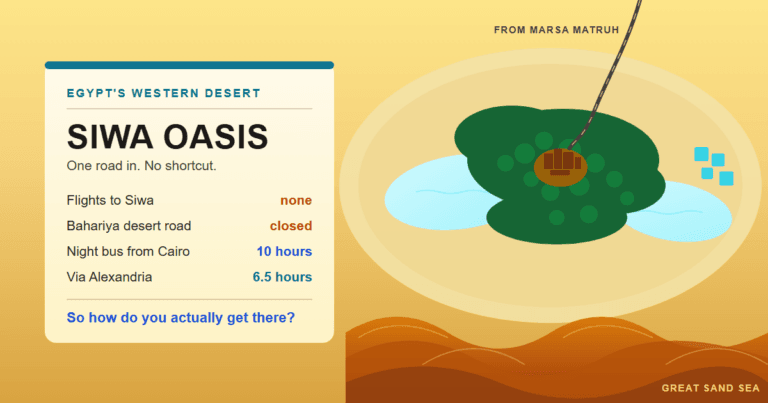
A second day adds Montazah’s gardens, the Royal Jewellery Museum, the Greco-Roman Museum done properly rather than at a jog, and El Alamein’s war cemeteries as a half-day run west. If you’re heading to the oases afterwards, the oasis this city is the staging post for explains why the overnight makes sense.
I’ve done this both ways, and I’ll tell you the part that surprised me. My best hour in Alexandria wasn’t at any ticketed site. It was walking the Corniche east from Qaitbay in the late afternoon, past men fishing off the wall and families eating corn from carts, with the whole Mediterranean on my left. If that sounds like a criticism of the city, you’ve understood the city.
I also made the detour to Abu Mena, 45 km southwest, a UNESCO site on the in-danger list because of ground subsidence. It’s remarkable and it’s for the genuinely obsessed. I don’t think you should go.
Now the verdict, and I’m going to give you the same one I gave on the destinations pillar rather than a softer version because this happens to be Alexandria’s own page. On a first trip of ten days or fewer, skip it. It eats a full day you’d otherwise spend at Saqqara, and Saqqara wins. Compare how 7, 10 and 14-day trips actually fit together and you’ll see where the spare day comes from, if it comes at all. There’s also plenty of Egypt beyond the Pyramids-and-Nile classics competing for the same slot.
When Should You Go, and Is It Safe?
Late September to early November, or March to April. Not July, despite what you’ve read, and not January if you wanted the sea.
The summer advice everyone repeats is half right. Alexandria’s July high is 31°C against Cairo’s 35°C and Luxor’s 41°C (Climates to Travel, climate normals), which genuinely does make it the one Egyptian city that works in high summer. What no guide mentions is the other half: June to September is exactly when the Nile Valley decamps to the Mediterranean coast. The cool month and the crowded month are the same month, and the traffic in the late afternoon has to be experienced to be believed.
Winter is the reverse problem. It’s mild but windy, Alexandria gets Egypt’s only meaningful rainfall, and the sea is rough and cold enough that the beaches are decorative.
On safety, Alexandria is straightforward. The US State Department holds Egypt at Level 2, with elevated-risk areas confined to North Sinai, the Libya border strip and parts of the Western Desert. Alexandria is nowhere near any of them, and the honest read on the advisory zones covers what those designations mean in practice.
The Alexandria-specific notes are different and more useful. Hassle is markedly lower than Giza or Luxor, because the city isn’t built around tourist turnover. It’s also more socially conservative than Zamalek or the tourist strip in Cairo, so what passes unremarked at the Pyramids will draw looks on the Corniche. That’s a dress question rather than a safety one, and our season-by-season packing list covers it. Traffic remains the genuine risk, here as everywhere in Egypt.
One last thing, and it’s the most interesting true fact about this city that no travel guide will tell you. Alexandria is sinking. A University of Southern California study published in February 2025 found building collapses rose from roughly one a year to about 40 a year over the past decade. Around 280 buildings have been lost in 20 years (CNN, 2025).
The mechanism is specific: rising sea level pushes seawater inland, the water table saturates and erodes the soil under foundations, and salt corrodes the steel inside the concrete. It’s the same subsidence that put Abu Mena on the UNESCO in-danger list. Nobody should cancel a day trip over it. But it explains what you’re looking at when parts of the seafront seem to be losing an argument with the sea.
Where to Eat, Walk and Stay
The Corniche is the attraction. It runs roughly 15 km from Qaitbay round to Montazah, and an hour of it on foot at the right time of day will give you more of Alexandria than any ticket.
Don’t try to walk all 15 km. The stretch that earns your time runs east from Qaitbay toward the Bibliotheca, an hour or so. Go between four and six. The light goes gold and the whole city comes out to lean on the railings.
Seafood works differently here and it throws people. You pick your fish from ice at the front, they weigh it, and you pay by the kilo before it’s cooked. Ask the price per kilo first. That one question prevents the only real bill dispute you’re likely to have in this city, and the small stuff nobody warns you about covers the rest of the etiquette.
On staying: be realistic that Alexandria’s hotel stock is thinner and older than Cairo’s at every price point above budget. There are grand old seafront names and there are decent modern mid-range places, and not a lot in between. If the night is happening because Siwa is next, book near Sidi Gaber or the Corniche and keep it simple. The full lodging breakdown goes deeper across the country.
Alexandria Travel Guide FAQs
Is Alexandria worth visiting?
For one day, yes, if you want a Mediterranean port city and Greco-Roman fragments rather than pharaonic monuments. The Catacombs of Kom el-Shoqafa alone justify the trip at 200 EGP. On a first trip of ten days or fewer, it costs you a Saqqara day, and Saqqara wins.
How do you get from Cairo to Alexandria?
By train, from Cairo Ramses to Sidi Gaber, 208 km in about two and a half to three hours with several departures daily. Published foreigner fares run from $26 in non-air-conditioned third class to $50 in Talgo first class, and booking platforms add a markup on top of those.
Can you still ride the historic tram in Alexandria?
No. The Ramleh tram, running since 1863, went to partial suspension on February 11, 2026 and closed completely on April 1 for a rebuild as elevated light rail. Around 153 buses and minibuses cover the corridor. Reopening estimates run from late 2027 to late 2028 and the sources disagree.
How much does a day trip to Alexandria cost?
Priced on August 30, 2026 at 50 EGP to the dollar, a lean independent day came to about 4,850 EGP and a fuller one to about 7,800 EGP. The return train is 64% to 72% of that. All four major antiquities tickets together are 800 EGP.
What is left of the Great Library and the lighthouse?
Neither survives. The Bibliotheca Alexandrina is a modern library opened in 2002 in the old one’s memory, at 150 EGP for the main library or 300 EGP inclusive. Qaitbay Citadel is a 15th-century fort standing on the lighthouse’s footprint and built partly from its stone.
Is Alexandria safe for tourists?
Yes, with the ordinary Egypt caveats. It sits far from every elevated-risk zone in the current US State Department advisory, and hassle is noticeably lower than Giza or Luxor. It is socially more conservative than tourist Cairo, which is a question of what you wear rather than of safety.
The Bottom Line
So who is Alexandria actually for? Second trips. Anyone routing on to Siwa. People who came to Egypt wanting the Mediterranean rather than the Nile. And anyone travelling in July who needs one day that isn’t 41°C.
Who should skip it? First-timers with ten days or fewer, because Saqqara is the better use of that day. Anyone whose Egypt list is temples and tombs, because there are none here. And anyone hoping for Roman ruins on the scale of Italy or Turkey, because that comparison only ends one way.
Would I give it a day again? Yes, in October, on the early train, with no plan after four o’clock.
Egypt Travel Vibe carries advertising and partnerships, and discloses them. What it doesn’t do is sell Alexandria day tours. That’s why this Alexandria travel guide can say three things an operator page won’t. The tram in your itinerary stopped running in April. The Ministry’s own fee schedule contradicts most of the prices you’ll find online. And on a short first trip, the honest advice is to spend the day somewhere else. Where the record was genuinely unresolved, as with the tram’s reopening, I dated it rather than smoothed it.
Marco re-checked every fee, fare, figure and closure on this page against source on August 30, 2026.
Still shaping the trip? Where the Mediterranean fits against the rest of the country is the wide-angle view, and month-by-month heat and crowds will tell you whether your dates suit this coast at all.