
Last verified: August 23, 2026. Giza plateau access, GEM pricing, Metro and monorail fares, entrance fees, air quality and advisory status were checked against source on the date above. Hop times are typical ranges read off a maps service on October 4, 2026. I re-check this page monthly.
In 2025, Cairo International handled 30.94 million passengers, up 6.8% on the year before, which makes it comfortably the busiest airport in Africa (Business Today Egypt, 2026). Most of those people give the city a day and a half before flying south.
Disclosure: Some links in this guide may earn us a commission, at no extra cost to you. It never changes what we recommend.
That’s the mistake, and it isn’t really their fault. Cairo is a metropolitan area of more than 19 million people with the most famous monuments on Earth stuck on one edge of it and the historic core on the other. Almost every guide tells you what to see. Very few tell you how the city is shaped, which is the thing that actually decides whether your plan works.
So this Cairo travel guide starts with geography. How many days, which side of the river to sleep on, what changed at the Pyramids and the museum this year, what a day costs, and how to leave. If you’re still deciding how Cairo fits the rest of the trip, our region-by-region look at where to go in Egypt covers that first.
Key Takeaways
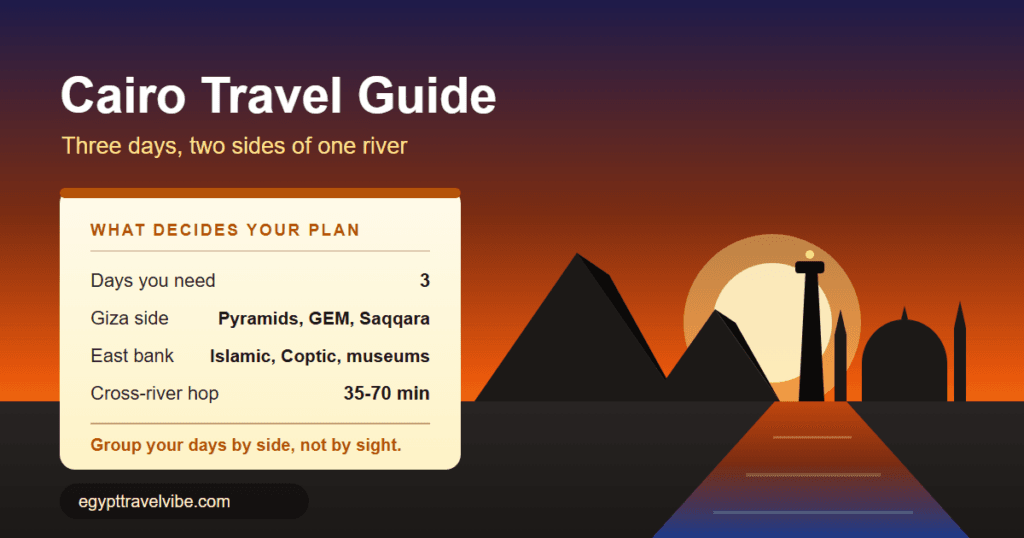
- Give Cairo three full days. Two works only if you skip the east bank entirely. Four is right if you add Saqqara.
- Cairo is effectively two cities. The Giza side holds the Pyramids, the Grand Egyptian Museum and Saqqara; the east bank holds Islamic Cairo, Coptic Cairo and the older museums. Alternating between them day by day is what wrecks first-timers’ itineraries.
- Two rules catch out older guides. Giza’s main entrance moved to the Cairo–Fayoum road, private cars are barred from the plateau, and the Grand Egyptian Museum sells tickets online only at tickets.gem.eg. It costs 1,500 EGP for foreign adults and rises by $5 on November 1, 2026 (Ahram Online, 2026).
- Tutankhamun is at the GEM. The royal mummies are at NMEC in Fustat. Neither is at the old museum on Tahrir Square, which is where most itineraries still send you.
- Ride-hailing is the default: Cairo airport to Zamalek runs about 180–280 EGP. Metro fares rose on March 27, 2026 to between 10 and 20 EGP.
Table of Contents
How Many Days Do You Need in Cairo?
Three full days for a first visit. The Grand Egyptian Museum alone absorbs half a day, and it passed three million visitors in its first seven months open, with Egypt’s Cabinet reporting an average of roughly 15,000 people a day (Excel Travel, 2026). A city with that kind of headline attraction doesn’t fold into an airport layover.
Here’s how the days break down in practice. Day one is the Giza side: the plateau in the morning, the GEM in the afternoon, or the reverse if you’d rather beat the museum queues. Day two is the east bank: Islamic Cairo, Khan el-Khalili, and either Coptic Cairo or the Citadel. Day three is your slack: Saqqara, the museums you skipped, or a slow morning you’ll be grateful for.
Two days works, but only if you accept a real cut. You do the Giza side properly and treat the east bank as one rushed evening at Khan el-Khalili. Four days is the comfortable number, and it’s the one I’d take again: it buys Saqqara and Dahshur, which are quieter than Giza and, on a good day, more affecting.
What doesn’t work is the stopover. A “pyramids day” wedged between two flights gives you about two hours on the plateau after transfers, at a site where the entrance alone is now a shuttle ride from the gate. If you’re still deciding how many nights the whole trip gets, compare the three itinerary lengths before you lock Cairo in.
How Is Cairo Actually Laid Out?
As two clusters with a river and a great deal of traffic between them. Greater Cairo holds more than 19 million people and is projected to reach 24 million by 2027 (World Bank, 2026). Everything pharaonic sits on the Giza side. Everything Islamic, Coptic and colonial sits on the east bank.
Now here’s the part almost no Cairo guide says out loud. Every itinerary you’ll read is organised by category: pyramids, then museums, then mosques, then markets. Organise your days by side of the river instead and the whole problem dissolves. The categories are scattered across 20 kilometres of traffic. The two sides are not.
I learned that the expensive way. I once booked Giza for the morning and Khan el-Khalili for four in the afternoon, which put me in a car for about 100 minutes in the worst of the evening crush. Same sights, wrong order. Grouping by side would have given me that time back.
Three bases make sense. Zamalek sits on an island in the middle of the river, which makes it the compromise: leafy, walkable, and roughly equidistant from both halves. Downtown puts you inside the east bank and on the metro. Giza wakes you up facing the pyramids and puts everything else an hour away. I compare Zamalek, Downtown or a pyramid-view hotel with dated prices and drive times.
How Long Does It Actually Take to Cross Cairo?
Longer than any itinerary admits, and it can nearly double in the evening. The Giza plateau sits about 18 kilometres from Downtown, and airport transfers to Giza run 60 to 90 minutes against 45 to 60 for Downtown (Cairo Airport Ride, 2026). Cairo’s worst crush runs roughly 3pm to 7pm.
Nobody publishes the hop times, so here they are. These are the typical ranges Google Maps gave for a Tuesday 5pm departure, read on October 4, 2026. They sit inside the worst of the day, so treat them as planning numbers rather than guarantees.
Fares are the easy part. A cross-town Uber or Careem run costs roughly 120–250 EGP, and airport to Zamalek typically lands between 180 and 280 EGP (Airport Transfer Portal, 2026). Cairo is cheap to move around and expensive in time, which is the opposite of most cities you’ve planned trips for.
What Should You Actually See in Cairo?
Five things carry the city, and the museum question trips up nearly everyone. Tutankhamun’s collection is at the Grand Egyptian Museum in Giza. The royal mummies are at NMEC in Fustat, where foreign adult entry runs 550 EGP with the Royal Mummies Hall included (egymonuments.com, NMEC, checked September 2026). The old museum on Tahrir Square is now the optional third.
The Giza side gives you the plateau and the GEM, two kilometres apart, plus Saqqara and Dahshur half an hour further out. The east bank gives you Islamic Cairo along al-Muizz Street, Khan el-Khalili at the end of it, the Citadel on its ridge, and Coptic Cairo down in Fustat with NMEC beside it.
Al-Muizz is the one I’d protect from the chopping block. The street itself is free, a combined ticket for the Qalawun complex and seven other monuments runs about 180 EGP, and most individual mosques ask 20–100 EGP. Go at dusk, when the medieval facades get lit and the street fills with Egyptian families rather than tour groups.
Skip nothing on that list lightly, but if something has to go on a three-day trip, make it the Tahrir museum. Its two headline collections have moved out. What remains is atmospheric and cluttered in a way I genuinely like, though it isn’t the first call on a short visit. My three-museum comparison shows which Cairo museum is worth your time.
What Changed at the Pyramids and the GEM in 2026?
Two rule changes that quietly break older guides. Giza’s main entrance moved to a new visitor centre on the Cairo–Fayoum road, south of the plateau. Private cars and tour buses can no longer drive up to the pyramids. Visitors ride electric shuttles instead (Ahram Online, April 9, 2025), on a loop of seven stops. Whether the shuttle is included in your 700 EGP isn’t stated by any official page. Going inside the Great Pyramid, and the rest of the plateau gate by gate, has the tickets and the prices.
The change came out of the plateau redevelopment run with Orascom Pyramids Entertainment, and it drew a fair amount of backlash when it landed. The intent is sound: fewer vehicles, less dust, less pressure at the old Mena House gate. What you feel on the day is a longer approach and less freedom to linger where you want.
The second change is the museum. The GEM sells no tickets on site at all. Booking runs through tickets.gem.eg in timed slots, foreign adult entry is 1,500 EGP, and it rises by $5 on November 1, 2026, with Egyptian adult tickets going from 200 to 220 EGP (Ahram Online, 2026). Turning up without a booking isn’t a queue. It’s a closed door. How GEM booking works, step by step walks through the checkout.
One honest caveat on crowd figures. You’ll see daily caps of 8,000 and 14,000 quoted confidently across tour-operator pages, and I can’t trace either to a primary source. What is documented: an average around 15,000 visitors a day (Egypt Today, 2025). Either way, peak-season slots go early.
How Do You Get Around Cairo?
Open Uber or Careem first, every time. The metro is the backup when traffic seizes up, and fares rose on March 27, 2026 to 10 EGP for up to nine stations, 12 for up to sixteen, 15 for up to twenty-three, and 20 beyond that (Cairo Metro fares, 2026). For a visitor, that ordering almost never changes.
Line 3 is the one you’ll use. Attaba puts you a short walk from Khan el-Khalili and interchanges with Line 1; Bab el-Shaaria drops you at the edge of Islamic Cairo. Trains run women-only carriages, marked on the platform. Avoid the 8am and 5pm crush with a daypack, because the carriages fill in a way that makes bag-watching hard.
| Mode | Typical cost | Best for |
|---|---|---|
| Uber / Careem | 120–250 EGP cross-town | Almost everything, especially Giza |
| Metro | 10–20 EGP | Short central hops, rush-hour escapes |
| White street taxi | 50–150 EGP, negotiated | Backup once you know the going rate |
| Monorail | 20–80 EGP by zone | Commuters to the new capital, not you |
| Hotel car | 600–1,200 EGP | Airport runs with luggage and no patience |
Now, the monorail. Africa’s first line opened to passengers on May 6, 2026, running 56.5 kilometres and 22 stations from Stadium to Justice City (The National, 2026). It’s a genuine engineering milestone and it will not help you. It runs east toward the new administrative capital, where no tourist site is, and per kilometre it costs about three times what Line 3 does. Moving between cities is a different problem, and flights, sleeper trains and Nile cruises compared covers it.
When Should You Visit Cairo, and How Bad Are the Heat and the Air?
November through March. Cairo averages 20°C in January against 36°C in July, and the khamsin dust winds blow for one to three days at a time between mid-March and mid-May, when temperatures can jump past 40°C (Weather Atlas, climate normals). Summer doesn’t cancel a trip; it moves it to dawn.
Then there’s the part travel guides don’t print. Cairo’s average PM2.5 in 2025 was 40.8 µg/m³, roughly eight times the World Health Organization guideline, and IQAir has ranked Cairo the world’s most polluted major city on multiple days across 2025 and 2026 (IQAir, 2026). Agricultural burning in autumn and still winter mornings are the worst of it.
For a three-day visit in decent health, that’s a haze on the horizon and a slightly scratchy throat, not a reason to cancel. If you have asthma or travel with a child who does, it’s worth planning around: an N95 for the metro and Khan el-Khalili, an afternoon indoors when the air sits still, and no morning run along the corniche.
Picking dates for the whole country rather than just Cairo? Our month-by-month look at heat and crowds ranks all twelve.
Is Cairo Safe, and How Much Hassle Should You Expect?
Cairo sits inside the normal-travel zone of every major advisory. The US refreshed its Egypt guidance on July 15, 2026 and kept it at Level 2, with elevated-risk areas confined to North Sinai, the Libya border strip and parts of the Western Desert (Travel.State.Gov, 2026). Violent crime against tourists is rare. Commercial hassle is not.
Four plays come up again and again. The camel handler quotes one price to get on and another to get down. The friendly stranger who offers to “show you the way” steers you into a shop where he earns commission. The taxi meter is broken. The papyrus institute is closing today, apparently only for you.
None of it is dangerous. It’s persistent, and it works on politeness. A friendly, unbothered la, shukran and continued walking handles nearly all of it. Agree every price before the thing happens, not after. That single habit removes most of the friction from a Cairo day.
Pickpocketing is the one real property risk, and it lives in crowds: Khan el-Khalili on a Friday evening, the metro at rush hour. Front pocket, zipped bag, no phone in the back pocket. Solo women report Cairo as manageable but wearying, with staring and comments more common than anything worse.
We’ve broken both halves of this down in full: how the touts actually work, play by play, and our honest read on the advisory zones that every guide mentions and few explain.
What Does a Day in Cairo Cost?
Budget roughly $45–60 a day per person before the hotel, and expect it to be lopsided. Your Giza-side day is the single most expensive day of most Egypt trips: the plateau at 700 EGP plus the GEM at 1,500 sits near 2,200 EGP before you’ve eaten. An east-bank day with the Citadel and NMEC runs closer to 1,100.
The payment split matters more than the total. Major sites are card-first now, and cash has stopped being accepted at gates like Giza. Everything informal stays cash: tips, street taxis, koshary and the rest of the street food, and shopping in Khan el-Khalili. ATMs dispense 200-pound notes that nobody wants to break, so ask for small notes early.
Two companion pages carry the numbers: the full Egypt budget in EGP and USD and how much baksheesh is normal at each point of contact.
How Do You Leave Cairo for Luxor or Aswan?
Fly if you want the day, take the sleeper if you want the night. But check your station: since October 2024, sleeper trains have left from Bashtil, also called Upper Egypt Station, out in Imbaba, not Ramses, where guides and even hotel staff will still send you (Seat61, 2026). Allow 45 to 60 minutes to reach it from the centre.
Trains 86 and 87 run daily, leaving Cairo around 8pm to 9pm and reaching Luxor between 6am and 8am, at roughly $60–90 per person sharing a cabin. Giza is an alternative boarding point and a much easier one if you’re staying near the pyramids. The flight takes an hour and costs about the same once you price a hotel night against the berth. Once you arrive, our Luxor travel guide covers how many days the city needs and which bank to sleep on.
Cairo Travel Guide FAQs
How many days do you need in Cairo?
Three full days for a first visit. One day covers the Giza side, the plateau plus the Grand Egyptian Museum, which averages around 15,000 visitors a day and needs half a day on its own. A second covers Islamic and Coptic Cairo. The third buys Saqqara or slack. Two days means dropping the east bank.
Where are Tutankhamun and the royal mummies now?
In two different museums, six kilometres apart. Tutankhamun’s complete collection is at the Grand Egyptian Museum beside the Giza plateau. The royal mummies moved to the National Museum of Egyptian Civilization in Fustat, where foreign adult entry is 550 EGP with the Royal Mummies Hall included. Neither is at the Tahrir museum any more.
Can tourists use the Cairo metro?
Yes, and it’s the fastest way across the centre when traffic locks up. Fares run 10 to 20 EGP by distance since March 27, 2026. Line 3 is the useful one: Attaba for Khan el-Khalili, Bab el-Shaaria for Islamic Cairo. Women-only carriages are marked. Avoid 8am and 5pm with luggage.
Is Uber safe and legal in Cairo?
Yes. Uber and Careem both operate legally and are the default way visitors move around, with upfront pricing that removes the meter argument entirely. Airport to Zamalek typically runs 180–280 EGP. If a driver phones to renegotiate or asks you to cancel and pay cash, decline and rebook. It costs three minutes.
How bad is Cairo’s air pollution for a short visit?
Real but manageable for most people. Cairo averaged 40.8 µg/m³ of PM2.5 in 2025, about eight times the WHO guideline, and has topped IQAir’s most-polluted-major-city list on several days. Over three days that’s haze and a dry throat. Asthma changes the calculus: carry an N95 and plan indoor afternoons.
Do Cairo’s sites take cards?
Mostly card only now. Giza, the GEM and the major museums are card-first, and cash has stopped working at several gates. The GEM sells tickets exclusively online at tickets.gem.eg. Tips, street taxis, Khan el-Khalili and small cafes stay cash, so carry small notes alongside the card.
The Bottom Line
Cairo rewards people who plan it as a city rather than a checklist. Five things decide whether your visit works:
- Three days, not a stopover. Four if you want Saqqara without rushing.
- Group your days by side of the river. Alternating costs about five hours over three days, and those are sightseeing hours.
- Book the GEM before you fly. Online only, timed slots, and $5 more from November 1, 2026.
- Ride-hailing first, metro second, monorail never. The new line is impressive and irrelevant to you.
- Expect hassle, not danger. Agree the price before the camel, the guide, or the ride.
Everything in this Cairo travel guide comes back to one decision: which side of the river you are on that day.
I’m Marco Delgado, and I write every guide on Egypt Travel Vibe. The site doesn’t sell tours, tickets or transfers. It does carry advertising and partnerships, and anything commercial is disclosed on the page it appears on; it doesn’t buy a verdict or change the order of a recommendation. That’s why this page can tell you the monorail is useless for visitors, that the Tahrir museum is now the one to cut, and that Cairo’s air is among the worst of any capital you’ll visit. Where sources disagreed, as they do on the GEM’s daily cap, I’ve said so instead of picking the tidier number.
Marco re-checked every fee, fare and rule on this page against source on August 23, 2026.
Once Cairo is settled, the rest follows: compare 7, 10 and 14-day plans to see where the city fits, then work out how to move between Cairo, Luxor and Aswan. If you’re still costing the trip, our itemised Egypt budget has the ticket bill in full, and the fifteen things I wish someone had told me covers the small stuff nobody warns you about. Got a spare day and wondering about the coast? Alexandria as a day trip from Cairo weighs it against Saqqara honestly. Landing soon? Sort a data plan before you fly. And when you start planning a second trip, the places beyond the Pyramids-and-Nile classics is where I would start.