
Last verified: September 2, 2026. Every bus fare, entry fee, safari price and advisory line in this Siwa Oasis guide was checked against source on the date above. The bus fares come from two dated sources that agree, the safari prices from a named Siwa operator’s own published list, and the safety wording from gov.uk, quoted rather than paraphrased. I re-check this page monthly.
Everyone arrives at Siwa Oasis knowing two things. It has salt pools you float in, and it’s a very long way from anywhere. Both are true. What nobody tells you is that the second one has no workaround at all, and that the oasis at the end of the road is changing faster than the photos let on.
Disclosure: Some links in this guide may earn us a commission, at no extra cost to you. It never changes what we recommend.
Egypt logged a record 19 million visitors in 2025 and is targeting up to 20 million this year (State Information Service, 2026). Siwa’s share of that is a rounding error. But it’s a rounding error that’s roughly tripled in five years, and that matters for how you visit.
So this guide answers five things before you book anything: how you actually get here, how many days it needs, what it costs in dated pounds, what there is to do once you’ve arrived, and whether it’s safe this close to Libya. If you’re still deciding whether the Western Desert belongs in the trip at all, where the oases fit against the rest of Egypt is the wider view.
Key Takeaways
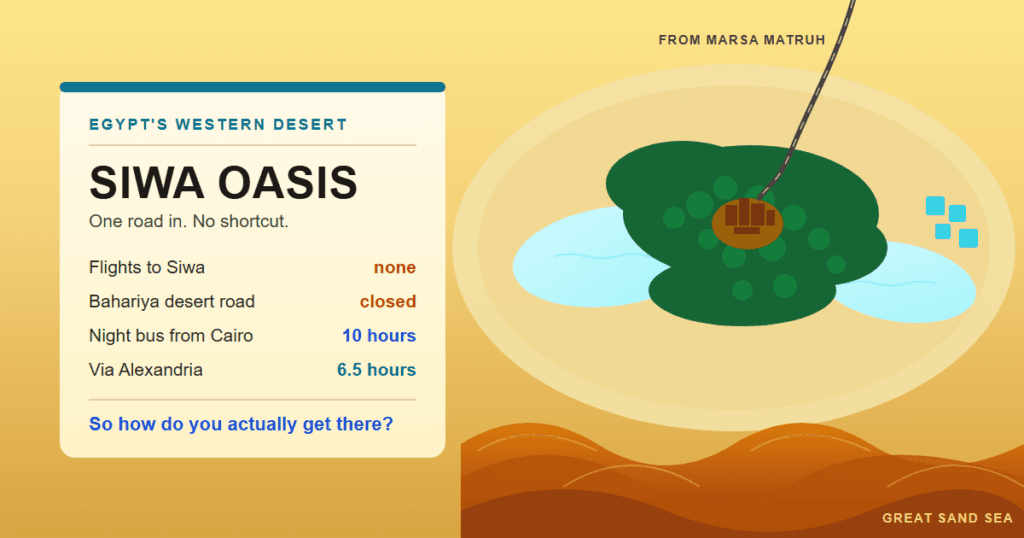
- No fast way in, and no shortcut. No commercial flights land at Siwa, the Bahariya road is closed with military checkpoints, and the only route is the Marsa Matruh road: about 9.5 hours from Cairo or 6.5 from Alexandria. Plan the trip around that fact, not against it.
- Three nights is the floor. The two-day tour sold from Cairo spends most of its hours on the road. Four nights is where Siwa starts to make sense.
- Once you arrive, it’s the cheapest stop on an Egypt itinerary. A 550 EGP night bus, 100 EGP tickets and guesthouse doubles from about 600 EGP, all dated below. A half-day 4×4 safari is 4,000 EGP per car, split between up to six people.
- The FCDO names Siwa and the Marsa Matruh-Siwa road as exceptions to its Western Desert warning. The no-go zone is 20 km from the Libyan border. Siwa is about 50 km from it. That distinction is most of the safety answer.
- It’s the most conservative stop you’ll make in Egypt. Most local women wear the niqab, alcohol is effectively absent, and you swim in the salt pools covered. Go knowing that.
- Siwa isn’t untouched, whatever the guides say. Nearly 100,000 visitors came in the two years to January 2026, and the main square has been rebuilt in concrete. Go lightly, and go soon.
Table of Contents
What Is Siwa, and Why Is It Unlike the Rest of Egypt?
Siwa is an Amazigh oasis in a depression about 19 metres below sea level, some 50 km from the Libyan border and roughly 750 km by road from Cairo. Around 200 springs feed it (EGU Four Degrees blog, 2014). It’s the one stop on an Egypt trip that doesn’t face the Nile, and it doesn’t feel like it belongs to the same country.
My first hour here was at first light, straight off the night bus, walking up into Shali before the tuk-tuks woke. The fortress town is the colour of the ground it’s built from, because it’s made of the ground: kershef, a mix of salt, mud and rock cut from the lake beds. In a place with almost no rain it’s an excellent building material. In 1926 it rained for three days and much of the town simply dissolved.
The people are Siwi, and they’ll tell you so. Their language is Berber, closer to what’s spoken in Morocco’s mountains than to Egyptian Arabic, and it has never been written down. A resident told The National in 2024 that it “will most likely die when the last of us dies” (The National, 2024). Learn two words of it. People notice.
The oasis runs on dates and olives. In 2016 the UN’s Food and Agriculture Organization listed the Siwa date system as a Globally Important Agricultural Heritage System: about 280,000 palms producing some 25,000 tons of dates a year, roughly 2% of Egypt’s crop, plus about 27,500 tons of olives (FAO GIAHS, 2016). You’ll eat both at every meal, and the olive oil is the souvenir worth the weight.
Now the part every guide leaves out. Siwa is not the untouched oasis it’s sold as, and the honest version is more interesting. In January 2026, France 24 reported that nearly 100,000 tourists had visited in the past two years alone, putting real pressure on the ecosystem and the culture (France 24, 2026). Older estimates had it at around 30,000 a year. The main square, all mud-brick as recently as 2019, now holds two-storey concrete buildings with cafés in them.
None of that is a reason to stay away. It’s a reason to visit the way the place can absorb: stay in a kershef lodge rather than a concrete one, hire a Siwi guide, and go before the square finishes changing. The other places that reward a second trip puts Siwa in that company.
How Do You Actually Get to Siwa Oasis?
By road, on the Marsa Matruh road, and by no other route. No commercial flights serve Siwa Oasis. The West Delta night bus leaves Cairo’s Turgoman station at about 9:30 p.m. and arrives at first light, roughly 9.5 to 10 hours with checkpoints. From Alexandria the same road takes about 6.5 hours, which is the whole reason to spend a night there first.
Here’s how the options actually shake out, priced on September 2, 2026.
| Route | Hours | Fare, dated |
|---|---|---|
| Cairo (Turgoman), West Delta | 9.5 to 10 | 550 EGP |
| Cairo (Abdel Moneim Riad), West Delta | 10 | 320 EGP |
| Cairo, Siwa Bus minivan | 8 to 9 | Higher, book online |
| Alexandria, West Delta | 6.5 | Ask at the window |
| Marsa Matruh, local bus | 4 | About 120 EGP |
Two things about those fares. The 550 and 320 EGP figures both come from Siwawi, a Siwa business that publishes its list with a date (November 12, 2025). They match the 320 to 550 EGP range in the most recently updated independent guide I checked (Into the Wild Unknown, 2026). The difference is the departure point, not the bus.
The resale platforms list the same seat at 1,265 to 1,364 EGP. That’s a markup of more than double. Buy at the West Delta window, on the left as you walk into Turgoman, or from the kiosk at Abdel Moneim Riad.
If the direct bus is full, use Marsa Matruh as a hub. GoBus and Blue Bus run Cairo to Matruh all day, and the local bus or a shared taxi covers the last four hours. A private driver does the whole run in 8.5 to 9.5 hours and makes sense for three or four people. Nobody sensible self-drives. After Matruh you’ll pass roughly ten checkpoints, so keep your passport in your hand, not your bag. The fuel stop outside Matruh around 4 a.m. is the last toilet.
On flying: Siwa Oasis North, the airfield you’ll see on a map, is military. The nearest civil airport is Marsa Matruh, about 300 km away, and its scheduled service in 2026 is thin and seasonal. EgyptAir’s own route list shows Cairo to Marsa Matruh as terminated, and what remains is a handful of summer flights. If one lines up with your dates it turns the trip into a one-hour flight and a four-hour road. If it doesn’t, the bus is the answer, and flights, sleeper trains and buses across Egypt compared explains why that’s fine.
On the desert crossing: the FCDO advises against all but essential travel on the road between Al Bawiti and Siwa, and its regional-risks page states plainly that “the road is closed and there are military checkpoints” (GOV.UK, 2026). So the “Western Desert loop” that older itineraries describe, Cairo to Bahariya to Siwa and back up the coast, cannot be done. Anyone combining Siwa with the White Desert overnight from Bahariya goes back through Cairo, and that’s two full travel days. Several operator pages still sell the loop. Don’t buy it.
Which leaves the sequencing rule this whole guide comes down to. Siwa can’t be a stop between two other places, because every road out returns the way you came. So put it at the end of the trip, and go via a night in Alexandria on the way out. That saves three hours on the road and turns a brutal overnight into a manageable day.
How Many Days Do You Need in Siwa?
Three nights minimum, four if you can find them. The two-day tour sold on the booking sites spends most of its hours in a vehicle, and a three-day package is the shortest version that doesn’t feel like a mistake. Independent travellers should count nights in Siwa Oasis, not days on the itinerary, because the bus eats a night at each end.
The shape that works: arrive on the morning bus, walk Shali before it gets hot, and spend the afternoon at the springs. Day two is the salt pools and the Fatnas sunset. Day three is the 4×4 into the Great Sand Sea. A fourth day is for the sand baths in season, or for nothing at all, which Siwa is unusually good at.
Who shouldn’t spend those days here? Anyone on a first trip of ten days or fewer whose priority is the Nile Valley. The desert costs two travel days plus the three nights, and on a short trip those days come out of Luxor. Where three desert nights fit in fourteen days shows the version where it works.
What Is There to Do in Siwa?
Five things, and they fit in three days. Shali, the 13th-century kershef fortress town that rain dissolved in 1926 and a 600,000 euro EU-funded restoration reopened on November 6, 2020 (State Information Service, 2020). The Temple of the Oracle at Aghurmi, where Alexander the Great was declared son of Amun in 331 BC (Britannica). The Mountain of the Dead. Cleopatra’s Spring. And Fatnas, for the sunset.
| Site | Fee, dated | Time needed |
|---|---|---|
| Shali fortress | Free | An hour, at dawn or dusk |
| Temple of the Oracle | 100 EGP | 45 minutes |
| Mountain of the Dead | 100 EGP | An hour |
| Cleopatra’s Spring | Free | As long as you like |
| Fatnas Island | Small fee at the gate | Sunset |
A note on those two tickets. Siwa’s sites don’t appear on the Ministry’s main published fee schedule, so I can’t point you at an official number. Every 2026 source I checked gives 100 EGP for each, with one recent independent guide saying 120. Egypt revises antiquities fees nearly every year, so budget a margin and don’t be surprised by a small rise.
The Oracle temple is a ruin on a rock with a view over the whole oasis, and the view is the point; the history you bring with you. The Mountain of the Dead is a cone of rock-cut tombs, four of them painted, and worth the hour. Umm Ubayda, the other temple on most lists, is a single standing wall. Look at it from the road and keep the ticket money.
Cleopatra’s Spring is a stone-ringed pool three kilometres from town, free to swim in, with tea gardens around it. Fatnas is a palm island in Birket Siwa about five kilometres west, with a small spring and a teahouse, and it’s the best place to watch the sun go down over the lake. The Siwa House museum, twenty minutes in a traditional home, explains everything else you’ll see and should come first.
Two seasonal things, the sand baths and the Siyaha festival, are covered in the when-to-go section below, because they decide the month more than the itinerary.
Getting between all of this is by bicycle or tuk-tuk. Bikes are 60 to 100 EGP a day from most guesthouses and the oasis is flat. A tuk-tuk for a full day runs 250 to 400 EGP, and you agree the price before you get in, then tip on top when it’s earned.
Can You Actually Swim in the Siwa Salt Lakes?
Yes, in the salt-mining pools on the east side of Siwa Oasis rather than in the lakes themselves. The pools sit inside a working salt concession about 12 km from the centre, they’re saturated brine, and they float you without any effort at all. Most are free. A couple with cafés attached ask a small fee. A freshwater spring runs beside them to rinse in, and you’ll need it.
Why the water is what it is: Siwa gets about 13 mm of rain a year, the wettest month barely clears 3 mm, and the depression has no outflow (Climate-Data.org, climate normals). Everything that flows in evaporates and leaves its salt behind. The big lakes are shallow and muddy at the edges and not for swimming. The mining pools, cut deep into the lake bed, are the ones in the photos.
You’ll read online that the pools are “95% salt”. They aren’t, and the number is nonsense that’s been copied from one operator page to the next. Saturated brine is roughly a quarter salt by weight, which is already far saltier than the sea and plenty to float you. What matters in practice is the same either way: any cut you’ve forgotten about will announce itself, your eyes must stay shut, and you rinse before the salt dries into a crust.
I had a forgotten cut. Go in the late afternoon when the light goes flat and blue across the water, wear a T-shirt and leggings over your swimwear, take water shoes, and get a tuk-tuk to wait. The last point isn’t optional. Nothing passes that road in the evening. What to pack for a desert that’s freezing at night and blinding by day covers the rest of the kit.
The springs are the other half of the answer. Cleopatra’s is cool and deep. Bir Wahed, at the edge of the sand sea, has a hot pool and a cold one a few metres apart. And the cold springs hidden in the palm groves are the ones nobody photographs, which is why you should ask your guesthouse for theirs.
What Does the Desert Safari Involve, and Do You Need a Permit?
A 4×4 into the Great Sand Sea. The half-day version leaves mid-afternoon and returns after sunset, with dune driving, sandboarding and a stop at Bir Wahed’s springs. Bir Wahed needs a national park permit and a police escort, which your operator files with a copy of your passport the day before. Trips that stay on the dunes at the oasis fringe skip the permit and cost less.
The scale is hard to hold in your head. The Great Sand Sea covers about 72,000 square kilometres and runs from western Egypt into Libya. The Siwa Protected Area, declared by Prime Minister’s Decision 1219 of 2002, covers about 7,800 square kilometres of it in three sectors, and the government’s own inventory lists around 28 mammal, 32 reptile and 164 bird species (State Information Service, 2024). You’ll see fossils in the rock and, if you’re lucky, a fennec.
Now the prices, from Siwawi’s published list dated November 12, 2025 (Siwawi, 2025). A half-day safari is 4,000 EGP per vehicle for four to six people. A full day is 5,500 EGP. The national park permission for the Bir Wahed area is 10 US dollars per foreigner per day on top.
An overnight camp, with permits, meals and the camp included, runs 2,500 to 3,500 EGP per person depending on group size. A local guide for the day is 1,200 EGP. Split four ways, the half-day comes to about 1,500 EGP a head with the permit, roughly 30 dollars.
On overnight camping: operators were selling desert camps freely when I checked on September 2, 2026, with the permit handled by the operator. This has been restricted before, so ask your operator directly rather than trusting a listing. Anything beyond the protected area toward the border needs a separate permit issued 48 hours ahead, and nothing in this guide goes there.
One practical thing. Phone coverage dies a few minutes out of town. The coverage chart in our guide to which network still works in the Western Desert rates Siwa as patchy on Vodafone and weak on the others, and the sand sea is worse. Download the map, tell someone your plan, and enjoy being unreachable.
What Does Siwa Cost, and Where Do You Stay?
Once you’ve arrived, Siwa Oasis is the cheapest stop on an Egypt trip. Guesthouse doubles with breakfast run about 600 to 900 EGP, a full day’s tuk-tuk is less than a Cairo airport taxi, and the two ticketed sites are 100 EGP each (Into the Wild Unknown, 2026). The expensive part is the time it takes to get here, and one luxury outlier at the top.
The accommodation ladder is short. Budget guesthouses in and around town, mid-range kershef lodges out in the palms, a few places on the lake edge, and then Adrère Amellal, alone at the far end. That last one is the most famous hotel in the Western Desert: no electricity, no wifi, candlelit, built into the mountain in kershef, and listed from 605 US dollars a night per room, all-inclusive (The Hotel Guru, read October 13, 2026). It’s extraordinary and it’s not what most people came for. The kershef eco-lodges compared is the honest ranking of everything below it.
Now the cash rule, in one sentence: withdraw everything you’ll need in Alexandria or Cairo. Siwa has two ATMs, both fail often, and card payment is mostly absent outside the top lodges. The nearest reliable bank is four hours back up the road in Marsa Matruh. Set against the full Egypt budget in EGP and dollars, three nights here will be the cheapest block of the trip, and the only one you can’t put on a card.
Food is dates, olives, bread from a clay oven, and a row of restaurants near the square that do grilled chicken and vegetable tagines for 250 to 400 EGP a head. Tea at the springs costs almost nothing. Alcohol is effectively unavailable: a few lodges serve it discreetly on request, no shop sells it, and drinking in public isn’t accepted. If a sunset drink is part of how you travel, Siwa is the one place in Egypt that won’t give you one.
Is Siwa Safe, and When Should You Go?
Yes, and the advisory is more precise than the internet suggests. The FCDO advises against all travel “to within 20km of the Egypt-Libya border”, and against all but essential travel to “the area west of the Nile Valley and Nile Delta regions”. It then lists the exceptions by name, and they include “coastal areas between Nile Delta and Marsa Matruh, Marsa Matruh-Siwa road, Siwa oasis” (GOV.UK, checked September 2, 2026). Siwa town is about 50 km from the border.
The US State Department holds Egypt at Level 2, refreshed July 15, 2026, with elevated risk confined to North Sinai, the Libya border strip and parts of the Western Desert (U.S. Department of State, 2026). Siwa is not the part it means. The checkpoints on the road are the visible version of that distinction, and the honest read on what the advisory zones mean covers the rest of the country.
On the ground, hassle is essentially nil. Siwa Oasis is widely reported as one of the safest places in Egypt for women travelling alone, and that matches what I saw. The discomfort readers actually feel is cultural, not criminal. Most Siwi women wear the niqab and keep out of public life, and a woman visitor in shorts will be looked at. Cover shoulders and knees in town, swim in a T-shirt and leggings, and what women arriving alone should expect covers the calibration for the rest of the trip.
The medical reality is worth one sentence. Siwa has a small hospital and the nearest serious one is ten hours away in Alexandria, so carry what you need and travel insured.
When to go is easier. October to April, and October above all. January highs sit around 19°C with nights near 5°C, July highs near 37°C, and rain is a rounding error. Month-by-month heat and crowds for the whole country sets Siwa against the Nile Valley.
Two seasonal things decide the month. For three days under the October full moon, the Siyaha festival gathers the whole oasis at Dakrur mountain for communal meals and the settling of the year’s disputes, timed to the date and olive harvest. If your dates can bend toward it, bend them. And from July to the end of September, Dakrur runs a sand-bath season: buried to the neck in hot sand for rheumatism and the like, which drew about 5,500 foreign visitors in 2016 (Egypt Independent, 2017). For everyone else, those are the brutal months.
Siwa Oasis FAQs
How do you get to Siwa Oasis from Cairo?
By West Delta night bus from Turgoman station, leaving about 9:30 p.m. and arriving at first light, roughly 9.5 to 10 hours. The fare was 550 EGP from Turgoman or 320 EGP from Abdel Moneim Riad on the dated list I checked on September 2, 2026. Going via Alexandria cuts the road to about 6.5 hours.
Is there an airport in Siwa?
No commercial one. Siwa Oasis North, the airfield on the map, is military. The nearest civil airport is Marsa Matruh, about 300 km away, and its 2026 service from Cairo is thin and seasonal. If a summer flight lines up, it’s an hour in the air and four hours by road. Otherwise, it’s the bus.
How many days do you need in Siwa?
Three nights minimum, four ideally. The two-day tours sold from Cairo spend most of their time on the road. Count nights in the oasis rather than days on the itinerary, because the night bus eats one at each end, and put Siwa at the end of the trip since every road out returns the way you came.
Is Siwa Oasis safe?
Yes. The FCDO names “Siwa oasis” and the “Marsa Matruh-Siwa road” as exceptions to its Western Desert warning, and its no-go zone is the strip within 20 km of the Libyan border, checked September 2, 2026. Siwa is about 50 km from the border. Hassle is close to nil, and the culture is conservative rather than unsafe.
Can you swim in the Siwa salt lakes?
Yes, in the mining pools about 12 km east of town rather than the lakes themselves. They’re saturated brine, you float without effort, cuts sting and eyes must stay shut. Most pools are free and a freshwater spring beside them is for rinsing. Swim in a T-shirt and leggings over your swimwear, and have your tuk-tuk wait.
Can you drive from Siwa to the White Desert?
No. The FCDO advises against all but essential travel on the Al Bawiti to Siwa road and says the road is closed with military checkpoints. Combining Siwa with the White Desert means going back through Cairo, two full travel days. Any operator still selling the desert loop is selling a route that doesn’t exist.
The Bottom Line
So who is Siwa Oasis actually for? Second trips. Anyone with fourteen days or more. People who want one place in Egypt that isn’t built around a ticket queue. And anyone who’s read the dress and alcohol paragraphs above and is fine with them.
Who should skip it? First-timers with ten days or fewer, because the desert costs Luxor days. Anyone who can’t spare two travel days for three nights. Anyone who wants a drink at sunset. And anyone who needs a reliable phone signal or a hospital within an hour. If you want a taste of the Western Desert on a short trip, Fayoum is two hours from Cairo and the honest substitute.
Would I do the night bus again? Yes, in October, from Alexandria, for four nights, with every pound I needed already in my pocket.
Egypt Travel Vibe carries advertising and partnerships, and discloses them. What it doesn’t do is sell Siwa packages. That’s why this Siwa Oasis guide can tell you the desert loop in your itinerary is closed, that the resale sites are charging double for a bus seat, and that the oasis is changing faster than the brochures admit. Where the record was unresolved, as with the entry fees that sit outside the Ministry’s published schedule, I dated it rather than smoothed it.
Marco re-checked every fare, fee, price and advisory line on this page against source on September 2, 2026.
Still shaping the trip? Where the Western Desert fits against the rest of the country is the wide-angle view, and a night in Alexandria on the way out is the sequencing that makes this journey humane.