
Last verified: September 4, 2026. Every tour price, park fee, bus fare, temperature and advisory line in this White Desert Egypt guide was checked against source by Marco Delgado on the date above. The prices come from named operators’ own dated pages, the climate figures from NOAA normals, and the safety wording from gov.uk, quoted rather than paraphrased. I re-check this page monthly.
Everyone who books the White Desert has seen the same photo: a white chalk mushroom under a purple sky. Nobody has seen the other photo, which is the same traveller at hour six of a paved highway with three hours still to go. Both are the trip. In the White Desert Egypt has a landscape found nowhere else in the country, and getting there is most of what you pay for.
Disclosure: Some links in this guide may earn us a commission, at no extra cost to you. It never changes what we recommend.
Egypt logged a record 19 million visitors in 2025, and arrivals rose another 7% in the first four months of 2026 (State Information Service, 2026). In the first half of 2025 alone, 80 companies ran 300 desert excursions for more than 20,000 of them (State Information Service, 2025). The White Desert is the destination the ministry named first.
So this guide answers five things before you book: how you get there, what the two days actually involve, what it costs, how cold it gets and when to go, and whether it’s safe and allowed. If you’re still deciding whether the desert belongs in the trip at all, where the Western Desert fits in the shape of an Egypt trip is the wider view.
Key Takeaways
- The two-day White Desert Egypt tour is mostly a paved road. About eleven of its 34 hours are on tarmac, two to three are in the 4×4 off it, and under two are on foot among the rocks. The night is the point. If you can’t stay the night, don’t go.
- You can’t do it independently, for three concrete reasons. The FCDO says visitors to Bahariya, Farafra and the White and Black Deserts “must apply for permits in advance and use an official guide”, the checkpoint outside Bawiti checks, and the tracks are unmarked sand. The public bus to Bawiti is the only DIY leg. It makes the highway nearly free, but the jeep still costs 485 to 650 dollars a vehicle for a three-day circuit, so it only pays with three or four people.
- Every price here is dated to a named operator’s page. Shared overnights from Cairo run about 85 to 120 US dollars a person at the hostel end and 150 to 275 at the mid-market end. Private two-day trips are 175 to 250 a person, a private three-day trip runs to about 400, and the park fee was 250 EGP on the most recent dated list I found.
- It gets close to freezing. Farafra’s January nights average 4°C and the record low is minus 3.3°C. October to April is the season. A summer overnight is inadvisable.
- The advisory lists the White Desert by name as permitted. The FCDO names the White and Black Deserts, the four oasis towns and the Giza to Farafra road corridor as exceptions to its Western Desert warning. The closed road is Bawiti to Siwa.
- The photos hide the other camps. An official once estimated real visitors at three times ticket sales, and one annual clean-up hauled out four tons of rubbish. Pick the operator who camps away from the cluster and packs everything out.
Table of Contents
What Is the White Desert, and Why Does It Look Like That?
The White Desert, Sahara el Beyda in Arabic, is a 300 square kilometre national park in the Farafra depression, about 45 km north of Qasr Farafra and roughly 520 km southwest of Cairo, protected since 2002 (Wikipedia). Its rock is chalk, the floor of an ancient sea, carved by sand-laden wind into the shapes the photos show. It isn’t salt and it isn’t snow.
My first sight of it was from the back of a Land Cruiser at about four in the afternoon, when the light goes gold and the chalk goes pink. I’d spent the day expecting to be underwhelmed. Then the jeep dropped off the track and a field of white shapes the size of houses opened up, with nothing moving in any direction. I stopped taking photos within ten minutes. They don’t work.
The chalk formed on the bed of the Tethys Sea in the late Cretaceous, roughly 70 million years ago, from the shells of microscopic marine algae that settled in their trillions; the park’s management plan dates it to the Maastrichtian, the last age of the dinosaurs (Egyptian Environmental Affairs Agency, management plan). The sea drained, the plateau rose, and the wind has been sandblasting it ever since. The mushrooms have narrow stems because sand travels low and eats the base first. Give it another few thousand years and they fall over.
This is also a real national park with a real management plan, which matters for where you sleep. Prime Ministerial Decree 1120 of 2002 declared it a protected area under Egypt’s 1983 protectorates law, and the plan zones it into a strict nature zone with no roads or camping, a wilderness zone, and a recreational zone where camping “is allowed only in designated sites” (Egyptian Environmental Affairs Agency, management plan). Your “wild camp” is one of those sites, and a good operator uses one.
The protected list includes the Rhim gazelle, the Dorcas gazelle, Barbary sheep, the sand cat and three kinds of fox (Wikipedia). You’ll see one of those: the fennec, at the edge of the firelight, waiting for your chicken bones. Don’t feed it. Everyone does, which is why it’s there. The other places that reward a second trip puts the desert in that company.
How Do You Get to the White Desert from Cairo?
Through Bahariya, and almost always on a tour. Bahariya’s main town, Bawiti, is about 370 km southwest of Cairo, four to five hours on a paved highway (Wikipedia). From Bawiti a 4×4 takes you south past the Black Desert and Crystal Mountain and into the park, about two more hours with stops, and only the last stretch of it is off the tarmac. Once you leave the tarmac you’ll find no fuel, no water, no signal and no signs.
Three real ways in, checked September 4, 2026.
| Way in | Hours to camp | Dated cost |
|---|---|---|
| Tour from Cairo, hotel pickup | 7 to 8 | Bundled, see below |
| Upper Egypt bus to Bawiti, then local 4×4 | 9 to 10, over two days | Bus, estimate 150 to 200 EGP |
| Private transfer to Bawiti, then local 4×4 | 6 to 7 | From 98 US dollars one way (Bookaway) |
The tour is what almost everyone does. Pickup from your Cairo hotel between 6 and 7 a.m., the highway, lunch in Bawiti, the 4×4 in the afternoon, camp, and back at your hotel between 5 and 7 p.m. the next day. The highway is the same road whichever operator you pick.
The bus is the cheap leg. The Upper Egypt Bus Company runs Cairo’s Turgoman station to Bawiti three or four times a day, about six hours with a rest stop; the company’s Cairo office is on 02 2576 0261 and its timetable changes without notice (Ask Aladdin bus timetables, 2026). The last dated fare I could find, from 2019, was 100 EGP, and an undated operator guide quotes 150 for foreigners. Intercity fares have risen steeply since, so budget about 200 EGP and ask at the Upper Egypt window on the ground floor.
Microbuses from El Moneeb are faster and pricier. Either way, you sleep in Bawiti, book the 4×4 there, and bring every pound you need from Cairo. Assume no working ATM in Bawiti and no card machines in the desert.
Why can’t you just drive in? Three reasons that stack. The FCDO states that tourists entering Bahariya, Farafra and the White and Black Deserts “must apply for permits in advance and use an official guide” (GOV.UK, checked September 4, 2026). The tourism police checkpoint on the Bawiti approach logs foreigners and asks who you’re with. And the park’s tracks are soft sand with no markers, no water and no signal, which is not a place to learn desert driving. “Independent” in practice means the bus to Bawiti and a local operator from there.
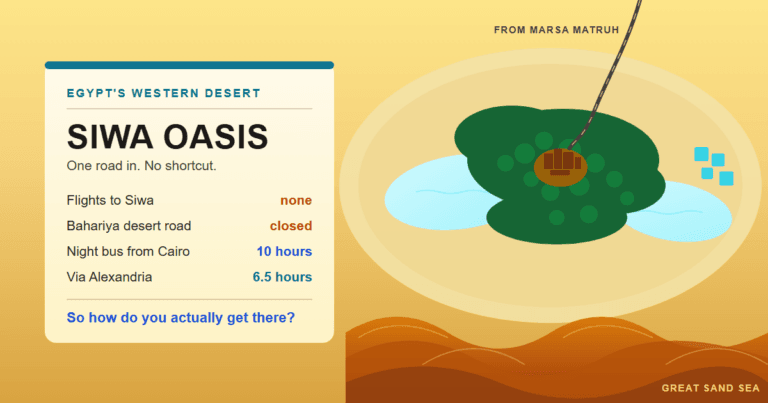
One more thing about the map. The road from Bawiti to Siwa is closed with military checkpoints, and the FCDO advises against all but essential travel on it. So the “desert loop” that older itineraries describe doesn’t exist. Why Siwa is a separate trip, not the other half of a loop explains it, and buses, drivers and flights across Egypt compared covers getting back to Cairo for the next leg.
A Two-Day White Desert Tour, Hour by Hour
About 34 hours door to door. Eleven of them are on tarmac, two to three in a 4×4 off it, under two on foot, and one night in a designated camp. I timed my own trip and cross-checked it against a published account with the same 7 a.m. pickup and 6 p.m. return (Walk My World, 2023). The numbers match: the day is the drive, and the night is the trip.
The stops are always the same five, in the same order. Bahariya first, for lunch and sometimes a hot spring. Then the Black Desert, a belt of cone-shaped hills capped with dark basalt that runs for about 30 km south of the oasis (Wikipedia). You’ll climb one. It takes fifteen minutes and the view explains the name. Then Crystal Mountain, a roadside ridge of barite and calcite crystals in the chalk, not the quartz most tour pages claim and not a mountain (Wikipedia), and worth exactly the ten minutes you’ll get. Then Agabat, the first place the jeep leaves the road, a valley of cliffs and soft dunes. Then the White Desert for the last hour of light.
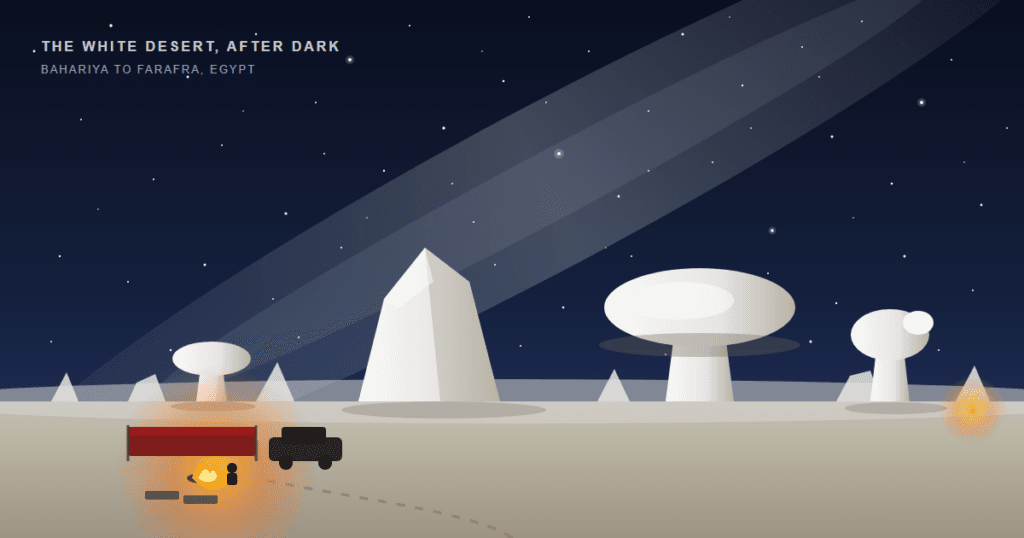
Camp is a windbreak of blankets strung between the jeep and a couple of poles, a low table, a fire, and a foam mat and blanket per person. Tents exist if you ask. Dinner is Bedouin-cooked, usually chicken with rice and vegetables, then tea. No toilet, just a designated spot and a shovel, though some operators bring a portable one on request. Water is limited. Then the sky does what it does, and the fox arrives.
Morning is the best part. Sunrise on the chalk, breakfast, a slow loop through the formations while the light is low, and the highway home. The Golden Mummies stop in Bawiti on the way back is optional: about 34 tombs have been dug since the valley was found in the mid-1990s, with estimates of up to 10,000 burials, but the town museum shows around ten (Wikipedia). Treat it as a lunch break with a museum attached.
The three-day version adds a second night, usually deeper in the park or at Farafra, plus the hot springs and the Badr Museum in Farafra’s old town. It’s the better-value trip if you have the day, because the tarmac hours are the same either way, and the 145 to 200 dollars a second night adds buys a whole extra day in the park. At the end, tip the driver-guide and the cook, because the tour price mostly doesn’t reach them. And download your maps in Cairo: our coverage chart already rates the Western Desert as patchy, and the park itself has nothing.
How Much Does the White Desert Cost?
A White Desert Egypt overnight runs from about 85 US dollars a person for a hostel-run shared trip to about 400 a person for a private three-day trip, which a Bawiti operator quotes at 350 to 450 (Egypt Camp White Desert, 2026). A second operator’s 2026 list puts a private two-day trip at 190 to 250 dollars a person for two people, or 150 to 200 a person for four, with park entry included (Sem Elegant Voyage, May 31, 2026). The difference between tiers is group size and who you book through, not which stops you see.
What each tier buys, dated September 4, 2026.
| Tier | Per person, dated | What changes |
|---|---|---|
| Hostel-run, shared | 85 to 120 USD | Minibus, shared jeep, mats and blankets, basic food |
| Mid-market, shared | 150 to 275 USD | Smaller group, tent option, better food |
| Private, two to four people | 175 to 250 USD | Your own jeep and guide, camp away from the cluster |
| Three days via Farafra | 320 to 450 USD | Second night, hot springs, Badr Museum |
Two things sit outside every price. The park fee, which was 250 EGP, about five dollars, on the most recent dated list I found (Sem Elegant Voyage, May 31, 2026); older, undated listings had it far lower, and operators bundle it inconsistently, so ask. And the tips, which for a driver-guide and a cook over two days are a genuine part of their income. The range in my tipping guide is 100 to 200 EGP a day for a guide and 70 to 120 for a driver; for a crew of two over two days, budget around 500 EGP between them.
The do-it-yourself arithmetic looks like this. The bus to Bawiti is a few dollars. Sem Elegant Voyage’s component list puts a Bawiti lodge at 38 to 86 dollars a night, a night in the desert bivouac at 43 to 54 a person, meals at 13 to 19 a day, and the guide plus fees at 32 to 43 a day. The expensive line is the jeep, quoted at 485 to 650 per vehicle for a three-day circuit. So the DIY saving depends entirely on how many people you can put in it. Alone, book the tour. As three or four, book the bus.
Where that fits in the whole trip is in the full Egypt budget in EGP and USD. And for people who’d rather sleep in a bed either side of the night in the sand, the Bawiti and Farafra lodges compared is the roundup.
How Cold Does It Get, and When Should You Go?
October to April, and pack for a night near freezing in the middle of it. Farafra’s January nights average 4.1°C and the record low is minus 3.3°C; July days average 37.8°C and the year brings 2 mm of rain (NOAA normals via Wikipedia). A summer overnight is inadvisable, which is what our month-by-month guide to heat and crowds already says.
Month by month, it goes like this. October and November: warm days around 25 to 31°C, nights around 10 to 16°C, the easiest weeks of the year. December to February: days near 20°C, nights around 4 to 6°C on average and below zero on the bad ones, the driest air and the busiest camps. March and April: warming fast, with the khamsin sandstorm season starting. May to September: 35 to 38°C average highs and nights around 18 to 22°C. Operators sell summer trips. I wouldn’t buy one.
What the operator gives you is a foam mat and a blanket, which is fine in October. In December and January bring a real sleeping bag, a hat, socks and a fleece, and ask what’s actually supplied before you pay. The coldest hour is the one you get up in. Our season-by-season packing list covers the rest.
One thing that matters more than the month: the moon. My night was two days off full, and the desert was lit like a stage. I could walk between the mushrooms without a torch, and the chalk glowed. What I couldn’t see was the Milky Way, which needs a dark sky and a new moon. The nearest town, Qasr Farafra, is 45 km away, and the air holds almost no moisture, so on the right night the sky is as good as I’ve seen anywhere. Check the phase before you book, and decide which show you want. You can’t have both.
If you’re choosing between Egypt’s two independent-traveller deserts, Sinai is the quieter one with walking in it. I’d take the White Desert in winter and Sinai in the shoulder months.
Is the White Desert Safe, and Is It Allowed?
Yes, on the corridor every licensed operator uses, and the advisory is more precise than the internet suggests. The FCDO advises against all but essential travel to “the area west of the Nile Valley and Nile Delta regions”, then lists the exceptions by name: “the oasis towns of Bahariya, Farafra, Dakhla (Mut) and Kharga”, the White and Black Deserts, and the road between Giza and Farafra within 50 km either side (GOV.UK, checked September 4, 2026).
The same page adds the sentence that decides how you visit: tourists entering Bahariya, Farafra and the White and Black Deserts “must apply for permits in advance and use an official guide”. And it names the one hard no in the region: the road between Al Bawiti and Siwa, which “is closed and there are military checkpoints”. Your operator files the permit with a copy of your passport. You’ll never see it. You’ll just be waved through.
The US State Department holds Egypt at Level 2, refreshed July 15, 2026, with elevated risk confined to North Sinai, the Libya border strip and “parts of the Western Desert” (U.S. Department of State, 2026). Read against the FCDO’s exception list, the parts it means are the border strip and the deep south-west, not the Bahariya road. The honest read on what the advisory zones mean covers the rest of the country.
The risks that matter are the ones no advisory covers. No phone signal in the park. The nearest serious hospital is back in Cairo, hours away. A driver showing off on soft sand, which is how jeeps roll over. Dehydration in April, hypothermia in January, and a fire at night. So check that the operator is licensed, ask whether they use the designated sites, and keep your passport in your hand at the checkpoints, not in your bag.
For women travelling alone, the desert was one of the easier places in Egypt on the evidence of my own jeep: a shared vehicle, a Bedouin crew who kept a respectful distance, two women travelling solo who said the same, and nowhere for hassle to come from. What women arriving alone should expect covers the calibration for the rest of the trip.
Is the White Desert Worth It, and Who Should Skip It?
A White Desert Egypt trip is worth it if you have three spare days and stay the night. It is not, if you’re on a first seven- or ten-day trip built around the Nile, or if you’re considering the day trip. The day trip exists. On the hour audit above, which I timed and matched against Walk My World’s 2023 account, it’s about twelve hours of driving for ninety minutes of chalk, and the one thing everyone remembers, the night, isn’t in it.
The White Desert also isn’t as empty as it looks in the photos. In 2017, Mahmoud El Kaissouni, environmental adviser to Egypt’s tourism minister, told PRX that 120,000 entrance tickets had been sold the previous year but that real visitors were about three times that, because guides enter off-track and bypass the booths (The World from PRX, 2017). A Cairo guide’s annual clean-up had just hauled out more than four tons of rubbish. “Less tourism through our fragile desert is better for us in the long run,” El Kaissouni said.
That was nearly a decade ago and visitor numbers have only grown. On my night I could see two other camps’ fires. So ask three questions before you pay.
- Where do you camp, and is it a designated site?
- Do you stay on the marked tracks?
- Do you pack everything out, including the fire ash?
An operator who answers all three without hesitating is the one to book.
If you want a taste of the Western Desert on a short trip, Fayoum, about 100 km from Cairo, is the honest substitute. Where three desert days fit in fourteen shows the version where the real thing works.
White Desert Egypt FAQs
How do you get to the White Desert from Cairo?
Through Bahariya. Bawiti is about 370 km and four to five hours from Cairo on a paved road, then it’s about two more hours south, the last stretch of it off the tarmac by 4×4. Most people take a tour with hotel pickup. The alternative is the Upper Egypt bus from Turgoman to Bawiti, about six hours and roughly 150 to 200 EGP, then a local operator for the jeep.
Can you visit the White Desert without a tour?
Not the park itself. The FCDO says tourists entering Bahariya, Farafra and the White and Black Deserts “must apply for permits in advance and use an official guide”, checked September 4, 2026, and the tracks are soft sand with no markers. What you can do is take the public bus to Bawiti and book the 4×4 overnight with a local operator there, which cuts the cost if you fill the jeep.
How much does a White Desert Egypt tour cost?
From about 85 US dollars a person for a hostel-run shared overnight to about 400 a person for a private three-day trip, on the dated prices I audited on September 4, 2026. A named operator’s 2026 list puts a private two-day trip at 150 to 250 dollars a person depending on group size, and another quotes 350 to 450 a person for a private three-day trip. Add the park fee, 250 EGP on the most recent dated list, and tips.
How cold is the White Desert at night?
Near freezing in midwinter. Farafra’s January nights average 4.1°C and the record low is minus 3.3°C, per NOAA normals. October and November nights sit around 10 to 16°C. The operator’s foam mat and blanket are fine in autumn; from December to February bring a real sleeping bag, a hat and socks, and ask what’s supplied.
Is the White Desert safe?
Yes, with a licensed operator on the Bahariya corridor. The FCDO names the White and Black Deserts, the four oasis towns and the Giza to Farafra road within 50 km either side as exceptions to its Western Desert warning, checked September 4, 2026. The closed road is Bawiti to Siwa. The real risks are no signal, no nearby hospital, and soft-sand driving.
How many days do you need for the White Desert?
Two days and one night minimum. Three days with a second night and Farafra is the better-value version, because the eleven hours of tarmac are the same either way, and the 145 to 200 dollars a second night adds buys a full extra day in the park. The day trip is about twelve hours of driving for ninety minutes among the formations, and it skips the only part that matters.
The Bottom Line
So who is the White Desert for, knowing that eleven of the tour’s 34 hours are tarmac? Second trips. Anyone with fourteen days or more. Anyone who’ll trade a day of highway for one night that looks like nowhere else. And anyone who has read the cold paragraph and packed for it.
Skip it if you’re a first-timer on a Nile trip of ten days or fewer, if you only have a day, if you’re travelling in summer, or if you need a door on the toilet. Fayoum is the short-trip substitute, Sinai is the quieter desert, and Siwa is a separate journey entirely.
Would I go again? Yes, for three days, in November, on a new moon, with a proper sleeping bag and a question for the operator about where they camp.
Egypt Travel Vibe carries advertising and partnerships, and discloses them. What it doesn’t do is sell desert packages. That’s why this White Desert Egypt guide can tell you that eleven of the tour’s 34 hours are tarmac, that the park fee gets bundled or doesn’t depending on who you ask, and that the wilderness in the photos has two other camps in it. Where the record was unresolved, as with the bus fare and the fee, I dated it rather than smoothed it.
Marco re-checked every price, fee, fare, temperature and advisory line on this page against source on September 4, 2026.
Still shaping the trip? Where the Western Desert fits against the rest of the country is the wide-angle view.