
Last verified: August 13, 2026. The US, UK, Australian and Canadian advisories, the arrival figures and the WHO road-safety rates were checked against source on the date above. Advisories get rewritten without notice, so I re-check this page monthly and update the date each time.
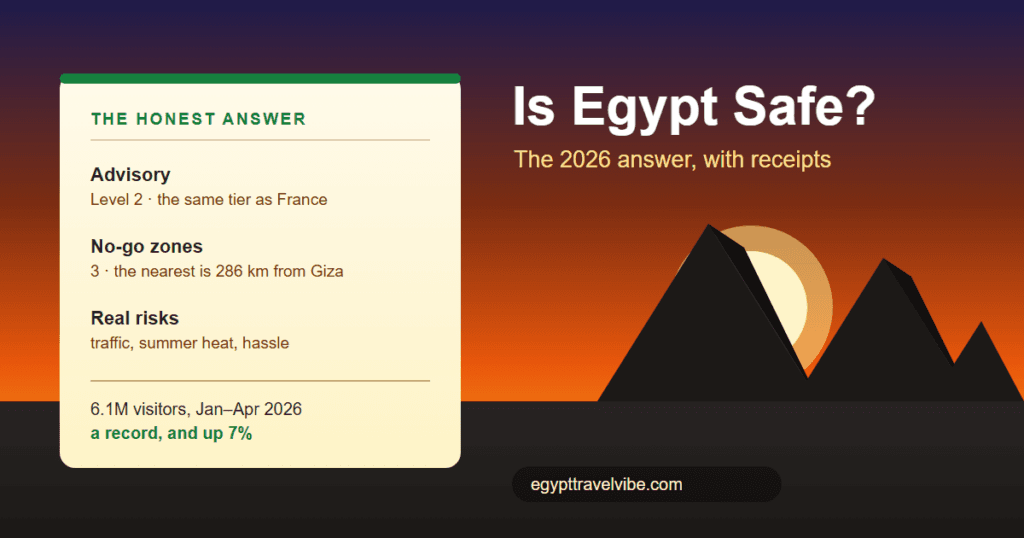
Every regional headline sends “is Egypt safe” searches spiking. Meanwhile, in the first four months of 2026, Egypt logged a record 6.1 million visitors, up 7% on the year before (Egypt’s State Information Service, 2026). Both things are real, and this guide explains how they fit together.
Disclosure: Some links in this guide may earn us a commission, at no extra cost to you. It never changes what we recommend.
Here’s what you’ll get. The current advisory status in plain English. A map answer nobody else publishes. An honest ranking of what actually goes wrong for tourists, and a straight take on solo female travel. I’ve walked the full Cairo-Luxor-Aswan route solo, and I re-check every advisory cited here monthly. Most safety pages are written by companies selling tours. This one isn’t, which is why it can tell you about the hassle too. If you’re still shaping the trip itself, start with our complete Egypt travel guide.
Key Takeaways
- Egypt’s tourist corridor (Cairo, Luxor, Aswan, the Red Sea) is operating normally. The US advisory was refreshed on July 15, 2026 and stayed at Level 2, the same tier as France.
- Every major Western advisory flags the same three no-go zones: North Sinai, the Libya border strip, and parts of the Western Desert. The nearest sits 286 km from the Pyramids, by our calculation.
- The risks you’ll actually meet are hassle, scams, traffic, and summer heat, not violence.
Table of Contents
Is Egypt Safe to Visit Right Now?
Yes, for the standard tourist route. On July 15, 2026, the US State Department refreshed its Egypt travel advisory and kept it at Level 2, “Exercise Increased Caution,” with no rating change (Travel.State.Gov, 2026). A refresh that changes nothing is itself the news: the situation was reviewed and judged stable.
Level 2 sounds ominous until you see who shares it. France and Turkey, two of the most visited countries on the planet, sit at the same level in 2026 (travel.state.gov advisory listings, 2026). The tier means “be more alert than at home,” not “reconsider your trip.”
The consensus runs deeper than one government. As of mid-2026, the UK (GOV.UK), Australia (Smartraveller), and Canada (travel.gc.ca) all rate the main tourist areas the same way: travel normally, stay alert. All three flag the same three exceptions we’ll map below. Four governments drawing the same line, each on its own review cycle, is about as strong as safety evidence gets.
| Advisory | Tourist areas (Cairo, Luxor, Aswan, Red Sea) | Flagged zones |
|---|---|---|
| US (Level 2) | Exercise increased caution | North Sinai, Libya border, parts of Western Desert |
| UK | Travel with normal caution | Same three zones |
| Australia | Exercise a high degree of caution | Same three zones |
| Canada | Exercise a high degree of caution | Same three zones |
All four advisory positions as checked on August 13, 2026; each links above.
The company Egypt keeps at Level 2 says more than the label does.
Is Egypt Safe With the Regional Conflict Going On?
This is 2026’s live question, and the answer so far is that the conflict hasn’t touched the tourist corridor. As of the July 2026 advisory roundups, Cairo, Luxor, Aswan, Hurghada, and Sharm El-Sheikh are operating as usual. Egypt itself has not been targeted (Jetpac Global, Egypt advisory roundup, July 2026).
Travelers are answering with their bookings. Egypt’s arrivals rose 7% year over year through April 2026, a record pace. The tourism ministry is targeting 20 million visitors for the year (Ahram Online, 2026). Worth knowing: those figures all trace back to ministry data, so treat them as one source, not several. The advisory picture, which comes from four separate foreign governments, is the stronger evidence.
What would regional escalation actually look like for a tourist? Mostly flight-path changes and higher airfares before anything on the ground. Which is exactly why the last section of this guide lists the specific signals that would change our answer.
Which Areas of Egypt Should You Avoid?
Three zones, and every major Western advisory names the same ones: North Sinai, the strip along the Libyan border, and parts of the Western Desert (GOV.UK, 2026). Now the part nobody shows you: none of them are anywhere near the places you’re going.
We measured it. In straight-line terms, the Giza pyramids sit 286 km from El Arish, the North Sinai capital at the heart of the restricted zone. Hurghada is 431 km away. Luxor is 612 km, and Aswan 788 km. For scale, London to Edinburgh is 534 km. Standing at Karnak, you’re further from the restricted zone than a Londoner is from Scotland.
The no-go zones are real. So is the distance between them and your itinerary.
One nuance the headlines flatten: Sinai isn’t one place. The restrictions cover North Sinai. The South Sinai resorts, Sharm El-Sheikh, Dahab, and their neighbors, sit under a separate, heavy security regime with milder advisory wording. They even get a dedicated free entry stamp for short stays. The Western Desert isn’t blanket-banned either. The White Desert camping route runs on permits with licensed guides, which is how it’s meant to be done anyway.
What Actually Goes Wrong for Tourists in Egypt?
Petty, opportunistic stuff, almost never violence. The UK government’s own advisory wording is that most crime affecting foreigners in Egypt is opportunistic theft like pickpocketing (GOV.UK, 2026). The rest of its list: aggressive vendors, taxi overcharging, and unsolicited “guides” who expect a tip. That matches what you’ll actually feel on the ground. Here’s the honest hierarchy.
Hassle sits at the top. Tout pressure around Giza, Luxor’s east bank, and the bazaars is constant, and it’s the thing that makes new arrivals feel unsafe. It isn’t danger; it’s commerce played loud. A firm “la shukran” (no thanks), no eye contact, and forward motion solves ninety percent of it. Our full breakdown of how Egypt’s tourist scams and touts actually work covers the 11 common setups, what each should really cost, and the exact words that end them.
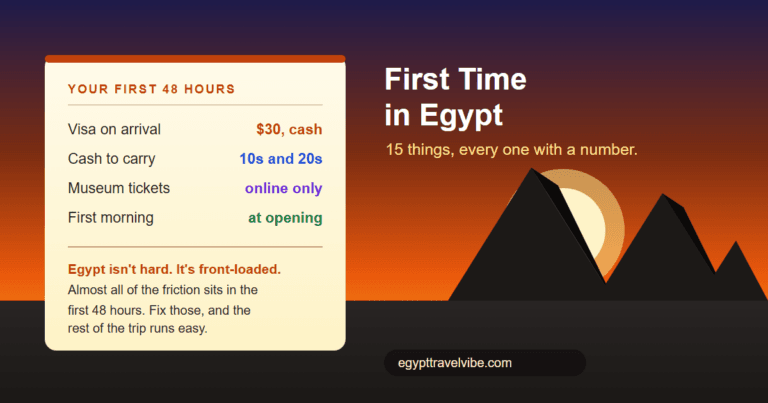
Scams come second. Unmetered taxis, “the site is closed, come to my shop instead,” and gift-then-demand routines are the classics. Most of them collapse against basic preparation. Know your site’s real opening hours before you arrive, and agree every price before a service starts. Treat anything handed to you “as a gift” as a sale you haven’t agreed to yet. The most expensive scam happens before you even fly: copycat e-visa sites charging double the official rate. That’s why the visa guide is the first thing we tell readers to check. In cities, Uber removes the taxi problem entirely.
Traffic is the real danger, and no safety page leads with it. Per WHO estimates, Egypt’s road traffic death rate runs around 10 per 100,000 people (WHO road traffic mortality data), latest estimates). That’s roughly four times the UK’s 2.6, and nearly three times Germany’s 3.7. Crossing a Cairo road is a skill. Do it beside a local the first few times, and pick drivers, not the cheapest ride, for intercity trips.
Statistically, the most dangerous thing you’ll do in Egypt is cross the street.
From walking the route: the scariest moment of my whole trip wasn’t a tout, a checkpoint, or a dark alley. It was a six-lane crossing near Tahrir at dusk. The things that felt threatening, the follow-along “guides,” the aggressive selling, never once turned into more than noise. The two times I was genuinely at risk, it was traffic and a July afternoon I pushed too far at Karnak.
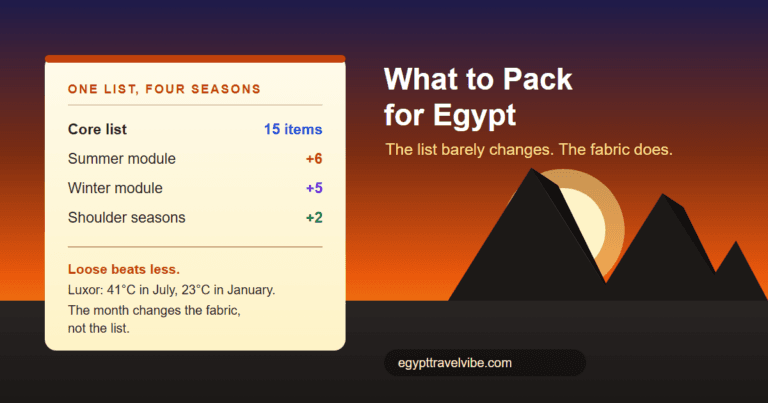
And then there’s heat. In August, Luxor runs around 41°C, and heatstroke puts more tourists in clinics than crime does in any summer. The month-by-month guide exists partly for this reason: picking your month is a safety decision as much as a comfort one.
Is Egypt Safe for Solo Female Travelers?
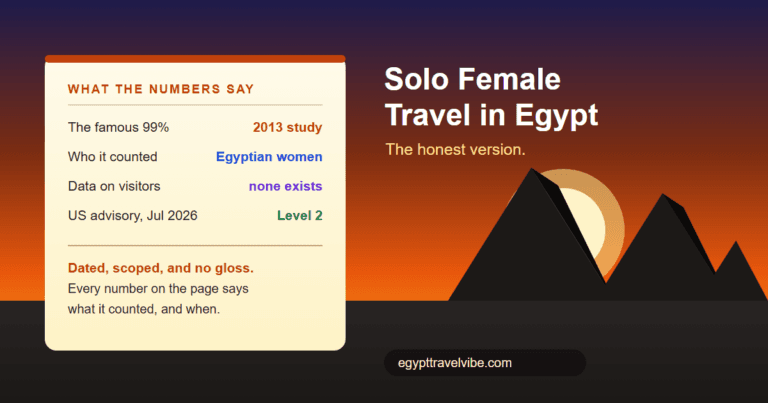
Yes, with preparation and one honest caveat: street harassment is real and common enough that you should plan around it. On the Travel Ladies community platform, solo female travelers rate Egypt 3.8 out of 5 for safety across 117 reviews as of August 2026 (Travel Ladies). That’s community data, not research. But it matches the tone of every honest first-person account we’ve read.
What does the harassment usually look like? Verbal attention, staring, and persistent vendors, mostly in crowded city areas. Violent incidents against tourists are rare, per the government advisories above. That gap matters more than anything else on this page: constant low-level annoyance on one side, rare actual danger on the other. Plan for the first. Don’t let fear of the second cancel the trip.
What works, according to the solo travelers who go repeatedly? Dress on the conservative side outside resort areas. Use Uber rather than street taxis in Cairo, and take the women-only metro cars. On trains and buses, sit next to women. And for the days you don’t want to manage attention at all, book a guide. None of this is required. All of it lowers the volume, and most women who’ve done Egypt solo say the trip was worth the extra planning.
Summer heat is a genuine safety variable. Time your trip and the biggest physical risk shrinks with it.
That full solo female guide, written with this same no-gloss policy, is now live: an honest look at solo female travel in Egypt, including what the widely quoted harassment statistics actually measure.
How Do Egyptians and the Police Handle Tourist Safety?
Tourism brought Egypt about $5.1 billion in the first quarter of 2026 alone (Ahram Online, 2026), and the state protects that income accordingly. Expect tourist police at every major site, bag scanners at hotel doors, checkpoints on intercity roads, and permit rules for desert routes. Around the monuments, that presence makes petty crime rarer than most visitors expect.
The same security posture has a flip side worth stating plainly: demonstrations are rare, and every advisory tells you to leave the area immediately if one forms. That’s advice to follow, not debate. Day to day, what you’ll notice more is ordinary hospitality. Nearly every interaction that starts with “welcome to Egypt” ends exactly as warmly as it begins. And when someone does cross a line, Egyptians nearby are often the first to step in on a visitor’s behalf. Shopkeepers wave off touts, and older men scold the persistent ones. The social pressure runs in your favor more than any first-day impression suggests.
What Would Change This Answer?
An honest safety page should name the things that would prove it wrong. Ours are short and specific. A US or UK advisory level change for the tourist corridor. Any incident targeting tourists inside that corridor. Airspace or airport disruptions from the regional conflict, or new zone restrictions. If any of those happen, this page changes the same week, and the “Last verified” date at the top of this page moves.
That’s the deal Marco Delgado makes on every practical guide on this site: the four advisories cited here get re-checked monthly, and this page gets corrected before your plans do. What won’t change the answer: another scary headline about the region that leaves Egypt’s corridor untouched. That’s been the pattern all year.
Frequently Asked Questions
Is Egypt safe to visit right now?
Yes, on the tourist corridor. The US advisory was refreshed July 15, 2026 and held at Level 2, the same tier as France, and Egypt drew a record 6.1 million visitors in January-April 2026. The three restricted zones sit hundreds of kilometers from the classic route.
Is Cairo safe at night?
In the districts tourists use, yes, with normal big-city sense. Use Uber instead of street taxis, keep valuables out of sight, and expect crowds rather than crime; GOV.UK’s 2026 advisory describes most crime against foreigners as opportunistic pickpocketing rather than anything violent.
Is Sharm El-Sheikh safe? Isn’t it in Sinai?
It’s in South Sinai, which is not the restricted zone. The no-go area is North Sinai, 286+ km from the resorts by our calculation. Sharm, Dahab, and Nuweiba run under heavy security and even offer a free Sinai-only entry stamp for stays under 15 days.
Is Egypt safe for solo female travelers?
Yes, with preparation. Street harassment is the honest caveat: common, verbal, and manageable with conservative dress, Uber, and women-only metro cars. Solo female travelers rate Egypt 3.8/5 across 117 reviews on Travel Ladies as of August 2026, and violent incidents remain rare.
Are the Pyramids and Luxor safe?
Yes; both are heavily policed, and the realistic problems are tout pressure and heat. Luxor averages 41°C in July and August, so dawn visits solve the heat and thin the crowds at once. Our month-by-month guide maps the comfortable windows.
The Bottom Line
Is Egypt safe? On the corridor where 6.1 million people traveled in the first four months of 2026: yes, with the same increased-caution posture the US assigns to France. The no-go zones are real, and they’re also 286 to 788 km from where you’ll stand. The dangers that deserve your planning are traffic, summer heat, and energy-draining hassle, in that order.
So prepare for the trip you’ll actually have. Sort the visa on the official portal before anything else, pick a month that keeps the heat manageable, and size the trip right so you’re not sprinting through it exhausted. Alertness works better when you’re not running on fumes.