
Last verified: August 13, 2026. Ride-hail and transfer prices, GEM ticketing, visa fees and advisory status were checked against source on the date above; the cold-quote figures are typical reported openers, not survey data. I re-check this page monthly and update the date each time.
What exhausts first-time visitors at Giza isn’t danger. It’s being sold to, continuously, from the moment you step out of the car. The UK government’s Egypt advisory names the same recurring friction most travelers describe: aggressive vendors, taxi overcharging, and unsolicited “guides” who expect a tip afterward (GOV.UK, 2026).
Disclosure: Some links in this guide may earn us a commission, at no extra cost to you. It never changes what we recommend.
Here’s what this guide does differently. Before the list, I’ll show you the three-step pattern that nearly every Egypt tourist scam follows, because once you can spot the pattern you can handle setups nobody has written about yet. Then 11 specific setups, what each should genuinely cost, and the exact words that end the conversation politely. These 11 were picked because they recur across government advisory wording, traveler forum reports, and my own trips, ordered roughly by how early a first-timer runs into them. For the wider picture of risk in Egypt, our honest Egypt safety guide separates hassle from actual danger. New to planning the trip? Start with the first-trip planning guide.
Key Takeaways
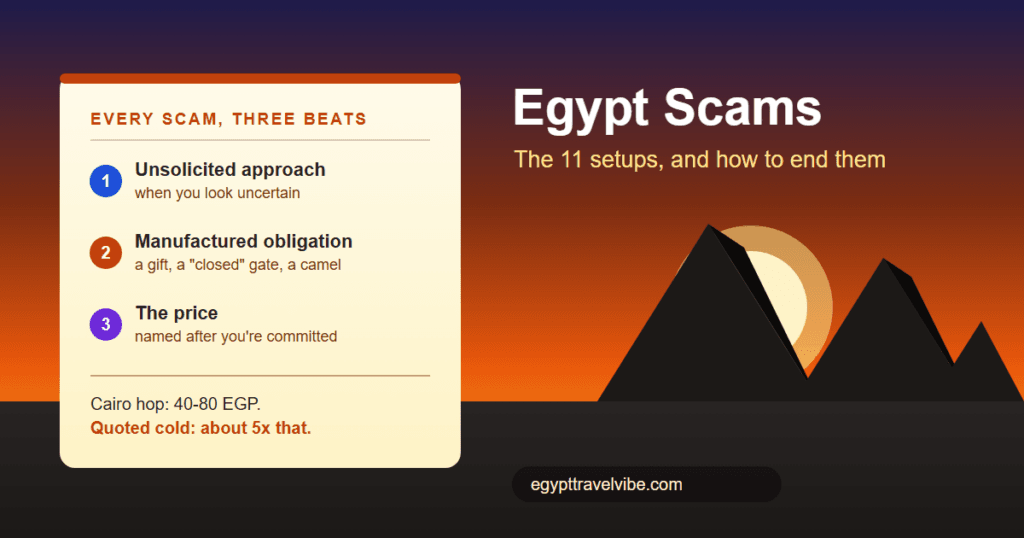
- Nearly every Egypt tourist scam runs the same three beats: an unsolicited approach, a manufactured obligation, then a price revealed only after you’re committed.
- The gap is the tell. A central Cairo ride-hail hop runs 40-80 EGP ($0.80-1.60) in 2026, and cold quotes to tourists routinely open several times higher.
- Almost all of it is commercial pressure, not crime. GOV.UK describes most crime against foreigners in Egypt as opportunistic pickpocketing.
- Two habits prevent most of it: agree every price before a service starts, and treat anything placed in your hand as a sale, not a gift.
Table of Contents
How Do Egypt Tourist Scams Actually Work?
Learn the structure and you won’t need to memorize the list. Nearly every setup below runs three beats in the same order, and the middle one is where it actually works.
Beat two is the hinge. Once you’re holding the “gift,” standing at the gate someone told you was closed, or sitting on a camel, the negotiation has already moved onto their ground. Beat three then costs whatever they decide it costs, and arguing about it in public feels worse than paying. So the counter is always the same: decline during beat one, when declining costs you nothing.
Worth stating plainly before the list, because plenty of guides get this wrong. The people running these setups are a small commercial minority working a hard trade in a country where tourism brought in roughly $5.1 billion in the first quarter of 2026 alone (Ahram Online, 2026). Most people who speak to you near a monument want nothing at all. Shopkeepers wave touts off tourists, and other Egyptians will often step in on your behalf when someone pushes too hard.
What Should These Things Actually Cost?
The gap between the real price and the opening quote is the clearest signal you’ll get. In 2026, a ride-hail hop across central Cairo runs 40-80 EGP, about $0.80-1.60, and our full Egypt cost breakdown prices the rest of the trip the same way, with a date on every figure.
Here’s the comparison nobody publishes. Left column: our published, dated price data. Right column: the kind of opening number quoted cold to an obvious tourist, compiled from traveler reports and quotes I’ve been given myself. Treat the right column as typical rather than measured. Nobody surveys this, and I’m not going to pretend otherwise.
| Service | Real price (2026) | Typical cold quote | Multiple |
|---|---|---|---|
| Ride-hail hop, central Cairo | 40-80 EGP | 250-350 EGP | ~5x |
| Cairo to Giza by car | 150-250 EGP | 500-700 EGP | ~3x |
| Bottled water at a site | ~10 EGP | 30-50 EGP | ~4x |
| Short camel ride, agreed first | 200-400 EGP | 1,000+ EGP after you mount | ~3x |
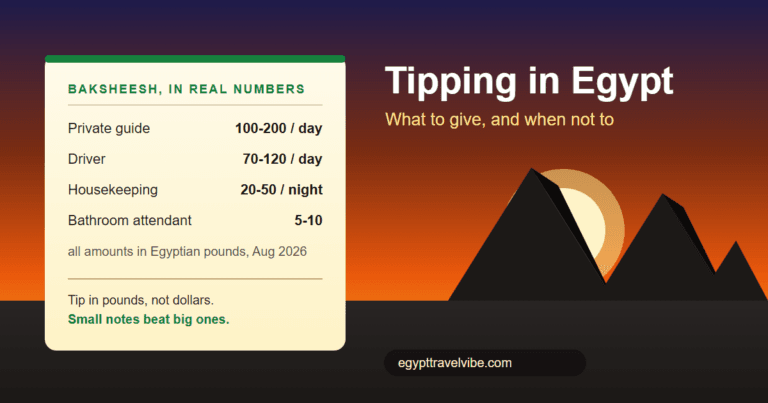
One habit removes most of this: agree the price before the service starts, every time. In cities, ride-hailing apps remove the negotiation entirely, because the fare is set before anyone moves. For tipping, which is a genuine custom rather than a scam, real amounts matter. Our guide to how baksheesh actually works, with real amounts covers every role, plus the times you should not tip at all.
1. The Broken Meter
You get in, and the meter is “broken today.” The fare gets decided at the end, when you’re already at your hotel with your bags in the trunk. It’s the most common setup in Cairo and the easiest to sidestep.
The counter is structural rather than verbal. Use Uber or Careem, where the price is fixed before pickup and there’s nothing to argue about. If you’re taking a street taxi anyway, name your price before you open the door, and be ready to close it again. Drivers who won’t agree upfront are telling you something useful.
2. “The Site Is Closed Today”
Someone near the entrance tells you the site is closed, the ticket office has moved, or there’s a holiday. They know a shop, a stable, or a “special entrance” instead. It’s beat two in its purest form: a manufactured obstacle that only they can solve.
Check the real hours before you leave your hotel, and keep walking toward the official gate. Egypt’s newer ticketing rules actually help here. Grand Egyptian Museum tickets sell online only, currently 1,500 EGP for foreign adults and rising by $5 on November 1, 2026 (Ahram Online, 2026), so anyone offering to sort your GEM entry on the pavement is offering something that no longer exists. Spotting a fake GEM ticket site takes four checks.
3. The Gift in Your Hand
A scarf, a bracelet, a small carved scarab, pressed toward you with “welcome to Egypt, this is a gift.” Accept it and the price appears seconds later, along with an audience. Refusing then feels rude, which is exactly the mechanism.
Keep your hands occupied or in your pockets, and say no before the object crosses the gap between you. If something has already landed in your hand, give it straight back with a smile and don’t break stride. The word you want is “la, shukran,” which is simply “no, thank you.”
4. The Camel You’re Already On
Cheap to get on. Expensive to get off. A short ride is agreed at a friendly number, and the price changes once you’re up, or the handler wants a separate fee to bring you back down.
Agree four things before you mount: total price, how long, where it ends, and that getting down is included. Say them out loud, and don’t pay in full upfront. Camel and horse rides at Giza aren’t a scam by nature. Plenty of people have a genuinely good time on one. The trouble lives entirely in the gap between mounting and dismounting.
5. The Unofficial Guide at the Gate
Someone falls into step beside you inside the site, starts narrating, points out a photo angle, and delivers a bill at the end. They never claimed to be free, and they never claimed to be official.
Official guides in Egypt are licensed, and a licensed guide will show you their Ministry card without any fuss. Ask early, before the narration starts. If you’d rather not engage at all, “I have a guide, thank you” ends most approaches instantly, and nobody checks.
6. The Helpful Photographer
At the classic viewpoints, a friendly stranger offers to take your photo with your own phone. Sometimes they’re being kind. Sometimes the phone comes back with a fee attached, and occasionally it doesn’t come back quickly at all.
Keep hold of the phone. If you want the shot with both of you in it, ask another tourist, or bring a small tripod. This one carries a slightly higher edge than the others, because it’s the only setup here where your property leaves your hands.
7. The Papyrus and Perfume “Factory”
Your driver or guide makes an unscheduled stop at a papyrus institute, perfume laboratory, or alabaster workshop. There’s a demonstration, tea, and a long soft sell. They earn commission on whatever you buy, which is why the stop exists.
Settle the itinerary before the day starts, ideally in writing over WhatsApp, and say clearly that you don’t want shopping stops. If one happens anyway, ten minutes and a polite “not today” is a complete answer. These places aren’t fake, exactly. The prices are simply built around commission.
8. Wrong Change and the Note Swap
Egyptian banknotes are easy to confuse in a hurry, and a 200 can come back as a 20 in the shuffle. Sometimes it’s genuine confusion. Sometimes it isn’t.
Count your change out loud, without hurry, before you walk away. Carry small notes deliberately, which you’ll want anyway for tips and taxis. For a mid-range week, budget 3,000-5,000 EGP, roughly $60-100, in cash for tips, taxis, and markets, while most major sites now expect cards.
9. The Free Ride That Isn’t
Someone offers transport for nothing, or close to nothing. The ride is real, and it ends at a shop where they collect commission on whatever you buy, with a long wait if you don’t.
Nothing here is dangerous, just expensive in time. Ask directly where you’re going and whether there are stops. When the answer gets vague, take the ride-hail instead and pay the 60 EGP.
10. The Airport Arrival Squeeze
You land tired, and the pressure starts immediately: unofficial porters who grab bags before you agree to anything, taxi touts intercepting you before the official rank, and exchange counters with margins built for jet lag.
Pre-book a transfer or walk past everyone to the official rank. Keep hold of your own bags unless you actually want the help, and change only a small amount at the airport, then use a bank ATM in town. Withdraw in Egyptian pounds, and when a card machine offers to charge you in dollars, decline it.
11. The Copycat Visa Site
The most expensive setup on this list happens before you leave home. Search for an Egypt e-visa and you’ll find third-party sites that look official and charge well above the government rate for the same document.
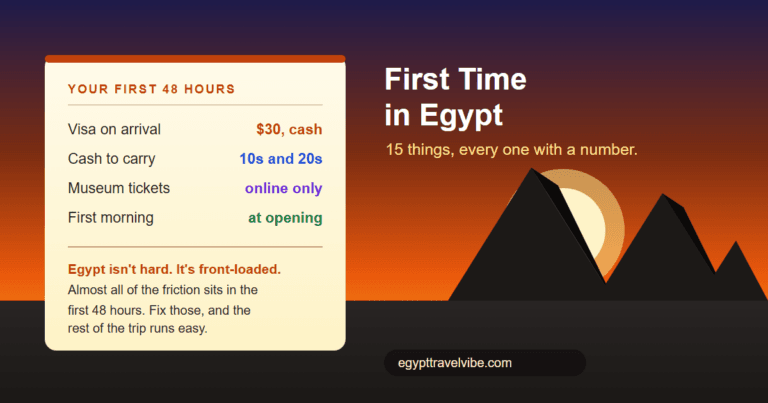
Only one domain is real, and it ends in `.gov.eg`. Visa on arrival costs $30 in cash, and the official portal is visa2egypt.gov.eg (GOV.UK, 2026). Our full guide to Egypt visa requirements walks through the tells, because this one costs more than every taxi overcharge of your trip combined.
How Do You Say No Without Being Rude?
Declining well is the single most useful skill against Egypt tourist scams, and most travelers get it wrong by over-engaging. A polite refusal in Egypt is short, warm, and doesn’t explain itself. “La, shukran,” a hand on your heart, no eye contact, and you keep walking.
Explanations are what prolong the exchange. “I already have one” or “maybe later” both read as an opening, so the conversation continues. Silence with a small smile works better than a reason. If someone follows, stop responding entirely and head toward a ticket office, a guard, or a hotel entrance, all of which end it.
Worth separating two different things here, because plenty of guides blur them. Haggling in a market is not a scam. Bargaining in Khan el-Khalili is a normal commercial register, it’s expected, and it can be genuinely fun once you stop treating every price as an insult. What you’re opting out of is pressure, not Egyptian commerce.
The one I didn’t spot: at Giza, a man in a neat shirt near the entrance told me my ticket didn’t cover the plateau road and pointed me toward a stable. I’d read about this exact setup and still followed him for thirty seconds, because he sounded like staff and I was disoriented in the heat. What broke it wasn’t cleverness. I looked up, saw the official gate, and walked to it. That’s the whole skill: check the thing yourself instead of accepting someone else’s version of it.
When Is the Hassle Worst?
Timing changes the volume more than any technique does. Arrive at Giza when the gates open and you’ll meet a fraction of the pressure you’d meet at eleven, because the crowd that touts work simply hasn’t formed yet. What to expect on the Giza plateau, gate by gate covers the tickets and the new entrance.
The same rhythm handles Egypt’s other physical risk. Luxor averages around 41°C in August, so the dawn start you’re making to dodge the crowds is the one that keeps you out of the afternoon heat as well. Our month-by-month guide to heat and crowds covers which weeks are worth targeting, and the 7, 10, and 14-day itineraries are built around early starts for exactly this reason.
Frequently Asked Questions
What are the most common tourist scams in Egypt?
The most common Egypt tourist scams are taxi meters that are “broken,” the claim that a site is closed, and the gift-then-demand routine. All three follow the same three beats: unsolicited approach, manufactured obligation, then a price named after you’re committed. GOV.UK’s 2026 advisory names the same friction.
How much should a taxi from Cairo to Giza cost?
Roughly 150-250 EGP by ride-hailing app in 2026, depending on traffic and your exact pickup point. Cold quotes to tourists commonly open two to three times higher. A hop across central Cairo runs just 40-80 EGP, about $0.80-1.60.
Are camel rides at the Pyramids a scam?
Not by nature. The problem is the dismount, where a friendly agreed price becomes a bigger one. Fix all four terms before you mount: total price, duration, where it ends, and that getting down is included. Expect roughly 200-400 EGP for a short ride.
How do I politely refuse a tout in Egypt?
“La, shukran,” which means no thank you, with a hand on your heart and no eye contact, while you keep walking. Explanations invite negotiation, so skip them. If someone follows, head for a ticket office or guard, which ends nearly every approach.
Is Egypt safe despite the scams?
Yes. Hassle and danger are different things. The US advisory held Egypt at Level 2, the same tier as France, when it was refreshed on July 15, 2026 (Travel.State.Gov, 2026), and GOV.UK describes most crime against foreigners as opportunistic pickpocketing rather than anything violent.
The Bottom Line
This guide is long because the setups are many, not because they’re dangerous. Almost everything here costs you money or patience, and almost nothing here costs you your safety. Learn the three beats and you’ve covered the Egypt tourist scams I haven’t listed, including whichever new one is being tried this season.
Two habits carry most of the weight. Agree every price before the service starts, and treat anything placed in your hand as a sale rather than a gift. Add a dawn start and you’ve removed most of the pressure before it forms.
Next: our honest safety guide for how hassle fits against real risk, and the full cost breakdown for every other price you’ll be quoted. I re-check the figures on this page monthly against primary sources and my own receipts.