
Last verified: October 14, 2026. Every price comes from the restaurants’ current online menus, read that evening, and converted at the Central Bank of Egypt’s rate of the day. Egyptian food prices are rising, so I re-check this page monthly.
In December 2025, UNESCO added a bowl of rice, lentils and macaroni to its list of humanity’s intangible heritage. Koshary is now a world heritage practice, and a small box of it at Koshary Abou Tarek in Downtown Cairo still costs 30 EGP, about 57 US cents. That’s about what a bottle of water costs at Zooba in Zamalek (28.10 EGP).
Disclosure: Some links in this guide may earn us a commission, at no extra cost to you. It never changes what we recommend.
Most food lists for Egypt read like a menu with the prices torn off. They don’t say where to go, what it costs or whether a dish is breakfast or a wedding feast. This Egyptian food guide fixes that. It lists 20 dishes, grouped by when Egyptians actually eat them. Each one has a named place and a price I read on October 14, 2026, plus the rules that keep street food fun instead of risky. For the manners around the table, see my guide to Egyptian culture and etiquette.
Key Takeaways
- Egyptian food is cheap, filling and often vegetarian. A ful or ta’ameya sandwich costs 12 EGP at a Downtown counter, about 23 US cents.
- Koshary joined UNESCO’s heritage list on December 10, 2025. Prices run from 23 EGP at a counter to 134 EGP at a sit-down restaurant.
- Eat by the clock. Ful and ta’ameya for breakfast, home cooking like molokhia at lunch, grills and feteer at night.
- Hot, cooked and busy is the safe end of the menu. The CDC rates the travelers’ diarrhea risk in Egypt as high, and says tap water outside big hotels isn’t safe to drink.
Table of Contents
All 20 Dishes at a Glance
Here’s the whole Egyptian food guide in one table, with a price for each dish. Low prices are counter or street prices. High prices are sit-down restaurants in Zamalek, the leafy island district many visitors stay in. All are menu prices read on October 14, 2026.
| # | Dish | What it is | Vegetarian? | Price range (EGP) |
|---|---|---|---|---|
| 1 | Ful medames | Slow-cooked fava beans | Yes | 12 to 76 |
| 2 | Ta’ameya | Fava bean falafel | Yes | 12 to 34 (sandwich) |
| 3 | Aish baladi | Whole-wheat flatbread | Yes | about 9 a loaf |
| 4 | Bessara | Fava and herb purée | Yes | 80 to 111 |
| 5 | Koshary | Rice, lentils, pasta, tomato sauce | Yes | 23 to 134 |
| 6 | Hawawshi | Spiced meat baked in bread | No | 154 to 188 |
| 7 | Kebda Iskandarani | Alexandria-style liver | No | 32 to 290 |
| 8 | Molokhia | Jute-leaf stew | Usually not | 70 to 482 |
| 9 | Mahshi | Stuffed vegetables and vine leaves | Often | 85 to 160 |
| 10 | Bamia | Okra in tomato sauce | Sometimes | 70 to 528 |
| 11 | Macarona béchamel | Baked pasta with meat | No | 135 |
| 12 | Fattah | Rice, bread, garlic sauce, meat | No | 350 to 509 |
| 13 | Kofta and kebab | Charcoal-grilled meat | No | 120 to 975 |
| 14 | Hamam mahshi | Stuffed pigeon | No | 236 |
| 15 | Sayadeya | Fish on caramelised-onion rice | Pescatarian | 402 (Cairo) |
| 16 | Tahina, baba ghanoug, torshi | Dips and pickles | Yes | 43 to 67 |
| 17 | Om Ali | Bread pudding with nuts | Yes | 112 |
| 18 | Basbousa and konafa | Semolina cake and shredded pastry | Yes | 43 to 160 |
| 19 | Roz bel laban | Rice pudding | Yes | 25 to 103 |
| 20 | Feteer meshaltet | Layered flaky pastry | Depends on filling | 85 to 285 |
At the Central Bank of Egypt’s rate of 53.04 to 53.18 EGP to the dollar on October 14, 100 EGP is about $1.89. The wide ranges on molokhia, bamia and kofta are portion sizes: a side dish against a full plate, or a sandwich against a kilo.
What Is Egyptian Food Actually Like?
Egyptian food is bread, beans, rice and vegetables first, with meat for weekends and feasts. The Egyptian word for bread, aish, also means life. Fava beans, lentils, onions, garlic, cumin and coriander do most of the work. Lemon, vinegar and chilli sauce sit on the table to finish things off.
That base comes from the Nile Valley, and some dishes are usually traced a long way back. Molokhia and flatbread are often linked to pharaonic kitchens, and the primer that makes the temples make sense covers that world. Later layers came with later rulers. Stuffed vegetables, kofta and konafa are usually credited to Ottoman and Levantine cooks, and macarona béchamel to Italian and French influence.
The regions differ too. Alexandria eats fish and spicy liver. Aswan cooks Nubian stews in clay pots. Sinai’s Bedouin bake bread in the sand, and Siwa runs on dates and olives. This guide stays mostly in Cairo, because that’s where you’ll eat most of your meals. I flag the regional versions where they matter.
How central are beans? Egypt eats far more fava beans than it grows.
Those are 2019 figures from a Cairo importer, so read them as scale, not a current count. The point stands: the beans in your morning ful have most likely crossed an ocean (Middle East Eye, April 2019).
What Do Egyptians Eat for Breakfast?
Ful and ta’ameya stuffed into baladi bread, eaten standing up before work, may be the most Egyptian meal there is. Breakfast counters are everywhere and cheap. A sandwich at GAD, a national chain, costs 12 EGP, and it’s the best-value meal in this guide.
1. Ful medames (stewed fava beans)
Fava beans are cooked low and slow, often overnight, then mashed and dressed with oil, cumin and lemon. Toppings change the name: ful bel tahina with sesame sauce, ful Iskandarani with tomato, pepper and onion. It’s earthy and filling, and it keeps you going until a late lunch.
Where to try it: GAD’s foul sandwich costs 12 EGP and its Alexandrian foul sandwich 19 EGP. Zooba in Zamalek sells a ful plate for 69.65 EGP, and Abou El Sid’s costs 76 EGP. In Alexandria, Mohamed Ahmed near Raml Station is the classic. It isn’t on the platform I used, so I couldn’t read a current price there.
2. Ta’ameya (Egyptian falafel)
Ta’ameya is Egypt’s falafel, but it’s made from fava beans rather than chickpeas, with a lot of fresh herbs. That makes it green inside, softer and lighter than the chickpea kind. It’s fried to order and stuffed into bread with tahina, salad and pickles.
Where to try it: GAD sells a falafel sandwich for 12 EGP, and Arabiata El Shabrawy’s costs 14.30 to 15.40 EGP. Zooba’s modern version is 25.41 to 34.37 EGP, or 11.53 EGP a piece. El Tabei El Domiaty, which Lonely Planet places near Ramses Station, is the old-school name; its branches list foul demes from 17 EGP.
3. Aish baladi (Egyptian flatbread)
Aish baladi is a round whole-wheat flatbread that puffs into a pocket in a very hot oven. It’s the spoon, the plate and the wrapper for most of this list. The government sells a subsidised loaf for 20 piastres to ration-card holders, five a day each. That price was quadrupled from 5 piastres in June 2024, the first rise since 1989 (IFPRI, 2024). Visitors buy at market price: Zooba charges 9.23 EGP a loaf.
4. Bessara (green fava purée)
Bessara is dried fava beans cooked with garlic, onion and a big handful of green herbs, then blended and topped with crispy fried onions. It’s a fasting dish, so it has no meat or dairy. It’s harder to find than ful, but worth asking for. Abou El Sid serves it for 80 EGP and Zooba for 111.23 EGP.
What Are the Best Egyptian Street Foods?
Koshary is the one street food every visitor should try, and the best-known shops sell it for 23 to 55 EGP a box. After that, the two classics are hawawshi, a meat pie in bread, and spicy Alexandrian liver. Street food in Cairo is a Downtown thing above all. A walk around Talaat Harb Street and up toward haggling and shopping around Khan el-Khalili passes most of the famous names.
5. Koshary
Rice, brown lentils, short macaroni and chickpeas go into a bowl, topped with a spiced tomato sauce, garlic vinegar and a pile of crispy fried onions. The chilli sauce is up to you. UNESCO inscribed “Koshary, daily life dish and practices associated with it” on its Representative List in December 2025, decision 20.COM 7.B.16. The decision notes it’s shared with neighbours and friends and passed down within families (UNESCO).
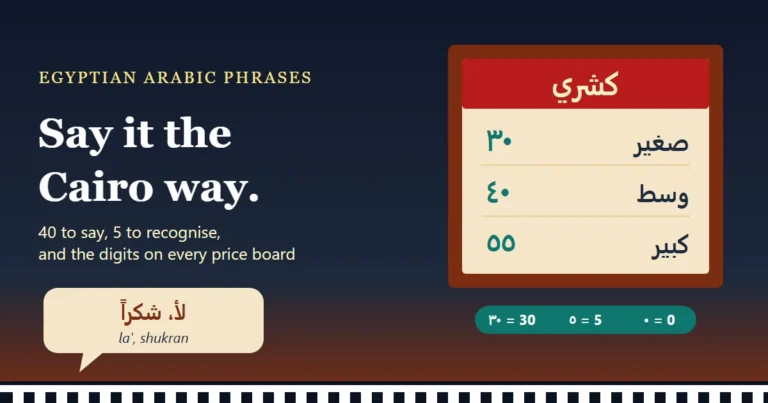
Where to try it: Koshary Abou Tarek on Champollion Street has more or less one dish. On October 14 it charged 30 EGP for a small box, 40 for a medium and 55 for the house size. Koshary El Tahrir starts at 32 EGP, and Sayed Hanafy at 23 EGP. The sit-down versions cost three to four times as much: 92.08 to 120.72 EGP at Zooba and 134 EGP at Abou El Sid.
6. Hawawshi (spiced meat baked in bread)
Hawawshi is minced beef or lamb mixed with onion, peppers and chilli, stuffed into baladi bread and baked until the fat crisps the crust. It’s greasy and very good late at night. I couldn’t find a dated street price for hawawshi on the platform, so here are the sit-down ones: 153.78 to 188.46 EGP at Zooba and 170 EGP at Abou El Sid.
7. Kebda Iskandarani (Alexandria-style liver)
Strips of beef liver are fried hard with garlic, green chilli and cumin, then stuffed into a roll with tahina and a squeeze of lime. It started in Alexandria and spread to late-night carts everywhere. Ezz El Menoufy sells a liver sandwich for 32 EGP. Zooba’s costs 174.89 EGP, and Abou El Sid’s Alexandrian veal liver plate 290 EGP.
That gap is the most useful thing in this guide. The same sandwich can cost five times as much depending on where you sit.
Ful and ta’ameya barely get dearer when you sit down. Liver and koshary do. The big jumps come on dishes that need a kitchen and a waiter, like molokhia, liver plates and koshary in a nice room. If you want to keep costs down, eat the breakfast and street dishes at counters. Save the sit-down budget for home cooking, which is the next section. For planning the rest of a Cairo day around these stops, see planning a Cairo day.
What Do Egyptians Cook at Home?
The best Egyptian food is home food, and lunch is the main meal. Families sit down around 3 to 5 in the afternoon, and Friday lunch after the noon prayer is the big family table of the week.
As a visitor, you’ll get closest to it at restaurants that cook like a home. Cairo Kitchen and Abou El Sid in Zamalek are the easiest. In Luxor, Sofra, a restaurant in an old house near the town centre, is the name most guides give. It isn’t on the platform I used, so check it’s open before you go. The Luxor guide has more on eating there.
8. Molokhia (jute-leaf stew)
Jute leaves are chopped fine and simmered in chicken or rabbit stock, then finished with garlic and coriander fried in ghee. The texture is silky, a little slippery, and that’s the point. You eat it over rice or with bread, alongside the chicken or rabbit it was cooked with. Cairo Kitchen sells a side of molokhia for 70 EGP and a plate with chicken for 300 EGP. Abou El Sid charges 420 EGP with chicken and 446 with rabbit, and Zooba 482.45 EGP with half a chicken.
9. Mahshi (stuffed vegetables)
Courgettes, peppers, aubergines, cabbage and vine leaves are stuffed with herby, tomato-red rice and simmered. Mahshi is a weekend job in most homes because rolling it takes hours. Cairo Kitchen sells a mixed plate for 85 EGP and vine leaves for 95. Abou El Sid’s vine leaves with a yoghurt dip cost 160 EGP. During Coptic fasts, the rice-only version is the default.
10. Bamia (okra stew)
Small whole okra are stewed in tomato sauce, usually with chunks of beef or veal, and eaten with vermicelli rice. Cairo Kitchen sells it as a 70 EGP side, or with meat for 350 EGP on its Thursday menu. Abou El Sid serves an okra tagine with veal for 468 EGP, and Zooba a version with beef shank for 527.68 EGP.
11. Macarona béchamel (baked pasta)
Penne goes into a tray with spiced minced beef and a thick white sauce, then into the oven until the top browns. It’s the dish of family gatherings and school lunchboxes. Cairo Kitchen’s oven macaroni with minced meat and béchamel costs 135 EGP. Neither Zooba nor Abou El Sid had it on the menu I read.
12. Fattah (rice, bread and meat)
Toasted bread goes in a deep dish under rice, garlic-vinegar tomato sauce and pieces of boiled lamb or veal. It’s the Eid al-Adha dish, served after the sacrifice, and it’s rich. Cairo Kitchen sells Egyptian veal fattah for 350 EGP. Abou El Sid’s knuckle fattah is 509 EGP.
What Should You Order at a Grill or by the Sea?
Grills sell meat by weight, and that’s the key to ordering. Ask the price per kilo, or order a quarter kilo, before they start cooking. At ElDahan, a quarter kilo of kofta was 247.50 EGP on October 14. On the coast, fish is chosen raw and also paid by weight.
13. Kofta and kebab (mashwiyat)
Kofta is spiced minced meat pressed onto skewers. Kebab is cubed lamb or veal. Both are grilled over charcoal and served with bread, tahina and salad. ElDahan, a Cairo kebab chain, charges 247.50 EGP for a quarter kilo of kofta and 277.50 for a quarter kilo of veal kebab. A kofta sandwich at El Haty is 120 EGP. Abou Shakra, the old-school grill house, prices lamb kofta and kebab by the kilo, at 840 to 975 EGP after its current discount.
14. Hamam mahshi (stuffed pigeon)
A small pigeon is stuffed with spiced rice or freekeh (smoked green wheat), boiled, then roasted or fried until the skin crackles. There’s not much meat, so you eat the stuffing and pick at the bones. It’s a celebration dish, made for feasts and family occasions. Abou El Sid charges 236 EGP for one pigeon and 446 for a pair. Farahat, a famous pigeon place near Khan el-Khalili, isn’t on the platform I used, so I don’t have a current price.
15. Sayadeya (Alexandria fish and rice)
White fish is cooked in a spiced broth, then served on rice made brown and sweet with caramelised onions. Sayadeya means “the fisherman’s”. In Cairo, Abou El Sid serves it for 402 EGP. In Alexandria, Abo Rawia sells seafood rice for 154 EGP. The traditional way is a fish restaurant in the Bahary district, like Kadoura: you pick your fish downstairs and pay by weight. Neither Kadoura nor the fish markets publish a price I could read, so ask the price per kilo before they cook. The Alexandria guide covers the rest of the city.
What Goes on the Mezze Table?
Mezze are the small cold plates that open a sit-down meal, and they cost 43 to 67 EGP a plate at the Zamalek restaurants I read. They’re also where vegetarians do best.
16. Tahina, baba ghanoug and torshi
Tahina is sesame paste thinned with lemon and garlic. Baba ghanoug is smoky charred aubergine. Torshi is the bright pink and yellow pickles: turnip, carrot, lemon and chilli. Add gebna beda (salty white cheese), salata baladi (chopped tomato and cucumber) and bread, and you have lunch. Abou El Sid’s baba ghanoug costs 67 EGP. At Zooba, a cup of tahina is 49.75 EGP and mixed pickles 42.76.
Raw salad is the one part of the mezze table to go easy on early in a trip. I explain why in the street food safety section below.
Egyptian Desserts Worth Saving Room For
Egyptian desserts are sweet, soaked in syrup or milk, and cheap at the specialist shops. Tseppas, a Cairo pastry chain, sold basbousa from 42.50 EGP on October 14, and Koshary El Tahrir’s rice pudding was 25 EGP.
17. Om Ali (bread pudding)
Pastry or bread is torn into a dish with hot milk, cream, raisins, coconut and nuts, then baked until the top blisters. The name means “Ali’s mother”, and every family has a story about who she was. Abou El Sid’s Om Ali with nuts costs 112 EGP.
18. Basbousa and konafa
Basbousa is a dense semolina cake soaked in syrup. Konafa is shredded pastry baked around cream, nuts or soft cheese and drenched in syrup. Konafa is the sweet of Ramadan nights, alongside qatayef pancakes, and my guide to traveling in Egypt during Ramadan covers the nights when the bakeries stay busy until dawn. At Tseppas, plain basbousa was 42.50 to 85 EGP by size, and konafa with qeshta, Egypt’s clotted cream, 80 to 160 EGP.
19. Roz bel laban (rice pudding)
Rice is cooked slowly in sweetened milk, chilled, and dusted with cinnamon or topped with nuts. It’s the cheapest dessert on this list. Koshary El Tahrir sells it for 25 EGP and Tom and Basal for 30. Zooba’s classic version is 68.17 EGP, and Abou El Sid’s with nuts is 103.
Feteer: Why Is Egypt’s Layered Pastry the Last Word?
Feteer is where an Egyptian night out often ends, and a plain round costs from 130 EGP. It’s dough stretched paper-thin, folded over and over with ghee, and baked into a flaky round. You can have it sweet with sugar, honey or cream, or savoury with cheese, sausage or minced meat.
20. Feteer meshaltet
Meshaltet is the plain, buttery village version. You tear it by hand and dip it in honey, molasses or mish (aged cheese). A fatatri (feteer bakery) makes it in front of you. On October 14, Re Cota El Manial charged 130 to 180 EGP for a plain meshaltet, by size. Abou El Sid’s was 156 EGP. Sweet feteer started at 85 EGP at Feteer El Anfoushy, and filled savoury rounds ran to 285 EGP and more.
It’s rich and filling enough to share. Order one between two or three people, then add a second if the table is still hungry.
Drinks to Order in Egypt
Tea first. Shai is black, strong and sweet, served in a glass, and offered everywhere from carpet shops to guesthouses. Cairo Kitchen charges 25 EGP for a pot and 30 EGP for Turkish coffee. I couldn’t find a dated price list for a traditional ahwa (café).
Karkadeh is hibiscus tea, deep red and tart, served hot in winter and iced in summer. Cairo Kitchen charges 65 EGP a glass, and Zooba’s hibiscus limeade is 71.73 EGP. Asab is fresh-pressed sugarcane juice from the juice stands with the green cane stacked outside. Fresh mango and guava juice cost 118.46 EGP at Zooba; I couldn’t read a stand price. Sahlab, a hot, thick milk drink with nuts, is the winter treat. On alcohol, my guide to Egyptian culture and etiquette covers the law. In short, drink only in licensed hotels, bars and restaurants.
Juice-stand and café prices aren’t published anywhere I could read, so I can’t chart them. What I can chart is how fast food prices are moving. In September 2026, prices for vegetables alone jumped more than 15% in a month (Daily News Egypt, October 2026, citing CAPMAS).
Bread and grains barely moved, which is good news for koshary and ful. Salads and anything vegetable-heavy are where menu prices will creep up first.
Is Egypt Easy for Vegetarians, Vegans and Halal Diets?
Yes, unusually so. Coptic Christians fast for “nearly 210 days out of 365,” giving up meat and, on most fast days, dairy (Egyptian Streets, February 2023). So plant-based food is built into the cuisine, and menus often mark it siyami, meaning fasting food. Muslims make up most of the country, so almost all meat is halal by default. Pork is rare and clearly labelled where it’s sold.
Of the 20 dishes, these are vegetarian as standard: ful, ta’ameya, bread, bessara, koshary, the mezze plates and most desserts. Mahshi and bamia come in meatless versions, especially in fasting season. Watch three things:
- Molokhia is almost always made with meat or chicken stock.
- Rice is often cooked in ghee or stock. Ask “bi zeit?” (with oil?).
- Feteer and Om Ali use butter, ghee and milk, so they’re fine for vegetarians but not vegans.
The fasting calendar also tells you when siyami food is easiest to find. Here’s how 2027 lines up.
In 2027, Ramadan and the start of Great Lent overlap in early March. That’s a quirk of the two calendars. In those days, much of Cairo is either fasting until sunset or eating no meat.
For the Nubian food of Aswan, made with dates, lentils and stews baked in clay pots, start with the Aswan guide. Then read how to visit a Nubian village respectfully before you sit down at a village table.
How Do You Eat Street Food in Egypt Without Getting Sick?
The CDC’s own page on Egypt says plainly that “The risk of travelers’ diarrhea in Egypt is high.” It also says thoroughly cooked meat and vegetables are generally safe in tourist hotels, on Nile cruise ships and in tourist restaurants (CDC Yellow Book). Street food is a different setting, and it isn’t one the CDC covers. Here are the five rules I follow.
- Hot and cooked in front of you. Ta’ameya fried to order, koshary ladled from a steaming pot and liver off a hot pan are the low-risk end. Lukewarm trays that have sat out are the high-risk end.
- Busy beats fancy. A long queue means the food doesn’t sit around. The famous koshary and ful shops turn over their pots all day.
- Peel it yourself. The CDC calls the safety of uncooked vegetables and salads “questionable.” Eat whole fruit you peel and go easy on raw salads in your first few days.
- No tap water outside big hotels, and that includes ice. The CDC says tap water isn’t safe to drink outside international tourist hotels. Ice can be made from it, so I skip ice at juice stands and street cafés. The tap-water question gets a full answer in my first-timer’s guide.
- Go easy on the buffet. Hotel and cruise buffets are where food sits warm for hours. Eat what’s freshly made or comes straight off the grill.
One dish the locals get warned about too: fesikh, grey mullet salted and fermented for the spring festival of Sham el-Nessim. Badly prepared fesikh can carry botulism. Health officials warn against it every spring, and Alexandria University’s toxicology centre warned again on April 10, 2026 (Al-Ahram, in Arabic). Unless you’re at a family table that’s made it for generations, skip it.
The CDC also rates the hepatitis A risk in Egypt as high. So check your vaccinations before you go, and pack oral rehydration salts. If you get sick, ask a pharmacist or doctor about treatment rather than guessing at antibiotics.
How Much Does Food Cost in Egypt, and How Do You Pay?
For this Egyptian food guide I priced every dish on October 14: a street breakfast costs 12 to 35 EGP, a koshary 23 to 65 EGP and a home-style lunch plate 300 to 530 EGP at a sit-down place. At 53 EGP to the dollar, that’s about $0.23 to $0.66 for breakfast, under $1.25 for koshary and about $5.70 to $10 for a proper lunch.
Prices are moving. Nationwide annual inflation was 12.8% in September 2026, with the urban rate most headlines quote at 13.9%, and food and drink prices were 7.9% higher than a year earlier (Arab Finance, October 2026, citing CAPMAS). That’s why every price on this page carries a date.
A few things to know at the table:
- Carry small notes. Street stalls, juice stands and ahwas run on cash. Sit-down restaurants are more likely to take cards, but ask before you order.
- Read the bottom of the bill. Sit-down restaurants often add a service charge and VAT. My restaurant tips and the service charge guide explains what to add on top.
- Ask the weight at grills and fish restaurants. Meat and fish are priced by the kilo, and the total can surprise you.
For how food fits into a whole trip budget, see my Egypt trip cost breakdown.
Egyptian Food Guide FAQs
What is the national dish of Egypt?
Koshary, by popular consensus. In December 2025 UNESCO inscribed “Koshary, daily life dish and practices associated with it” on its Representative List of the Intangible Cultural Heritage of Humanity. Ful medames is its daily rival. On October 14, 2026, a small koshary box cost 23 to 32 EGP at Cairo’s best-known shops.
What do Egyptians eat for breakfast?
Ful medames (stewed fava beans) and ta’ameya (fava bean falafel), usually in baladi bread with tahina, pickles and salad. Eggs, white cheese and bessara come on the side. A ful or ta’ameya sandwich cost 12 EGP at GAD in Downtown Cairo on October 14, 2026.
Is street food safe to eat in Egypt?
Choose food that’s cooked hot in front of you at a busy place, and it’s the low-risk end of the menu. The CDC rates the travelers’ diarrhea risk in Egypt as high. It says tap water outside international hotels isn’t safe and calls uncooked salads questionable. Skip ice at street stalls and peel your own fruit.
Is Egypt good for vegetarians?
Yes. Coptic Christians fast for nearly 210 days a year without meat, so meatless siyami dishes are on menus everywhere. Ful, ta’ameya, koshary, bessara, mezze and most desserts are vegetarian as standard. Watch for meat stock in molokhia and ghee in rice.
How much does a meal cost in Egypt?
On October 14, 2026, a street breakfast cost 12 to 35 EGP and koshary 23 to 65 EGP. A home-style lunch plate at a sit-down restaurant cost 300 to 530 EGP. At about 53 EGP to the dollar, that’s under $1 for most street food and about $5.70 to $10 for a full lunch.
What should I avoid eating in Egypt?
Avoid fesikh, the fermented fish of the Sham el-Nessim festival, which health officials warn about every spring over botulism. Also avoid tap water and ice outside large hotels, lukewarm buffet trays and raw salads in your first days. Cooked food served hot is the safe choice.
The Bottom Line
If this Egyptian food guide leaves you with one idea, make it this: Egyptian food rewards eating by the clock. Have ful and ta’ameya in the morning, home cooking at lunch, and grills, feteer and sweets at night. Price is no guide to quality here. The 12 EGP ta’ameya at a Downtown counter is the real thing, and the five-times mark-up buys a chair and a waiter, not a better sandwich.
- Start with koshary, ful and ta’ameya. They’re cheap, vegetarian and everywhere.
- Spend at lunch. Molokhia, mahshi and fattah are worth a sit-down meal.
- Ask the weight at grills and fish restaurants before they cook.
- Hot, busy and cooked in front of you beats any rule about where to eat.
Next, read my guide to Egyptian culture and etiquette for the manners around the table, and planning a Cairo day to fit these stops between the sights.
I’m Marco Delgado, and I write every guide on Egypt Travel Vibe. I read every price in this Egyptian food guide myself on the evening of October 14, 2026, from the restaurants’ current menus on the elmenus ordering platform. These are menu prices, which can differ a little from what you pay at the counter. Where I couldn’t read a price, like Mohamed Ahmed, Kadoura, Farahat or a street hawawshi oven, I’ve said so rather than guessed. I re-check this page monthly.