
Last verified: August 27, 2026. Entry fees, road curfew hours, convoy status, flight schedules and fares, bus and minivan prices, and Lake Nasser cruise rates were checked against source on the date above. Hour-by-hour timings and the road-day breakdown are my own, built from doing this trip both ways, not measured data. I re-check this page monthly.
Abu Simbel sits about 280 km south of Aswan, barely 40 km north of the Sudanese border. The desert road to it is closed to tourist traffic overnight. That one fact sets the departure time of every trip in this guide, including yours.
Disclosure: Some links in this guide may earn us a commission, at no extra cost to you. It never changes what we recommend.
Here’s what nobody tells you when you start working out how to get to Abu Simbel. The cheapest way to get there costs a few dollars. The most expensive costs the better part of a thousand. And four of the five options put you in front of the temples at exactly the same time of day, in exactly the same crowd, for exactly the same two hours.
So this guide to how to get to Abu Simbel is organised around the thing that actually varies, which is the hour you arrive. Below: all the routes priced door to door, the convoy question answered properly, and the two ways to escape the window everyone else is stuck in. If you’re still working out where this trip fits, our region-by-region look at where to go in Egypt covers that first.
Key Takeaways
- The police convoy people are warned about is largely gone. Vehicles now pass through monitored checkpoints instead of moving as an escorted column. The rigid 3.30am and 11.00am departure story describes a system that mostly no longer runs.
- Every day trip buys the same two hours, roughly 8am to 10am, in the same crush, whether you paid $6 for a minivan seat or $200 for a flight.
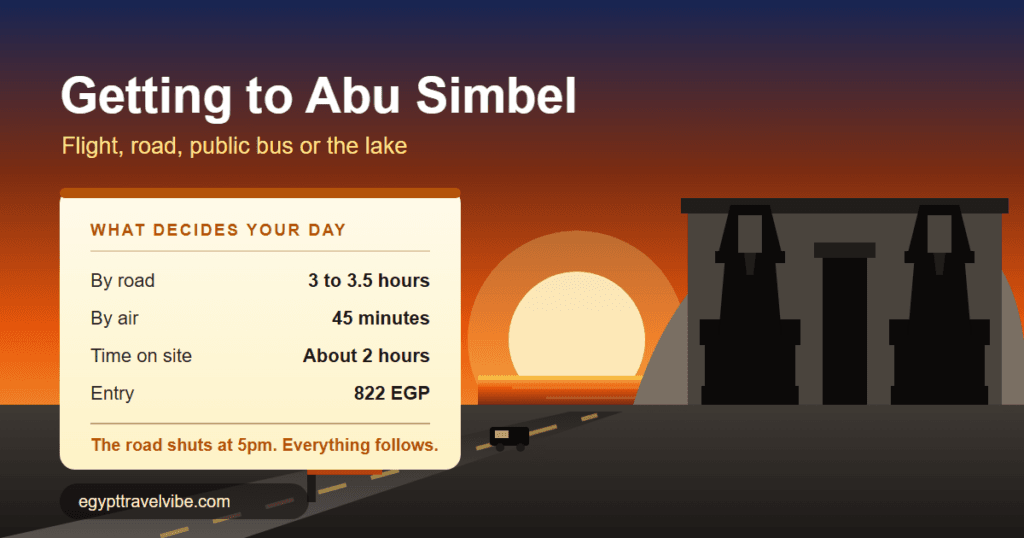
- The cause is a road curfew, not a schedule. The highway is shut to tourist traffic from about 5pm to 5am, so the 4am start and the 4pm departure cutoff are forced on everyone.
- Only two routes escape it: a night in Abu Simbel town, or a Lake Nasser cruise. Both put you at the temples at sunset and sunrise with almost nobody there.
- Live pages currently quote the entry fee at 200, 750, 822 and 1,272 EGP. The working figure is 822 EGP for a foreign adult at the official checkout, verified 21 July 2026.
Table of Contents
How to Get to Abu Simbel: Which Route Is Fastest?
The 45-minute EgyptAir flight from Aswan, which runs around 21 times a week as of July 2026 (FlightConnections, 2026). It’s the fastest by a wide margin. It is not automatically the best, and the reason why is the whole point of this guide.
There are five realistic answers to how to get to Abu Simbel, and they split into two groups. Four of them are day trips out of Aswan and back. One of them isn’t a day trip at all.
The spread is real and the outcome mostly isn’t. Spending more on this trip buys comfort, a shorter day and a softer wake-up. It does not buy you a better view, more time at the temples, or fewer people in your photographs. Understanding why requires understanding the road.
Getting there from Luxor or Cairo
You go via Aswan. There’s no sensible direct route: a Luxor-based day trip means roughly ten to twelve hours of driving on top of everything below, and Cairo means flying to Aswan first. Treat Aswan as the base and read how the flights, trains and cruises between Egypt’s cities actually compare before you book the leg south.
Why Does Every Abu Simbel Day Trip Start Before Dawn?
Because the desert highway is closed to tourist traffic from about 5pm to 5am on security grounds (Third Eye Traveller, 2026). Operators describe the same window, opening at 5am and shutting at 5pm (Tales From The Lens, 2025). Not because of sunrise. Not because of the heat. A curfew, nothing more.
Follow the chain and the whole day falls out of it. Hotels start collecting people around 4am so vehicles can be at the checkpoint outside Aswan when the road opens at 5am. Three to three and a half hours of driving puts the first arrivals at the temples between 7.30 and 8am. Everybody has to be back on the road by about 4pm to clear the checkpoints before it shuts again. Nobody chose any of that.
The consequence is the thing to take away, and it reframes the whole question of how to get to Abu Simbel. Day trippers structurally cannot see the temples at sunrise or sunset. Not for lack of money, and not for lack of trying. The road simply isn’t open when the light is good, so the decision you’re really making isn’t which vehicle to book. It’s which hour you’ll be standing there. Egypt’s checkpoints get misread as a safety warning constantly, and this is a good example of the opposite: they’re a scheduling constraint far more than a risk signal.
Is There Still a Police Convoy to Abu Simbel?
Not in the form guides describe. The grouped police escort that dominates older write-ups has largely been replaced by monitored transit through checkpoints. Buses now leave broadly when they like rather than moving as one column (Third Eye Traveller, 2026). Operators say the formal convoy requirement was lifted years ago, leaving checkpoints and some pre-dawn coordination behind it (Tales From The Lens, 2025).
What actually happens is quieter than the word convoy suggests. You get collected in the dark, you wait at a checkpoint on the edge of Aswan with a scatter of other vehicles, and at some point you’re waved through. Then you’re stopped several more times on the way down, passports out, and again on the way back. There’s no escort vehicle at the front and nobody counts you in or out at the far end.
Two things follow from that. First, you don’t need a tour to go: the rules that operators imply exist mostly don’t. Second, the persistent “3.30am and 11.00am convoy” line you’ll read on page after page is a description of a system that has been quietly dismantled around it.
The government advisories support that by omission. The UK Foreign Office lists Luxor, Qina, the Valley of the Kings, Aswan and Abu Simbel as permitted exceptions inside a region it otherwise warns about, and says nothing about escorts (FCDO, 2026). Canada draws its line west of the Giza to Luxor to Aswan to Abu Simbel road, which makes the road itself the safe corridor rather than the risk (Government of Canada, 2026). Neither requires a tour to use it.
Two honest caveats. Canada does still advise a high degree of caution in Aswan and Luxor generally, and suggests organised transport in rural areas. And no official advisory I can find mentions the 5pm curfew at all, so that rule rests on operator and traveller reporting rather than a published regulation. Ask your hotel the night before rather than trusting any page, this one included, on the fine detail.
Aswan to Abu Simbel by Road: What Does It Cost?
Shared transport runs roughly $20 to $50 per person and a private car with driver $100 to $150, which is about $40 each if three of you split it. Pickups start around 4.30am and the drive runs 3.5 to 4 hours (Tales From The Lens, 2025). Door to door that’s a ten to twelve hour day for about two hours at the temples.
That ratio is the honest headline, and it looks worse written down than it feels in practice. Here’s where the hours actually go.
I’ve done this both ways. The road day is genuinely hard, and it isn’t the outbound leg that gets you. Going down in the dark is fine, even good: you doze, the sun comes up over nothing at all, and the anticipation carries you. It’s the return that costs you the following morning.
You leave at eleven with the heat building, you’ve already been awake for eight hours, and three and a half hours of identical desert is a long time to sit with that. I arrived back in Aswan at three, ate nothing, slept badly, and lost most of the next day. If I’d known what it cost, I’d have paid for the night in Abu Simbel instead. That’s the whole recommendation in one sentence.
The private car buys one thing worth having, which is control of your departure time. Leave Aswan at 8am instead of 4am and you’ll reach the temples around 11.30, after the groups have cleared out. You’ll be hotter and you’ll have less margin before the 4pm cutoff, but you’ll have the place to yourself. Almost nobody sells this version, because it doesn’t fit a coach schedule. Whatever you book, agree the price and what’s included before you get in, since the price-after-the-fact play is common enough in Egypt to be worth ten seconds of your time.
Is the 45-Minute Flight Worth It?
Yes if your Aswan time is short or the heat is a genuine problem, and no if you thought it would buy you a better visit. EgyptAir flies the route in 45 minutes, with morning departures spread between roughly 07:00 and 12:10. One-way fares have been showing from about $62 to $126, depending on season and how far ahead you book (Skyscanner, 2026).
Call it $150 to $250 for the return in practice. The airport sits a couple of kilometres from the temples, so the transfer is trivial. That’s the real product. You leave Aswan after breakfast, you’re back for a late lunch, and your legs are intact.
What the flight doesn’t do is change your visit, which is the part people get wrong when they research how to get to Abu Simbel. The turnaround is built around the aircraft, not around you, so you get the same two hours in the same 8am window as the coach passengers who left at four. You’re just less broken when you arrive. If you’re weighing that against the rest of your Egypt spending, our itemised trip budget has the full picture, and the 10-day itinerary shows where the day usually slots in.
One correction while I’m here. An earlier version of our Aswan guide quoted $200 to $300 return for this flight, which sat at the top of the real range. Current fares are lower, and both pages now carry the same numbers.
Can You Get to Abu Simbel by Public Bus on Your Own?
Yes, and it’s by far the cheapest way at roughly 80 to 250 EGP each way, which is about $2 to $5 (Bookaway, 2026). Recent independent travellers report no checkpoint problems at all, which directly contradicts the operator pages implying foreigners must be on a tour.
This is the cheapest answer to how to get to Abu Simbel, and the mechanics are simple and unforgiving. Everything leaves from the station about 4 km north of central Aswan, so you’ll want a Careem or Uber to reach it. There’s one public bus a day at 8am, tickets aren’t sold in advance, and you need to be there by 7.30. Minivans go from the same place and leave when they’re full, which in practice means arriving before 6am.
| Option | Fare each way | The catch |
|---|---|---|
| Public bus, 8am | about 80 EGP | One departure, no advance tickets |
| Minivan | 60 to 250 EGP | Leaves when full, so be early |
| Return leg | same again | Reported around 13:00, and thin after that |
Here’s the honest risk. This is the route with no slack in it. Miss the return and you’re spending the night in a town with a handful of hotels. That’s a lovely outcome if you planned for it, and a stressful one if you didn’t. The fare spread in that table is real rather than an averaging problem. Travellers report 80 EGP, 60 to 84 EGP, and 180 to 250 EGP for minivans. Which one you get depends on the vehicle and the haggling. Doing this leg alone? The honest guide to travelling Egypt solo is worth a read first. The things I wish someone had told me on my first trip covers the station-level stuff.
Lake Nasser Cruise: The Only Route That Isn’t a Day Trip
From about $705 to $895 per person, and it’s the only option that turns Abu Simbel from a stop into a destination. Cruises run as a 4-night sailing from Aswan departing Mondays, or a 3-night sailing from Abu Simbel departing Fridays (Orbital Travel, 2026).
Full board, an Egyptologist and the temple stops are included, and those stops are the argument for the whole thing. Kalabsha, Wadi es-Seboua, Amada and Dakka sit along a lake almost no independent traveller reaches. Each one was moved to higher ground for the same reservoir that forced Abu Simbel uphill. You’ll likely have all of them to yourself.
That’s the part worth sitting with. UNESCO launched the International Campaign to Save the Monuments of Nubia on 8 March 1960, after Egypt and Sudan asked for help (UNESCO Courier, 2026). Between 1964 and 1968 the two temples were cut into roughly 1,035 blocks of 20 to 30 tonnes and rebuilt 65 metres higher and 200 metres further inland (Atlas Copco, 2026). Around 800 labourers and 100 technicians did the work. It was declared finished on 22 September 1968, in a campaign more than 50 countries paid into (VOA, 2018).
The alignment had to be reproduced precisely enough that the sun would still reach the sanctuary on the right mornings, which it does. So the cliff you’ll photograph is artificial, the hill behind it is a dome, and the boat that carries you there floats on the reservoir that made all of it necessary. The same water displaced roughly 70,000 Nubians, which is the story behind the villages you’ll be offered in Aswan. It’s a better trip if you know that.
Should You Stay the Night in Abu Simbel?
If you can spare the night, this is my recommendation, and it’s cheaper than people assume. Last entry is 4pm and the road shuts at 5pm (Egypt Travel Ways, 2026), so a bed in town is the only thing that buys the temples at sunset and sunrise. It’s what a $250 flight can’t get you.
The town has a small stock of hotels and very little else going on. That’s fine, because you’re there for two specific moments. The first is the evening, when the temples are lit and the sound and light show runs. It needs a minimum group to go ahead at all, so confirm on the day rather than counting on it. The second is the following morning, when you can be standing in front of the Great Temple at sunrise, hours before the first vehicle from Aswan clears the checkpoint.
Build it the obvious way: road or flight down, one night, bus or flight back. It’s the one version of how to get to Abu Simbel that changes what you see rather than how comfortably you get there. Set against a private car for a day trip, the extra cost is often just the room. And it converts the worst part of the whole experience, that three-and-a-half-hour return leg with the heat coming up, into a morning you’ll actually remember.
Back in Aswan, a 4am pickup is routine from a Corniche hotel and harder from a guesthouse across the river, which is worth weighing when you decide where to sleep before the 4am pickup.
What Does It Cost to Get In, and Why Do the Prices Disagree?
Budget 822 EGP for a foreign adult. That’s what the official checkout portal displayed on 21 July 2026, while the Ministry’s own information page still shows 750 EGP (Egypt Travel Ways, 2026). Students with valid ID pay 445.50 EGP, and children under six are free.
The site opens at 6am with last entry at 4pm, and the official checkout lists the same hours during Ramadan (egymonuments.com, read October 18, 2026). Mobile phone photography is free. Unofficial price lists put the adult ticket at about 1,272 EGP on the two solar alignment dates. The official checkout had not listed either 2027 date when I checked on October 26, 2026.
I’m not going to smooth that spread into a single tidy number, because the spread is the useful information. The 200 EGP figure still sitting on well-ranked pages is years stale. The 750 and 822 figures are both official and neither page explains the gap, which may be a portal fee or simply an un-updated information page. The authority is the Ministry of Tourism and Antiquities’ own booking portal, not any blog, this one included. Pay what its checkout says and carry a card, since Egyptian sites have been moving steadily to card-only payment.
One more date-driven thing. The solar alignment falls on February 22 and October 22. From around 06:00 the rising sun reaches about 65 metres into the Great Temple. It lights three of the four sanctuary statues for roughly twenty minutes (On The Go Tours, 2026). Those are the two days when everything in this guide stops applying: the town fills, the road fills, and the price goes up by half. Go then only if the alignment is the reason you’re in Egypt. Our month-by-month guide to timing an Egypt trip has the rest of the calendar. February 2027 also brings Ramadan, so check what else falls in February before you book.
Abu Simbel Logistics FAQs
How do you get from Aswan to Abu Simbel?
There are four answers to how to get to Abu Simbel. A road transfer takes 3 to 3.5 hours and costs $20 to $50 shared or $100 to $150 for a private car. EgyptAir flies it in 45 minutes for about $150 to $250 return. Public buses and minivans run 80 to 250 EGP each way. Lake Nasser cruises start around $705.
Is there still a police convoy to Abu Simbel?
Not in the rigid form older guides describe. The escorted column has largely been replaced by monitored transit through checkpoints, and vehicles now depart independently. What hasn’t changed is the road curfew, which shuts the highway to tourist traffic from about 5pm to 5am and forces the pre-dawn start.
Can you visit Abu Simbel without a tour?
Yes. Public buses and minivans run from the station about 4 km north of central Aswan, and recent independent travellers report no checkpoint restrictions. The public bus leaves at 8am with no advance tickets, so arrive by 7.30. The return timing is the real constraint, not permission.
How much time do you get at the temples?
About two hours on every day-trip option, road or air, roughly between 8am and 10am. The flight is faster to reach but the turnaround is timed to the aircraft. Only an overnight stay in Abu Simbel or a Lake Nasser cruise changes that, and both add sunrise and sunset.
How much is the Abu Simbel entrance fee?
About 822 EGP for a foreign adult at the official checkout portal as of 21 July 2026, and 445.50 EGP for students. The Ministry information page still shows 750 EGP. Unofficial lists put the two Sun Festival dates, February 22 and October 22, at about 1,272 EGP.
Is Abu Simbel worth the trip from Aswan?
Yes, and it’s the strongest reason to give Aswan a third night. Seven hours of driving for two hours on site sounds absurd, and most people who do it would repeat it. It’s the one Egyptian monument that reliably beats its own photographs.
The Bottom Line
How to get to Abu Simbel is a logistics problem disguised as a transport choice, and the logistics all come back to one curfew. Five things decide whether your trip works:
- Pick the hour, not the vehicle. Four of the five routes deliver the same two hours in the same crowd.
- Fly if your time is short, drive if your budget is. The flight buys comfort and a shorter day, not a better visit.
- Stay the night if you possibly can. It’s the only affordable way to see the temples at sunrise, and it fixes the worst part of the day trip.
- Take the bus if you’re travelling cheap and flexible. It works, foreigners are fine on it, and the return leg is the only real risk.
- Budget 822 EGP and carry a card. Ignore any entry fee published without a date attached.
Everything here comes down to a road that closes at five. Plan around it and the trip is straightforward. Ignore it and you’ll do what most people do, which is pay for a flight and still arrive at eight with everyone else.
Egypt Travel Vibe carries advertising and partnerships, and discloses them. What it doesn’t do is sell tours, tickets or transfers. That’s why this page can tell you the flight buys comfort rather than a better visit. It’s why the public bus gets a section at all, and why I’ll say the sound and light show might not run. None of that is comfortable copy for someone selling the day trip. Where sources disagreed, as they badly did on the entry fee and the convoy, I’ve said so rather than picking the tidier number.
Marco re-checked every fee, fare and rule on this page against source on August 27, 2026.
With the logistics settled, the rest of the south follows. Read how Aswan itself earns its two or three nights to see where this day slots in, then compare 7, 10 and 14-day plans if you’re still sizing the trip. For the stop most people pair it with, Luxor’s two banks need their own plan, and what to tip the driver and the guide is worth knowing before the 4am pickup.
And if the lake tempted you, the full Nile cruise guide, all three products priced puts it beside the standard boats and dahabiyas.