
Last verified: October 15, 2026. Most ticket prices were read from the official checkouts that evening. Historical dates follow one published chronology and are approximate before 664 BCE.
When Ptolemy III’s builders began the temple of Horus at Edfu in 237 BCE, the Great Pyramid was already about 2,300 years old. Edfu itself is about 2,260 years old today. So the famous Nile cruise temple is closer in time to you than it was to the pyramid.
Disclosure: Some links in this guide may earn us a commission, at no extra cost to you. It never changes what we recommend.
That’s the problem with a first trip to Egypt. You see Giza on day one and a temple built by Greek kings on day five, and nothing joins them. This primer on ancient Egypt for travelers fixes that with three eras, eight pharaohs, ten gods and one idea about the west bank. It’s enough to follow a guide and actually enjoy the walls. For the living country around the ruins, start with my guide to Egyptian culture and etiquette.
Key Takeaways
- Three eras explain almost every site. The pyramids are the Old Kingdom, Luxor’s tombs and Karnak are the New Kingdom, and the cruise temples are Greek and Roman.
- The cruise temples are young. Edfu was built from 237 to 57 BCE, about 2,300 years after Giza (Egypt’s Ministry of Tourism and Antiquities).
- Tombs sit on the west bank, where the sun sets.
- The 17 big tickets on the classic route cost 9,462 EGP, about $178, on my September and October 2026 readings.
Table of Contents
Do You Need to Know Egyptian History Before You Go?
No degree needed, but an hour of context changes the trip. Egypt’s ancient history runs for about 3,000 years, and the University of Memphis timeline warns that every date before 664 BCE is approximate. You don’t need the dates. You need the order of three eras, a handful of names, and a way to spot a god.
Egypt welcomed a record 19 million tourists in 2025, up 21% on the year before (Egypt Today, January 2026). Most of them walk the same Cairo, Luxor and Aswan route. Most also hear dynasty numbers from a guide at speed, in the heat, and remember none of them.
You don’t need to memorise the dynasty numbers. Every site on the classic route belongs to one of three eras, and knowing which era you’re standing in tells you who built it, why, and what the walls are about.
A licensed guide still earns the fee at the dense sites, and most have studied Egyptology. But a guide’s story lands far better when you already have a rough map. That’s what this page is.
What Are the Three Eras You’ll Actually See?
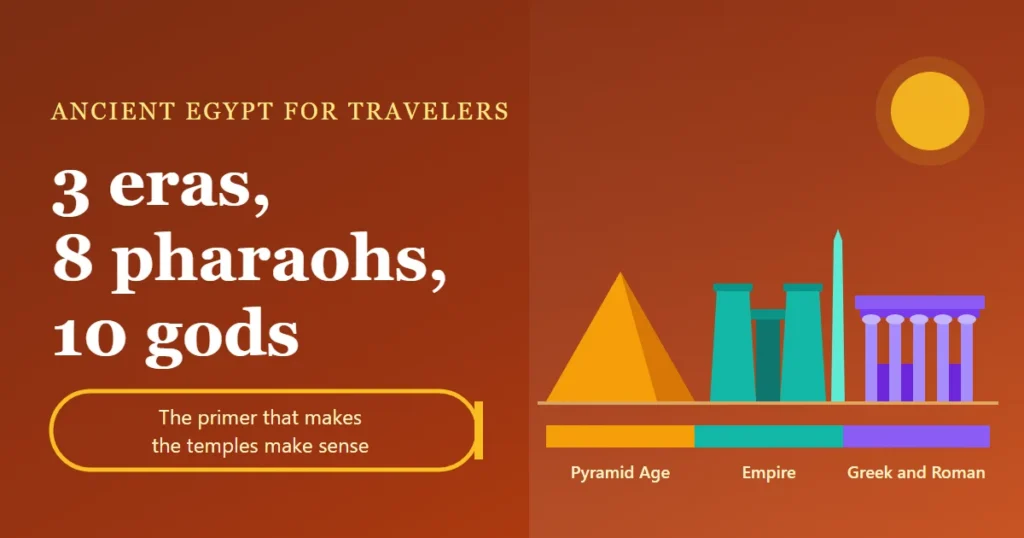
Almost everything on a first trip comes from three eras. The Pyramid Age is the Old Kingdom, about 2675 to 2130 BCE. The Empire is the New Kingdom, about 1539 to 1075 BCE. Greek and Roman Egypt starts in 332 BCE. Those dates come from the University of Memphis Egyptology timeline, which I use throughout this page. If a guide quotes a dynasty number, the same timeline puts the Pyramid Age at Dynasties 3 to 8 and the Empire at Dynasties 18 to 20. The Ptolemies came after the 31st.
The Pyramid Age is Cairo’s story. Kings ruled from Memphis, just south of the modern city, and built their tombs as pyramids in the desert to the west. Djoser’s step pyramid at Saqqara came first. The Great Pyramid of Khufu at Giza came about a century later. You see this era at the Giza pyramids and on the Saqqara and Dahshur day trip.
The Empire is Luxor’s story. After a long split and a foreign occupation, kings from Thebes (modern Luxor) reunited Egypt and pushed its borders into Syria and Sudan. They spent the profits on Karnak, Luxor Temple, the Valley of the Kings and, far south, Abu Simbel.
Greek and Roman Egypt is the Nile cruise. Alexander the Great took Egypt in 332 BCE. One of his generals founded the Ptolemaic dynasty, which ended with Cleopatra VII in 30 BCE. Then Rome ruled. These kings rebuilt old sacred sites in the old style, and those temples line the river between Luxor and Aswan.
What about the gaps? The Middle Kingdom (about 1980 to 1630 BCE) sits between the first two eras. It was a classic age for Egyptian writing, but little of it is on the tourist route. The easiest piece to see is a small white chapel in Karnak’s open-air museum.
Look at the right-hand edge of that chart.
Five of the river temples between Dendera and Philae were built in the last few centuries BCE or later. Did you expect the cruise temples to be the old ones? Most people do. That’s the single most useful fact on this page.
Why Are the Nile Cruise Temples So Much Younger Than the Pyramids?
Because the Ptolemies built them. Egypt’s Ministry of Tourism and Antiquities dates Edfu from 237 BCE under Ptolemy III to 57 BCE under Ptolemy XII, 180 years of work (egymonuments.gov.eg). These Greek-speaking kings ruled as pharaohs and rebuilt the old sacred sites in the old style.
They did it well, and they did it late, which is why these are the best-preserved temples in the country. Edfu still has its roof. The earliest king named at Kom Ombo is Ptolemy VI, who came to the throne in 180 BCE. Dendera’s temple of Hathor was started in 54 BCE and finished under Roman emperors (UNESCO). At Esna, the surviving columned hall went up under the Roman emperor Claudius, who ruled from 41 to 54 CE (University of Tübingen).
Esna is also the best proof that young doesn’t mean dull. In March 2023, the University of Tübingen and Egypt’s antiquities ministry announced that cleaning soot off Esna’s ceiling had revealed a complete zodiac. It’s one of only three complete zodiacs in Egyptian temples, and the other two come from Dendera (University of Tübingen, March 2023).
So when your guide points at a pharaoh offering to Horus at Edfu, ask which king it is. Often it’s a Ptolemy, a Macedonian Greek, dressed in the double crown. Cleopatra VII was the last of that line, and she lived closer to today than to the building of the Great Pyramid.
On a cruise, the boat stops at Edfu and Kom Ombo and the fare usually covers the tickets. My Nile cruise guide breaks down the temples inside a cruise fare.
For how to read the halls themselves, see my guide to walking Karnak, Edfu and Kom Ombo room by room. In short, every temple runs from a huge gateway, or pylon, through an open court and a hall of columns to a small dark sanctuary. The floor rises, the roof drops and the light fades as you walk in.
Which 8 Pharaohs Should You Know?
Eight names cover most of what guides talk about: Djoser, Khufu, Hatshepsut, Thutmose III, Akhenaten, Tutankhamun, Seti I and Ramesses II. Egypt had well over 100 kings in about 3,000 years, but you’ll meet each of these eight at a specific site. Learn them in the order below and you’ve learned the timeline too. Why these eight and not the famous queens? Because these are the names carved on the walls you’ll actually walk past.
| Pharaoh | Era | Why they matter | Where you’ll see them |
|---|---|---|---|
| Djoser | Pyramid Age | First pyramid, the stepped one, designed by Imhotep | Saqqara |
| Khufu | Pyramid Age | Built the Great Pyramid at Giza | Giza; his cedar boat is at the GEM |
| Hatshepsut | Empire | A woman who ruled as king for about 20 years | Her terraced temple at Deir el-Bahari; an obelisk at Karnak |
| Thutmose III | Empire | Egypt’s great conqueror; Hatshepsut’s stepson | Karnak |
| Akhenaten | Empire | Swapped the old gods for one sun disc, the Aten | Statues in Cairo’s museums |
| Tutankhamun | Empire | A minor king whose tomb was found nearly intact | KV62 in the Valley of the Kings; his treasure at the GEM |
| Seti I | Empire | Began the great columned hall at Karnak and cut the finest tomb in the valley | Karnak; Abydos; KV17 in the Valley of the Kings |
| Ramesses II | Empire | Ruled for over 60 years and put his name everywhere | Abu Simbel; Luxor Temple; the giant statue in the GEM’s atrium |
Two more names help. Cleopatra VII closes the story in 30 BCE. Look for her with her son Caesarion in the giant relief on the back wall of Dendera’s temple.
Thutmose II is the newest name in the news. In February 2025, Egypt’s Supreme Council of Antiquities and the New Kingdom Research Foundation announced that a flood-damaged tomb in Luxor’s Western Wadis belonged to him. Inscribed alabaster jars named him and his wife, Hatshepsut. It was called the first royal tomb identified since Tutankhamun’s in 1922 (Archaeology Magazine, February 2025). Some Egyptologists still debate the match, so treat it as a strong claim, not a closed case.
Seti I’s tomb is the reason the valley ticket gets complicated. It’s a 2,000 EGP add-on on the official checkout, and Tutankhamun’s is 700. My Valley of the Kings guide works out which tombs are worth the extra tickets. For Ramesses II’s masterpiece, see how to get to Abu Simbel.
Why do Ramesses II’s cartouches turn up on buildings he didn’t start? Kings often carved their names over older work. If a guide says a statue was “usurped”, that’s what they mean.
Which Egyptian Gods Will You See on the Walls, and How Do You Spot Them?
Ten gods cover most temple walls: Amun-Ra, Ra, Osiris, Isis, Horus, Hathor, Anubis, Thoth, Sobek and Ptah. Each has a tell, an animal head, a crown or an object, so you can name them without reading a word.
| God | How to recognise them | What they stand for | Best place to see them |
|---|---|---|---|
| Amun-Ra | A man with a tall double-plumed crown | King of the gods | Karnak, Luxor Temple |
| Ra | Falcon head topped with a sun disc | The sun | Tomb ceilings, Abu Simbel |
| Osiris | Wrapped like a mummy, green or black skin, crook and flail | The dead and rebirth | Abydos, tomb walls |
| Isis | A throne-shaped sign on her head, or cow horns and a disc | Magic, motherhood | Philae |
| Horus | Falcon head with the double crown | Kingship | Edfu |
| Hathor | Cow horns around a sun disc, sometimes cow ears | Love, music, joy | Dendera |
| Anubis | Black jackal head | Mummification, guardian of tombs | Valley of the Kings |
| Thoth | Ibis head, often holding a scribe’s palette | Writing, wisdom | Tomb and temple walls |
| Sobek | Crocodile head | The Nile’s power | Kom Ombo |
| Ptah | Close skullcap, wrapped body, holding a sceptre | Craftsmen, Memphis | Memphis, Abu Simbel |
Some temples belong to two gods at once. Kom Ombo is a double temple, with two parallel aisles and two sanctuaries, one for the crocodile god Sobek and one for Horus the Elder (Ministry of Tourism and Antiquities).
Three small symbols turn up everywhere. The ankh, a cross with a loop on top, means life. The was sceptre, a staff with a forked foot, means power. The scarab beetle stands for the sun rising each morning.
Don’t worry when names stack up. Gods merged over time, so Amun and Ra became Amun-Ra, and Isis and Hathor often share the same horns. If a figure is hard to place, look at what’s on its head first. It’s right more often than not.
Why Are the Tombs on the West Bank?
The sun sets in the west, and the dead were believed to follow it into the underworld. That’s why Luxor splits in two: the temples of the living, Karnak and Luxor Temple, stand on the east bank, and the tombs and memorial temples sit on the west bank. The Empire buried its kings in the Valley of the Kings for most of the New Kingdom.
A second reason explains the switch from Giza to Luxor. A pyramid is a giant stone sign saying “treasure here”, and robbers broke into them long before modern times. So the Empire’s kings hid their tombs in a dry valley behind the cliffs and built their memorial temples, like Hatshepsut’s, down on the plain where everyone could see them. The tomb was secret. The temple was the advert.
That one idea explains Luxor’s whole map.
The tomb walls follow the sun’s night. The Books of the Underworld, painted in most of the royal tombs you’ll enter in the Valley of the Kings, map the sun god’s twelve-hour journey through the dark, past gates, snakes and judges, to sunrise. The king hoped to ride along and be reborn with him each morning. That’s why the walls feel like a road movie with sea serpents.
You’ll also notice the colour. Tomb walls still glow because no daylight or weather ever reached them. Temple walls were painted too, but centuries of sun stripped most of it.
My Luxor guide covers how to split your days between the two banks. If you’re still choosing a hotel, the East Bank versus West Bank comparison prices both.
How Do You Read a Cartouche?
Find the oval. A cartouche is a rope-shaped ring drawn around a royal name, and once you can spot one you know whose wall you’re looking at. It’s how Champollion began. His 1822 letter to the French Academy, built largely on the Rosetta Stone, is usually treated as the start of reading hieroglyphs (BCU Lausanne).
Hieroglyphs mix sounds and pictures. Some signs spell sounds, like letters. Others show the idea directly. A man with a hand to his mouth means “eat” or “speak”, and a seated figure often marks a person’s name.
Reading direction is easier than it looks. The people and animals in a line of signs face the start of the line. If the birds face left, read from the left.
Learn two signs before you go: the sun disc, a circle with a dot, which often stands for Ra, and the owl, which spells the sound “m”. With the ankh from above, that’s three you’ll spot within ten minutes of walking into any temple.
The Rosetta Stone itself isn’t in Egypt. French soldiers found it near Rashid in 1799, and it passed to Britain under the 1801 surrender (Artnet News). Zahi Hawass, a former antiquities minister, has campaigned since 2022 for its return and wants it shown at the GEM (The Art Newspaper, August 2022). For now it stays in London.
Where the Treasure Is Now: Three Cairo Museums
Mostly in Cairo, split three ways. The Grand Egyptian Museum shows Tutankhamun’s treasure, Khufu’s boat and the colossal Ramesses II. The royal mummies are at the National Museum of Egyptian Civilization (NMEC). The old Egyptian Museum on Tahrir Square keeps much of the rest. The GEM had about 4 million visitors between its opening in November 2025 and the end of August 2026 (Egypt Today, September 2026).
The eras map onto the museums neatly enough. Pyramid Age statues are split between the GEM and Tahrir. The 18th Dynasty’s gold, above all Tutankhamun’s, is at the GEM. The kings themselves, from the 17th to the 20th Dynasties, Ramesses II included, lie in NMEC’s mummies hall. My museum comparison explains which museum holds what and which to skip on a short trip.
So which museum comes first? I’d put the GEM at the start of a trip, not the end. An afternoon there turns every name on this page into a face, and the sites make more sense afterwards. Tickets are sold online only, so read how booking the Grand Egyptian Museum works before you land.
Here’s a number history pages leave out: what each era costs to see. On the evening of October 15, 2026, I read the foreign adult price of 15 of the 17 big tickets on the classic route from the official checkout. The GEM and NMEC prices are my September readings. The total was 9,462 EGP, about $178 at the central bank’s rate of about 53 pounds to the dollar. The Empire is the dearest era at 3,112 EGP, and the three museums come second.
Two caveats. The GEM’s foreign ticket rises by $5 from November 1, 2026, so that bar will grow. And the extras aren’t in it: Khufu’s pyramid interior is 1,500 EGP and Seti I’s tomb 2,000. My Egypt trip cost breakdown has the full bill.
Saved, Moved and Found: The Recent Story
Abu Simbel and Philae both stand where they do because UNESCO moved them. When the Aswan High Dam began filling Lake Nasser, UNESCO launched an international campaign on March 8, 1960. Workers started cutting Abu Simbel apart with wire saws in November 1963, into more than a thousand blocks of some 30 tonnes each. It reopened on September 22, 1968, 64 metres higher and 180 metres inland (UNESCO).
Philae’s temples, the last to be saved, were moved to the higher island of Agilkia between 1972 and 1979. UNESCO puts the campaign’s total cost at $80 million, half of it donated by about 50 countries. So when you stand at Philae, you’re on a different island from the one the priests of Isis knew. Does that make it fake? No. The stones are the originals, rebuilt on the next island along. My Aswan guide has the boat and ticket details.
New finds keep coming, and they change what guides say. The Thutmose II tomb came in 2025. Esna’s colours came back in 2023. On April 3, 2021, 22 royal mummies were driven across Cairo to their new home at NMEC (NMEC). And the GEM finally opened in full in November 2025, putting Tutankhamun’s whole collection on show together.
How Should You Order Your Sites So the Story Makes Sense?
Start with the GEM, then Giza and Saqqara, then Luxor, then the river temples, and you walk the story roughly in order: the Pyramid Age, the Empire, then Greek and Roman Egypt. Most Cairo, Luxor and Aswan trips already run this way. My 7, 10 and 14-day itineraries show how many days each stop needs.
If your cruise sails from Aswan to Luxor instead, you’ll see the young temples before the old ones. That’s fine. Just remember, at Kom Ombo and Edfu, that you’re looking at the last chapter, built by kings who were reviving a style already 2,000 years old.
Some of it never left. Tomb walls are full of bread, beer and harvests, and Egyptians still call their bread aish, the word for life. My Egyptian food guide covers what’s on the table now.
Ancient Egypt for Travelers FAQs
Do I need to know Egyptian history before visiting Egypt?
No, but an hour of context helps. Learn three eras: the Old Kingdom pyramids (about 2675 to 2130 BCE), the New Kingdom tombs and temples of Luxor (about 1539 to 1075 BCE) and the Greek and Roman cruise temples (from 332 BCE). Add eight pharaohs and ten gods and the guides make sense.
What are the main periods of ancient Egypt?
The University of Memphis timeline gives three kingdoms: the Old Kingdom, about 2675 to 2130 BCE, the Middle Kingdom, about 1980 to 1630 BCE, and the New Kingdom, about 1539 to 1075 BCE. The Late Period and the Ptolemaic dynasty (305 to 30 BCE) followed, then Rome. Dates before 664 BCE are approximate.
Are the Nile cruise temples as old as the pyramids?
No. They’re more than 2,000 years younger. Edfu was built from 237 to 57 BCE, Kom Ombo from about 180 BCE and Dendera from 54 BCE, under Greek-speaking Ptolemaic kings and then Rome. The Great Pyramid dates from about 2560 BCE. That’s why the cruise temples still have roofs and colour.
Why are the tombs on the west bank of the Nile?
The sun sets in the west, and Egyptians believed the dead followed it into the underworld. New Kingdom kings also hid their tombs in the Valley of the Kings because robbers had looted the pyramids. Temples for the living, like Karnak, stand on the east bank.
Which museum has Tutankhamun’s treasure?
The Grand Egyptian Museum near Giza shows his complete collection together. His tomb, KV62, is still in the Valley of the Kings, and the royal mummies of other kings are at NMEC in Cairo. When I last read its checkout, in September 2026, GEM tickets were sold online only, at 1,500 EGP for foreign adults.
Do I need a guide at the temples?
Not to get in, but one earns the fee at Karnak and the Valley of the Kings, where the walls are the whole point. Licensed guides in Egypt have studied Egyptology. At smaller temples like Kom Ombo, this primer and the site signs are usually enough.
The Bottom Line
If this guide to ancient Egypt for travelers leaves you with one idea, make it the three eras. Pyramids around Cairo, the Empire around Luxor, and Greek and Roman temples along the river. Everything else hangs off that.
- The cruise temples are the young ones, more than 2,000 years younger than Giza.
- The west bank is for the dead.
- Look at the head first to name a god, and find the cartouche to name a king.
- Start at the GEM so the names have faces before you reach the sites, and save Edfu and Kom Ombo for when you can spot a Ptolemy in pharaoh’s dress.
Next, read my guide to Egyptian culture and etiquette for the country around the ruins, the Valley of the Kings guide to choose your tombs, and how to read an Egyptian temple when you reach Karnak.
I’m Marco Delgado, and I write every guide on Egypt Travel Vibe. I read every ticket price on this page myself on the evening of October 15, 2026, from the official checkout pages, except the GEM and NMEC figures, which are my September 2026 checkout readings. Historical dates follow the University of Memphis timeline, and where scholars still disagree, like the Thutmose II tomb, I’ve said so. I re-check this page monthly.