
Last verified: August 12, 2026. Ramadan and Eid 2027 dates, climate normals and Red Sea water temperatures were checked against source on the date above. Ramadan depends on a moon sighting, so I re-check this page monthly and update the date each time.
On August 2, 2026, Upper Egypt recorded 46°C, with Greater Cairo and the Nile Delta sitting between 40°C and 43°C (Egypt Today, 2026). Six months earlier, the same temples were cold enough at dawn to want a fleece.
Disclosure: Some links in this guide may earn us a commission, at no extra cost to you. It never changes what we recommend.
That’s the whole problem with the question. Egypt isn’t one destination across the year, and “October through April”, the answer every guide gives, doesn’t help the reader whose leave is already booked for July. It also doesn’t say which part of that seven-month window to take, or what the cheap months actually cost you.
So this guide does it differently. The best time to visit Egypt isn’t a month, it’s a tradeoff, and which month wins depends entirely on what you’re willing to lose. Three questions, one answer, and a straight account of what you’re giving up. Then every month of the year, including the ones you’ve been told to skip. For everything else about a first trip, start with our complete Egypt travel guide.
Key Takeaways
- The best time to visit Egypt is October through April for Cairo, Luxor, and Aswan. That hasn’t changed. What matters is which part of it you take, and that depends on whether you’re optimising for heat, crowds, or price. You can’t have all three.
- March is the widest sightseeing window of the year. By our own calculation from published climate normals, Luxor gives you about 12 comfortable daylight hours in March against roughly 5 in July.
- Summer doesn’t cancel a trip, it shortens the day, and it cuts cruise and hotel rates by 30–50%.
- February 2027 is mostly Ramadan. It runs roughly February 8–9 to March 9–10, pending Dar al-Ifta’s moon sighting. Sites and hotels stay open. The week before Eid is the hard part.
- April is not March. The khamsin peaks in April, and that’s the honest reason to prefer one over the other.
Table of Contents
What Is the Best Time to Visit Egypt?
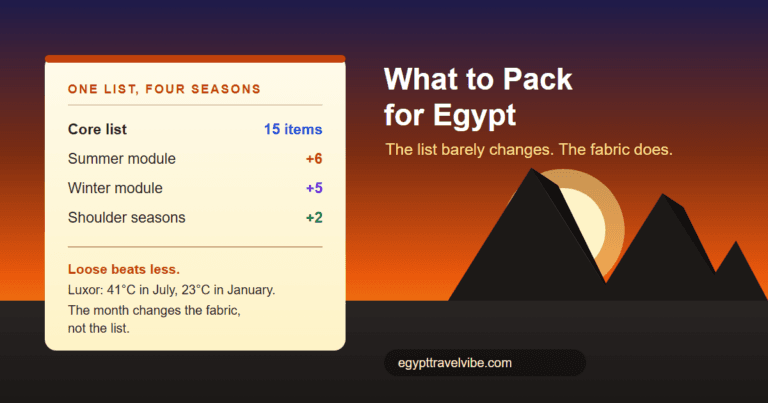
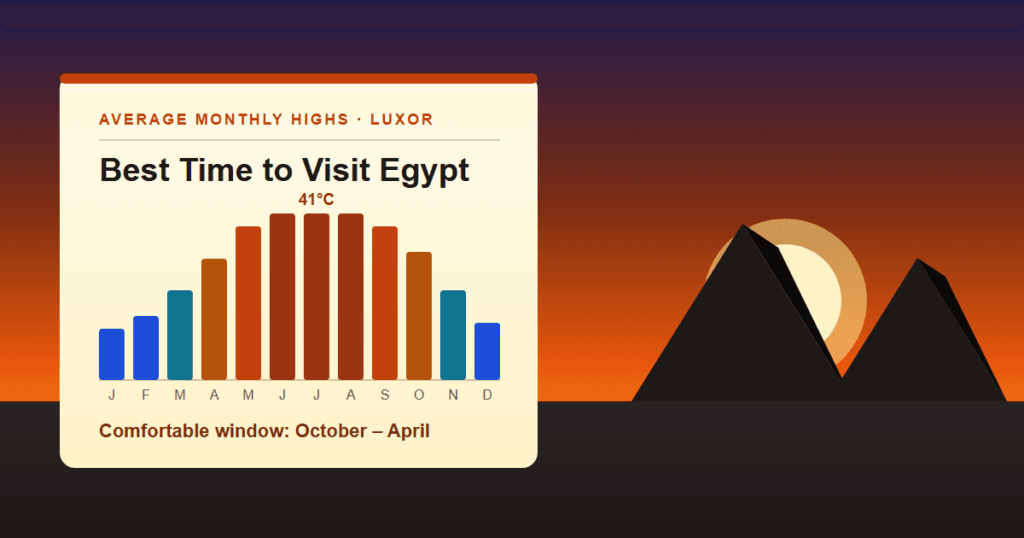
October through April, and the two best stretches inside it are late October to mid-November and March. Luxor averages a 41°C high in July against 23°C in January, and Aswan runs hotter still at 42°C against 24°C (Weather & Climate, climate normals). Those edges give you comfortable days without December’s peak crowds and peak rates.
The Red Sea sits outside all of this. On the coast, the best time to visit Egypt is more or less any month, because you spend the hot hours in the water instead of walking a temple complex. Hurghada, Dahab, and Marsa Alam work year-round, and Dahab is the one that suits independent travellers best. More on that below.
Pick Your Month in Three Questions
You’re optimising for one of three things, and you’ll get two of them at best. Heat points at December and January. Crowds point at May through September, or the last week of October. Price points hardest at June through August, when cruise and hotel rates run 30–50% below peak winter pricing (Egypt Tours Plus, 2026).
Which means the best time to visit Egypt is really a question about you, not about the calendar. Name the constraint you can’t move, and the month falls out.
Question one: can you move your dates at all? If your leave is fixed, skip to the month-by-month table at the end and read your row. Everything else here is for people with flexibility, and there’s no point pretending otherwise.
Question two: temples or coast? A Cairo–Luxor–Aswan trip is governed entirely by heat. A Cairo-plus-Red-Sea trip mostly isn’t. That single choice moves your answer by four months.
Question three: what’s actually binding: budget, heat tolerance, or crowd tolerance? Budget says June to August, and you’ll be doing dawn starts. Heat tolerance says December and January, and you’ll pay peak rates and queue. Crowd tolerance says late October or March, which is why those two keep coming up.
I want to be straight about that chart. Egypt has no published index of seasonal accommodation pricing, so I built one from the discount ranges tour operators advertise: roughly 30–50% off in summer, 15–20% off in May and September. It’s directional. Treat the shape as real and the numbers as a sketch.
How Hot Is Egypt in Summer, Really?
Hot enough to shorten your day, not hot enough to cancel your trip. By our calculation from published climate normals, Luxor offers roughly 12 comfortable daylight hours in March and about 5 in July. Summer doesn’t remove Egypt. It removes the afternoon.
Here’s how that number is built, because you should be able to argue with it. Luxor’s confirmed anchors are a January high of 23°C against a low of 9°C, and a July high of 41°C against a low of 26°C (Weather & Climate, climate normals). That’s a daily swing of 14 and 15 degrees. So I assumed a 15-degree swing in every month, then modelled the day as a sine curve between the low at sunrise and the high in mid-afternoon. From there it’s just counting the daylight hours below 32°C, the point where walking an unshaded site stops being pleasant.
What this is and isn’t: a planning model built from monthly averages, not measured hourly data and not a forecast. It ignores humidity, wind, and shade. A specific Tuesday will differ. The shape of the year won’t.
Two things fall out of that chart that I didn’t expect before running it. March beats the deep-winter months, because the days are longer and still below the heat threshold. And October is weaker than its billing at about 8.5 hours, which is the honest reason to say “late October” rather than “October.”
The practical shape of a summer day matches this closely. On the Theban west bank in high summer I was at the Valley of the Kings gate before it opened, done with Hatshepsut by nine, and finished by half past ten. That wasn’t the plan. The limestone radiates heat back at you until the decision makes itself. In a cool month, by contrast, I’ve walked the same ground from eight until four and stopped only because I was hungry. Same sites, same tickets, roughly triple the day.
Egypt’s meteorological authority warned of repeated multi-week heat waves through summer 2026, some running up to ten consecutive days (Egypt Independent, 2026). If you’re travelling in those months, treat shade and water as itinerary items rather than afterthoughts.
When Is Ramadan in Egypt, and Does It Matter?
Ramadan 2027 is expected to run roughly February 8–9 to March 9–10, with Eid al-Fitr around March 10–11, pending the moon sighting confirmed by Egypt’s Dar al-Ifta (AnyCalendar; Office Holidays, 2027 dates). Which means the month nearly every guide calls Egypt’s best is, next year, almost entirely Ramadan. I list every other festival and holiday date in my 2027 Egypt festivals calendar.
That collision is worth sitting with, because it isn’t in the pages ranking above this one. The most-cited guide for this exact search still tells readers that Ramadan “is expected to start around March 12th” in 2024, and around March 2nd in 2025 (Egypt Tours Plus). It carries no visible update date. It’s giving 2026 travellers dates that expired eighteen months ago.
So what actually changes? Less than the internet implies. Antiquities sites, hotels, and guided tours run normally. Some local restaurants close during daylight hours, though tourist areas largely don’t. Road traffic gets strange in the hour before iftar, when everyone in Cairo is trying to get home at once, and then the city goes eerily quiet for twenty minutes, which is genuinely one of the better things you can witness there. I’ve put the site-by-site Ramadan hours, iftar times and the Eid rush in my guide to Egypt during Ramadan.
The part that will affect your trip is the last week before Eid. Domestic flights and sleeper trains fill with Egyptians travelling to family, and that’s the hardest time of the year to book internal transport at short notice.
Ramadan moves about eleven days earlier each year, so 2028 lands in late January and February. I’m not going to print specific 2028 dates, because they depend on a sighting nobody has made yet. Check Dar al-Ifta closer to the time. For how the month fits into Egyptian daily life, faith and etiquette, see the Egyptian culture guide.
When Are the Crowds and the Prices Worst?
December 20 to January 5. The densest crowds and the highest rates of the year land in the same fortnight, and nothing else comes close. More broadly, high season runs December through March plus October and November. That tracks Egypt’s overall growth: a record 19 million arrivals in 2025, and 6.1 million in the first four months of 2026, up 7% year on year (Egypt’s State Information Service, 2026).
Two booking consequences follow. First, the Grand Egyptian Museum sells tickets online only, with the on-site office closed since December 2025, and it works to a daily cap that it reliably hits through the winter months. Book weeks ahead, not days. Second, Nile cruise cabins tighten the same way from December through March, and the good boats go first. How far ahead to book each class of boat is in the cruise guide. How GEM booking works now covers the entry windows and the terms.
On that cap: the museum’s designed maximum is about 15,000 visitors a day, and Egypt’s Cabinet reported in December 2025 that it was averaging roughly that figure (Egypt Today, 2025). You’ll also see 8,000 and 14,000 quoted on tour-operator pages. I can’t trace either to a primary source, so treat them with suspicion. The planning consequence doesn’t change across any version of the number: in peak season, walk-up availability isn’t something to count on.
Season moves what you pay more than almost any other decision, so it’s worth reading this next to what those rates actually work out to in EGP and USD.
What About Sandstorms? The Khamsin Season Nobody Warns You About
The khamsin blows between March and May and peaks in April, a hot southerly wind carrying Saharan dust that can lift temperatures by as much as 20°C within hours and drop humidity below 5% (Egyptian Streets, 2025). It’s the honest reason to prefer March over April, and almost nobody says so.
The name comes from the Arabic for “fifty,” after the roughly fifty-day window when the wind is most likely, traditionally counted from the day after Coptic Easter. That framing matters, because these arrive as intermittent events rather than a season-long condition. A khamsin day is a bad day, not a written-off month.
What it does to a trip: flights delay, visibility at the Giza plateau drops to the point where photography is pointless, and dust gets into everything you own. Severe episodes have closed schools across the country, with authorities warning of winds of 40–60 km/h and gusts to 80 km/h (The National, 2025).
If you catch one, move indoors and reshuffle. The Egyptian Museum, the GEM, and Coptic Cairo are all better in bad weather than in good, and the wind usually passes within a day or two.
Does the Answer Change for the Red Sea and the Desert?
Yes, and this is where “October to April” stops applying. The Red Sea works year-round because the water sits between roughly 21°C and 28°C all year, coolest in February and warmest in August (Weather & Climate, climate normals). You spend the hot hours submerged, so the air temperature matters far less.
That makes Hurghada, Sharm el-Sheikh, Dahab, and Marsa Alam the real answer for anyone locked into July or August dates. Rebalance the itinerary toward the coast, keep Cairo for early mornings and evenings, and you have a good trip instead of an endurance test.
For divers specifically, the sweet spots are April to June and September to November: warm water, calm seas, visibility past 30 metres, and thinner crowds than peak summer. Winter diving is perfectly good with a 5 mm wetsuit.
The Western Desert runs the opposite way entirely. Camping season opens around October, and summer overnights out at the White Desert are genuinely inadvisable rather than merely uncomfortable. If the desert is on your list, that constraint outranks everything else in this guide. Our White Desert guide covers when camping season opens and what the night really costs.
Every Month in Egypt, Rated
If your dates are already fixed, the best time to visit Egypt is whatever you can make of the month you’ve got, so find your row and read the tradeoff. No month here gets called a great time to visit without naming what it costs you. Temperatures are average highs from climate normals; the price column is relative, not absolute.
| Month | Cairo | Luxor | Crowds | Price | The verdict |
|---|---|---|---|---|---|
| January | 20°C | 23°C | Peak to high | Highest | Best weather of the year, worst value. Nile-valley mornings can be foggy and genuinely cold. |
| February | 22°C | 25°C | High | High | Excellent conditions, but in 2027 it’s almost entirely Ramadan. Abu Simbel aligns on the 22nd. |
| March | 25°C | 29°C | Medium-high | Easing | The widest sightseeing window of the year and rates coming off peak. Khamsin risk begins. |
| April | 29°C | 34°C | Medium | Shoulder | Still workable at about 9 comfortable hours, but this is the khamsin’s peak month. |
| May | 33°C | 39°C | Low | Shoulder | Upper Egypt turns hard. Fine for the Mediterranean coast and good for diving. |
| June | 36°C | 41°C | Low | Low | Roughly 5 usable hours in Luxor. Coast or nothing, unless you commit to dawn starts. |
| July | 36°C | 41°C | Lowest | Lowest | The cheapest month and the shortest day. Cruises run air-conditioned and heavily discounted. |
| August | 36°C | 41°C | Lowest | Lowest | Egypt hit a record 46°C in Upper Egypt in August 2026. Red Sea only, realistically. |
| September | 35°C | 39°C | Low | Shoulder | Heat easing at the end, prices still soft. One of the better value months for diving. |
| October | 31°C | 35°C | Building | Rising | Thinner than its reputation early on. Late October is the sweet spot, not the whole month. |
| November | 27°C | 29°C | High | High | Arguably the best all-round month. Comfortable, long days, before the December surge. |
| December | 22°C | 24°C | Peak | Highest | Lovely for the first three weeks. Then Dec 20–Jan 5 is the most expensive fortnight of the year. |
Frequently Asked Questions
What is the best month to visit Egypt?
March, or late October through mid-November. By our calculation from published climate normals, Luxor gives about 12 comfortable daylight hours in March, the widest window of the year, with rates already easing off the winter peak. December and January have marginally better weather and the worst crowds and prices.
Is Egypt too hot to visit in summer?
No, but it shortens your day sharply. Comfortable daylight in Luxor drops from roughly 12 hours in March to about 5 in June, July and August, so summer trips run on pre-dawn starts and indoor afternoons. Upper Egypt recorded 46°C on August 2, 2026 (Egypt Today, 2026).
When is the cheapest time to visit Egypt?
June through August, when cruise and hotel rates run 30–50% below peak winter pricing (Egypt Tours Plus, 2026). May and September offer smaller shoulder discounts of roughly 15–20% with far more tolerable heat, which is usually the better trade.
When is Ramadan in Egypt in 2027, and should I avoid it?
Roughly February 8–9 to March 9–10, 2027, with Eid al-Fitr around March 10–11, pending Dar al-Ifta’s moon sighting. Sites, hotels and tours run normally. The week before Eid is the difficult part, when domestic flights and sleeper trains fill with Egyptians travelling to family.
What is the worst time to visit Egypt?
Three different answers. For Upper Egypt temples, July and August, when Luxor and Aswan average 41–42°C. For crowds and cost, December 20 to January 5. For dust and flight disruption, April, when the khamsin peaks and can raise temperatures 20°C in hours.
The Bottom Line
The best time to visit Egypt comes down to which constraint you can’t move. Pick that, and the month follows:
- March and late October to mid-November are the two windows where heat, crowds and price are all tolerable at once
- Summer is a shorter day, not a cancelled trip: about 5 comfortable hours in Luxor, and 30–50% off the bill
- February 2027 is mostly Ramadan, which no other guide for this search seems to have noticed
- March beats April because of the khamsin, not the temperature
- The Red Sea ignores all of it, which is the answer if your dates are fixed in summer
One piece of timing that only applies right now: Grand Egyptian Museum entry for foreign visitors rises by $5 on November 1, 2026 (Ahram Online, 2026). An October trip is the last one at the current price.
Egypt Travel Vibe doesn’t sell tours, cruises, or tickets. That’s why this page can tell you that July in Luxor gives you about five usable hours and that the fortnight over New Year is the worst value of the year, neither of which is a comfortable thing for an operator to publish. Where sources conflict, I’ve said so rather than picking the tidier number.
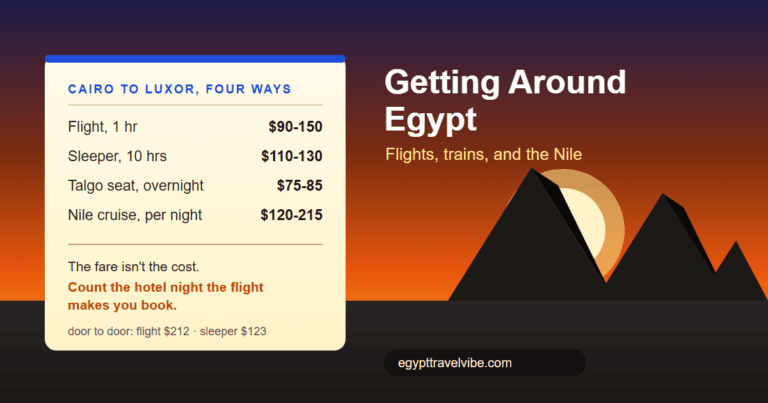
Once you’ve settled on a month, two things follow: sort your visa before you book anything, then price the trip properly with what a week or ten days in Egypt actually costs. Not sure how long to go for? Our 7-day vs 10-day vs 14-day itinerary comparison settles it day by day. Once the dates and length are set, our guide to how to move between Cairo, Luxor and Aswan compares flights, sleeper trains and Nile cruises. Our season-by-season packing list covers what to put in the bag once the month is set.