
Last verified: September 10, 2026. Entry fees come from the ministry schedule dated November 5, 2024, still the latest published, and Egypt revises them almost every year. Fares, room rates and advisory wording come from dated sources, and where they disagree I say so. I re-check this page monthly and update the date each time.
Egypt took 19 million visitors in 2025, up 21% on the year before (Egypt State Information Service, January 3, 2026), and the Giza plateau has counted 15,000 of them in a single day (Daily News Egypt, April 13, 2025). Sites and museums outside the GEM and NMEC logged 18.6 million visits, up 33.5%. I’ve stood in that crowd. The most underrated places in Egypt are the ones where I stood in no crowd at all, and this is the second-trip list that the region-by-region guide to where to go promised when it told first-timers what to cut.

Disclosure: Some links in this guide may earn us a commission, at no extra cost to you. It never changes what we recommend.
The pages that rank for this question are adjectives with photos. None of them tells you the Abydos day is eleven hours, that Minya may hand you a police escort, or what the official ticket costs. So here are ten places with the hours from the nearest hub, the fee from the ministry schedule, the nights each one needs, and the catch. Then which trip each belongs in.
Key Takeaways
- The record year was counted at the same handful of sites. Egypt logged 19 million visitors in 2025 and, outside the GEM and NMEC, 18.6 million site and museum visits, up 33.5% (Egypt State Information Service, January 2026). These ten places sit one detour off the Cairo, Luxor and Aswan corridor, and nine of them cost 250 EGP or less to enter, a third of a Valley of the Kings ticket.
- Three are detours from a hub you’re already in. Rosetta is about an hour from Alexandria, Fayoum two hours from Cairo, El Quseir 90 minutes from Marsa Alam.
- Three need their own trip. Dakhla and Kharga are nine hours from Cairo by bus, Siwa is 9.5 hours with no shortcut, and the White Desert is a 34-hour tour with eleven of those hours on tarmac.
- Two come with a catch the other lists skip. Minya’s sites sometimes come with a police escort, and Abydos plus Dendera is an eleven-hour day from Luxor.
- Every fee here is dated. They come from the ministry’s November 2024 schedule or a named operator’s page, and I re-check them monthly.
Table of Contents
How I Picked These 10 Underrated Places in Egypt
Four tests, and the fee ladder that fell out of them. Nine of the ten headline sites cost 250 EGP or less on the Ministry of Tourism and Antiquities schedule or a dated operator page, against 750 EGP for the Valley of the Kings (MOTA ticket schedule, dated November 5, 2024). That’s a third of the price. Abydos, at 260, is the one that tips over.
First, the place has to sit off the Cairo to Luxor to Aswan corridor, so no Medinet Habu and no Saqqara, however underrated they are. Second, a normal traveller has to be able to reach it without a permit that takes weeks. Third, it needs a concrete reason to go that survives a second look. Fourth, I need to be able to date the fee.
The audit, with hours by the transport you’d actually use. Prices are at 50 EGP to the dollar, checked September 10, 2026. How the buses, trains and drivers compare explains the choices behind each row.
| Place | Hours from hub | Headline fee |
|---|---|---|
| Rosetta | 1 from Alexandria | 120 EGP |
| El Quseir | 1.5 from Marsa Alam | 100 EGP |
| Fayoum | 2 from Cairo | 150 EGP |
| Nuweiba coast | 2 from Dahab | free beach |
| Abydos | 3 from Luxor | 260 EGP |
| Minya | 3.5 from Cairo | 200 EGP |
| Tanis | 3.5 from Cairo | 120 EGP |
| White Desert | 6 to 7 from Cairo | 250 EGP |
| Dakhla and Kharga | 9 from Cairo | 100 to 180 EGP |
| Siwa | 9.5 from Cairo | 100 EGP |
Three of these are detours you can bolt onto a trip you’ve already booked. Three are trips in themselves. The four in the middle are the interesting ones, because they’re a long day, or a night or two, from a city you were going to anyway. One footnote on the table: the nine-hour Dakhla figure is the Cairo bus via Assiut, and that road sits outside the FCDO’s named exceptions, which entry 4 explains.
1. Fayoum: Tunis Village, Wadi El Rayan and Wadi al-Hitan
Fayoum sits two hours from Cairo and is the only taste of the Western Desert that fits a ten-day trip. Wadi al-Hitan, at the far end of the Fayoum depression, is Egypt’s only natural World Heritage Site, inscribed in 2005, with about 1,500 marine vertebrate fossil skeletons lying where they died (UNESCO, Wikipedia). The largest is a 21 m Basilosaurus, and it has legs.
The region-by-region guide told first-timers under ten days to skip Fayoum. This is the page that says when to stop skipping it: the moment you have a spare night. Shared microbuses leave from Mounib, on the south side of Cairo, at roughly 70 to 125 EGP a seat each way; a private taxi runs 400 to 500 EGP (Sem Elegant Voyage, 2026).
Tunis village, on a ridge above Lake Qarun, is where you sleep. A guesthouse there starts around 20 US dollars a night and the Lazib Inn runs about 116 to 162, both on Kayak and Hotels.com listings in September 2026.
None of the fees will hurt. Wadi El Rayan’s protected area is about 150 EGP, the fossil museum at Wadi al-Hitan about 100, and Tunis is free (Sem Elegant Voyage, 2026). Qasr Qarun and the Roman town of Karanis are 150 EGP each on the ministry schedule.
The tour pages leave out two things. The famous Wadi El Rayan waterfall is a canal outfall between two man-made lakes, and it only exists while the upper lake sits higher than the lower one. It was flowing when I went; ask before you drive out for it. And the potters of Tunis hold a festival every year, usually in late November. The governorate hadn’t published 2026 dates when I checked, so plan around “late November” and nothing tighter.
The FCDO names “the Faiyum Governorate” as an exception to its west-of-the-Nile advice, so no permit or guide rule applies here (GOV.UK, checked September 10, 2026).
Nights: one at the floor, two to do it properly. The catch: Wadi al-Hitan needs a 4×4 and a guided track, so budget a driver for that half day.
2. Abydos and Dendera: The Temples the Luxor Crowd Skips
Abydos costs 260 EGP for Seti I’s temple and Dendera 300, and seeing both is an eleven-hour day from Luxor. Add another 100 for Dendera’s roof (MOTA ticket schedule, November 5, 2024). Abydos sits about 190 km north of Luxor, roughly three hours each way, and the two-temple day is listed at about eleven hours with checkpoints (Viator, 2026). My own day ran ten and a half.
You go for two things. At Abydos, the King List: 76 kings’ names in two rows of 38, with a third row that just repeats Seti’s own cartouches, the roll of ancestors he chose to acknowledge (Wikipedia). Behind the temple sits the Osireion, half-flooded and older-looking than anything around it. Entry needs a special permit I couldn’t get a price for, so don’t book the day for it.
At Dendera, the Hathor temple’s hypostyle ceiling was cleaned between 2000 and 2019 and the blue came back (Wikipedia). The zodiac in that ceiling is a replica; the original was cut out in 1821 and has been in Paris ever since, in the Louvre since 1919 (Louvre collections).
My driver stopped at four checkpoints on the way north, and at the third the officer waved us into a short convoy with two other vans. It added twenty minutes and no drama. The speed bumps added more than that.
Dated September 2026, a private car from Luxor runs about 3,300 to 9,000 EGP depending on group size, and guided day tours list at 62 to 142 US dollars a person (Viator, GetYourGuide). Tickets are usually included, but check the listing before you pay.
This is where those two sit against every other ticket on this list, with the Valley of the Kings for scale.
Nights: none, it’s a day trip, or one in Qena if you want Abydos at opening. The catch: the West Bank day already fills two mornings, and the regional guide’s verdict stands. You’ll have seen Karnak by then. This is day four of a Luxor stay, or trip two.
3. Minya: Beni Hasan, Amarna and Tuna el-Gebel
Minya offers three sites at 200 EGP each, three to four hours south of Cairo by train, with one honest catch: you may be assigned a police escort, and the reports differ by month. Beni Hasan, Tell el-Amarna and Tuna el-Gebel are each 200 EGP for a foreign adult on the ministry schedule (MOTA ticket schedule, November 5, 2024). The official online portal still shows 150 and 154 from the January 11, 2024 list (egymonuments.com), so expect the higher figure at the gate.
Beni Hasan is 39 Middle Kingdom tombs cut into a cliff above the Nile, and the painted walls of Baqet III’s tomb show hundreds of pairs of wrestlers, hold by hold (Archaeology Magazine, 2018). Amarna is Akhenaten’s capital, marked out by boundary stelae cut into the cliffs more than 3,300 years ago (Amarna Project). Tuna el-Gebel has the ibis catacombs and the painted tomb of Petosiris.
On February 7, 2026, Minya’s governorate said visits by multinational tour groups are part of an ongoing programme to upgrade the sites and services (Egypt State Information Service, 2026). That’s the official signal: the sites are open and the province wants you.
The escort question has no single answer, and any page giving one is guessing. Lonely Planet’s Egypt guide, rewritten in November 2023, reported police content to let visitors wander the town unescorted. A forum report from January 2024 describes reaching Beni Hasan by microbus alone. Other visitors describe a police car following the taxi to the sites. I got the car for the Amarna run and nothing for Beni Hasan. Treat it as weather. Neither the FCDO nor the State Department named Minya in its advisories when I checked on September 10, 2026 (GOV.UK); the honest read on the advisory zones covers what they do name.
Getting there is by train from Ramses station, three to four hours. Seat61 doesn’t list a Minya fare; foreigner fares are set by distance and sold through the ENR app or the foreigners’ window at Ramses, and the Luxor fares it lists at 35 to 50 US dollars are the ceiling for a leg a third as long (Seat61, August 26, 2026). The Grand Aton hotel runs about 100 US dollars with breakfast on Booking.com, and Cairo day tours to Amarna and Beni Hasan list at about 150 a person on Viator, both September 2026.
Nights: one at the floor, two to see all three sites without a 5am start. The catch: the escort, and a town with little to do after dark.
4. Dakhla and Kharga: The Far Oases and Al-Qasr
Tickets of 100 to 180 EGP, the cheapest on this list, at the end of a 550 km road. Kharga sits that far south of Cairo, Dakhla lies 310 km beyond Farafra, and the full desert circuit through all four oases is about 1,000 km (Wikipedia, Rough Guides). The bus from Cairo is listed at about nine hours to Dakhla, running south to Assiut and then west across the desert (Bookaway, 2026); a private car takes ten to twelve.
The tickets are cheap: Al-Qasr 100 EGP, the temple of Deir al-Hagar 100, Hibis 180, the Bagawat necropolis 120, Qasr al-Ghuweita 100 (MOTA ticket schedule, November 5, 2024). For that you get Al-Qasr, a mud-brick town the Ayyubids founded in the 12th century on a Roman fort, with a 21 m minaret and houses whose lintels are reused blocks from a temple of Thoth (BabMasr, March 2026). At Kharga, Hibis is the best-preserved Persian-period temple in Egypt, and Bagawat is one of the oldest Christian cemeteries anywhere, with more than 260 chapels from the 4th century (Wikipedia).
Is it allowed? By name, and by road. The FCDO advises against all but essential travel west of the Nile Valley, then lists the exceptions: “the oasis towns of Bahariya, Farafra, Dakhla (Mut) and Kharga”, “the road between Giza and Farafra and within 50km either side of this road”, “the road between Farafra, Dakhla (Mut) and Kharga”, “the road between Kharga and Baris” and “the road between Baris and Luxor” (GOV.UK, checked September 10, 2026). Tourists entering Bahariya, Farafra and the White and Black Deserts “must apply for permits in advance and use an official guide”.
The US State Department refreshed its Egypt advisory on July 15, 2026 and held the country at Level 2, but it keeps a separate Do Not Travel for North and Middle Sinai and for “parts of the Western Desert”, and it publishes no oasis exception list (U.S. Department of State, 2026). If you’re insured in the US, ask your insurer in writing whether “parts of the Western Desert” excludes the oasis roads, because the State Department publishes no exception list you can cite.
Read the list carefully and a loop appears. Giza to Farafra, Farafra to Dakhla to Kharga, Kharga to Baris to Luxor: every leg of that circuit is a named exception. The Assiut to Kharga road the Cairo bus uses is not on the list. The Assiut road is the same road in both directions, so if staying inside the FCDO’s named list matters to you or your insurer, go in and out via Farafra or via Baris and Luxor, and leave the Cairo bus to people who have made that call knowingly.
One question I couldn’t close is the flight. Wikipedia says EgyptAir flies Cairo to Kharga; Wikivoyage says Dakhla’s airport has no scheduled civilian service. I couldn’t confirm a Kharga timetable on writing day, so plan on the road and treat a flight as a bonus if one appears.
Nights: two at the floor, three or four to link Farafra and the White Desert overnight into one loop. The catch: distance. Give it a week or don’t go.
5. El Quseir: The Ottoman Port Between the Resorts
An old town of coral-block houses under a fort, 86 km north of Marsa Alam and 132 km south of Hurghada’s airport. The citadel is 100 EGP on the ministry schedule; older operator pages still say 40 (MOTA ticket schedule, November 5, 2024). Sultan Selim built it in 1517 to keep Portuguese traders out of the Red Sea spice route (Frommer’s).
What makes it work is that it’s a town. The quiet coast it sits on is a road of resort gates, and El Quseir is the one place along it with a souk, a harbour and a fort you can climb before dinner. The house reefs off the town’s hotels are as good as anything at Marsa Alam.
Getting there is easy if you’re already on the coast. Go Bus runs two afternoon services a day from Marsa Alam to Cairo via El Quseir, at 12:30 and 15:16 as of January 31, 2026 (MarsaAlam.com); re-check the times before you rely on them. A taxi from either airport is under two hours. The Radisson Blu averages about 135 US dollars a night on Momondo and dips to about 110, priced September 2026; the Mövenpick is the other big name, and the old town has guesthouses.
Nights: one or two, inside a Red Sea week. The catch: it’s a stop on the way to somewhere else. Don’t fly to Egypt for El Quseir; add it to a Hurghada or Marsa Alam trip.
6. Nuweiba and Ras Shitan: Sinai’s Hut-on-the-Beach Coast
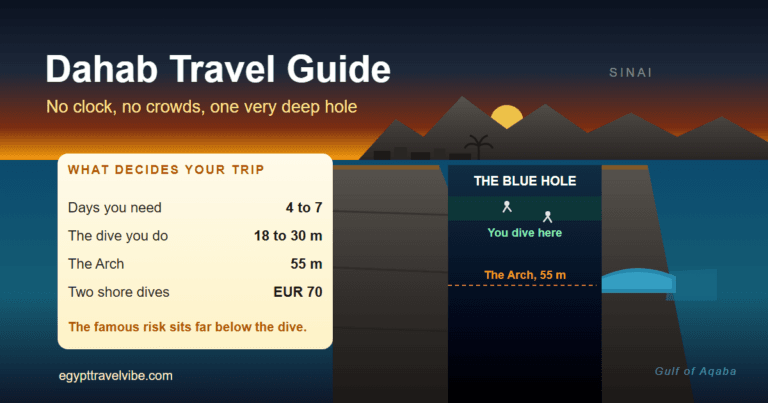
The Ras Shitan camps start 15 km north of Nuweiba and 45 km south of Taba, and in each one the room is a palm hut on the sand with the sea twenty steps away. Nuweiba to Dahab by East Delta or Go Bus takes under two hours and lists from about 3 US dollars (Bookaway, 2026). From the Taba border it’s 45 minutes by car (Bedouin Star).
The FCDO puts this coast inside normal advice, and the old Sharm perimeter rule is gone. As of its August 4, 2026 update it advises against all but essential travel to the northern part of South Sinai beyond the St Catherine to Nuweibaa road (its spelling), “except for the coastal areas along the west and east of the peninsula” (GOV.UK, checked September 10, 2026). Ras Shitan is coastal. And if your whole trip stays in Sharm, Dahab, Nuweiba, Taba or St Catherine, you likely qualify for the free Sinai-only entry stamp.
My hut had a fan, a mattress and a door that didn’t lock, and I slept better than in any hotel on this list. Breakfast at Bedouin Star was eggs, salad, white cheese and tahina. Prices are the one thing I can’t date well: the camps quote live rates only through their own booking tools, and Little Head Camp next door has no electricity at all. Email the camp, get a number in writing, and bring cash for it.
Signal is patchy on this stretch. Which network still works on the coast is worth checking before you rely on a map. If you want a town, Dahab is 90 minutes south by car, under two by bus, and it’s the reason many people never reach Nuweiba.
Nights: two at the floor, four if you want to do nothing properly. The catch: no town, cash only, and a reef you snorkel rather than dive.
7. Rosetta: Where the Stone Was Found
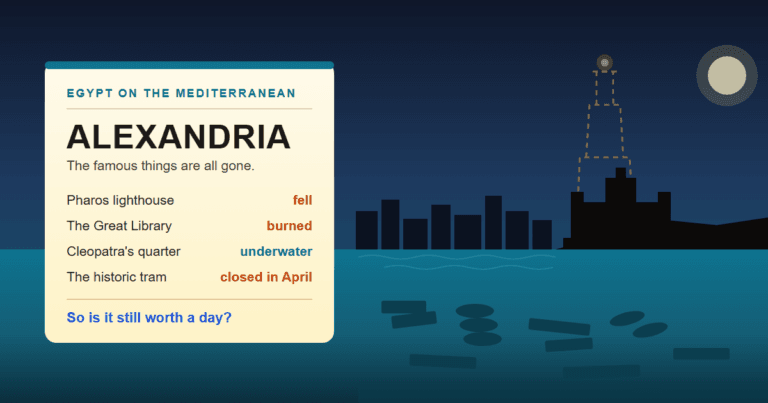
Rosetta sits 65 km east of Alexandria, about an hour by car, and it’s the one town in Egypt where Ottoman houses are the attraction. The Rosetta monuments ticket is 120 EGP and Fort Julien, the Qaitbay citadel, is 30 (MOTA ticket schedule, November 5, 2024). A return taxi with waiting time runs about 350 to 450 EGP on Travel2Egypt’s 2026 listing.
The Amasyali house and its neighbours are tall brick-and-timber mansions from the town’s 17th and 18th century boom as the port between Alexandria and the Nile, and on a weekday you’ll have them to yourself. The fort was built around 1470 under Qaitbay, and in 1799 an officer in Napoleon’s army, Pierre-François Bouchard, pulled a slab of grey granodiorite out of a wall his men were demolishing (British Museum). The Stone itself is in London. Say that plainly to anyone who asks; the fort has a replica.
Nights: none. It’s a half day. The catch: it only makes sense if you’re already sleeping in Alexandria, and whether an Alexandria night is worth it is its own question.
8. Tanis: The Delta Capital with the Empty Royal Tombs
Tanis costs 120 EGP on the ministry schedule, sits three to four hours northeast of Cairo, and produced the biggest royal-tomb discovery there since 1946. In October 2025 the French mission led by Frédéric Payraudeau found 225 ushabti of Sheshonq III in the tomb of Osorkon II, which finally settled whose sarcophagus had sat unattributed for decades (Archaeology Magazine, November 2025).
Tanis was the royal capital of the 21st and 22nd Dynasties, and Pierre Montet found its royal tombs intact in 1939. You can walk into them, and they’re empty: Psusennes I’s silver coffin and the rest of the treasure sit in the Egyptian Museum on Tahrir Square, not the GEM (Wikipedia). Which Cairo museum holds what sorts out the three-museum question. Around the tombs lie toppled colossi, obelisk fragments and a temple platform the size of a village.
It’s the least visited site on this list; I was the only visitor for the two hours I was there, and the reason is transport. No bus route I’d send you on goes there. It’s a private-car day from Cairo, about 100 to 150 US dollars a person on Viator listings priced September 2026, and most drivers pair it with Tell Basta, the cat goddess’s city, at 150 EGP on the same schedule.
Nights: none, a long day from Cairo. The catch: nothing to eat on site and nowhere to stay nearby, so bring lunch.
9. Siwa Oasis: Worth Its Own Trip
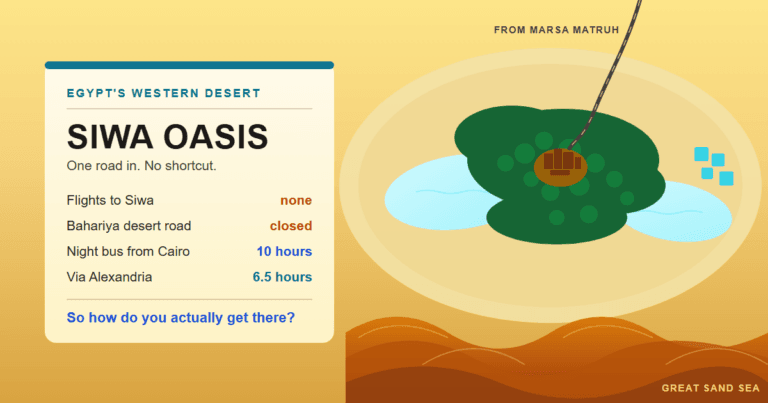
Nine and a half to ten hours from Cairo on the West Delta night bus at 550 EGP, no flights, the Bahariya shortcut closed with military checkpoints, and 100 EGP tickets once you arrive, all dated September 2, 2026 in the site’s Siwa guide. Those three facts put it on this list and they’re why it can’t be a detour.
Three nights is the floor, because the two-day tour sold from Cairo spends most of its hours on the road. Once you’re there it’s the cheapest stop in Egypt: guesthouse doubles from about 600 EGP and a half-day 4×4 safari 4,000 EGP a car split six ways, on the same dated list. The full Siwa guide covers the bus, the salt lakes and the safari prices, so I won’t repeat them here.
Nights: three at the floor, four to make the bus worth it. The catch: ten hours of bus each way.
10. The White Desert: The Overnight That Is the Trip
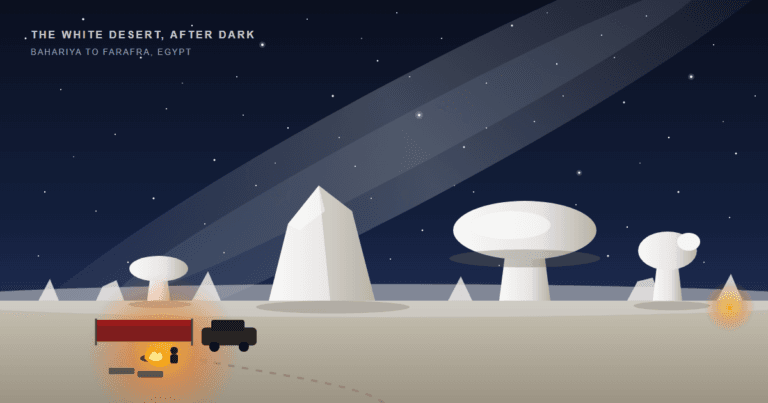
A 34-hour tour from Cairo, eleven of those hours on tarmac, a 250 EGP park fee dated May 31, 2026, and a night under the chalk that is the entire point. No operator sells it as a day trip, which is the one thing they all get right.
Everything you need is in the hour-by-hour White Desert overnight: the shared versus private prices, how cold three in the morning gets, and the FCDO permit rule. The one thing to add from this list is the Farafra link. The road on from the White Desert reaches Farafra in about 50 km, per the White Desert guide’s distance chart, and Dakhla 310 km after that, so if entry 4 tempts you, the two combine into one loop.
Nights: one at the floor, two via Farafra. The catch: eleven hours of tarmac for one night of chalk. Book it for the night or don’t book it.
What Didn’t Make the List, and Why
The lists that rank for underrated places in Egypt are padded with stops on the classic route. Medinet Habu at 220 EGP, Deir el-Medina at 220, Dahshur at 200 and Coptic Cairo are underrated stops, not underrated places, and they’re already in the days those city guides lay out (MOTA ticket schedule, November 5, 2024).
That distinction is the whole reason this list looks different. The Luxor West Bank day already includes Medinet Habu. The Cairo guide is where Coptic Cairo and the City of the Dead belong, and the Saqqara day trip that out-delivers Giza gets its own post. Alexandria, Dahab and Marsa Alam have full guides and sit in the regional guide. Wadi el Gemal lives inside the Marsa Alam guide. Mount Sinai and St Catherine’s have their own guide, and the monastery is in an unresolved ownership dispute with the state; its gates closed for 10 to 16 days during a 2025 leadership crisis (the Dahab guide has the detail), so I’m not sending anyone there on this page.
So which trip is each of the ten for?
| Place | Which trip | Nights |
|---|---|---|
| Rosetta, Fayoum, El Quseir | Long first trip | 0 to 2 |
| Abydos, Tanis | Second trip, day trips | 0 to 1 |
| Minya, Nuweiba | Second trip | 1 to 4 |
| White Desert, Dakhla, Siwa | Own trip | 1 to 2, 2 to 4, 3 to 4 |
A fourteen-night return built from this list looks like one of these two. The desert version runs from Fayoum to Farafra, Dakhla, Kharga and Luxor on roads and governorates the FCDO names as exceptions, and needs a licensed operator for the middle five nights.
Both assume October to April for everything except the Sinai coast, which runs longer; the month-by-month heat and crowds settles the timing. Where a detour fits in 7, 10 and 14 days is the arithmetic for a first trip that wants one of these anyway.
Underrated Places in Egypt FAQs
What are the most underrated places in Egypt?
Fayoum, Abydos and Dendera, Minya, the Dakhla and Kharga oases, El Quseir, the Nuweiba coast, Rosetta, Tanis, Siwa and the White Desert. All ten sit off the Cairo to Aswan corridor where Egypt’s 19 million visitors in 2025 were counted, and nine cost 250 EGP or less on the ministry’s November 2024 schedule or a dated operator page. Fayoum, two hours from Cairo, is the closest.
Is Fayoum worth visiting from Cairo?
Yes, as a one-night trip. Shared microbuses from Mounib cost roughly 70 to 125 EGP a seat and take two hours. Wadi El Rayan is about 150 EGP, the Wadi al-Hitan fossil museum about 100, Tunis village free, and a guesthouse there starts near 20 US dollars, all checked September 2026. The fossil site is Egypt’s only natural World Heritage Site.
Is Abydos worth the drive from Luxor?
On a second trip or the fourth day of a Luxor stay, yes. Seti I’s temple costs 260 EGP and sits 190 km north, about three hours each way, so the two-temple day with Dendera runs eleven hours. Guided tours list at 62 to 142 US dollars a person in 2026. The King List’s 76 royal names are the reason.
Can you visit Minya independently?
Yes, by train from Cairo in three to four hours. Escort practice varies: Lonely Planet’s 2023 guide found police happy to let visitors wander unescorted, a January 2024 traveller reached Beni Hasan by microbus alone, and other visitors report a police car for the sites. Neither the FCDO nor the US State Department named Minya when I checked on September 10, 2026. The three main sites are 200 EGP each.
Are the Western Desert oases safe to visit?
The FCDO advises against all but essential travel west of the Nile, then names its exceptions, including the four oasis towns and the roads linking Farafra, Dakhla, Kharga and Luxor, and says visitors to Bahariya, Farafra and the White and Black Deserts must apply for permits in advance and use an official guide, checked September 10, 2026. The US advisory holds Egypt at Level 2 but keeps a Do Not Travel for parts of the Western Desert with no exception list. Book a licensed operator.
How many days do you need for a second trip to Egypt?
Fourteen nights covers four entries from this list comfortably. A river-and-coast version runs Cairo two, Fayoum one, Minya two, Luxor three with the Abydos day, Nuweiba three and Dahab three. A desert version swaps the coast for the White Desert, Farafra, Dakhla and Kharga, which alone need five nights and a licensed operator.
The Bottom Line
The classic route earns its crowds, and the regional guide’s cut list stands: on a first trip under ten days, do Cairo, Luxor, Aswan and Abu Simbel and skip every one of these underrated places in Egypt. Fayoum is what a spare night buys you, and Rosetta a spare Alexandria afternoon. If you’re already on the Red Sea, El Quseir is an easy two nights.
Which three would I send a friend to first? Minya comes first, because the tombs are the equal of anything on the West Bank and the wrestlers are unlike anything there. Then a hut on the Nuweiba coast, which is one of the cheapest good nights’ sleep in the country. Abydos makes the cut too, but only on day four of a Luxor stay, since the King List is worth one long day and not a second. Dakhla and Siwa I’d save until you have a week to give them, and then give them the whole week.
Build the return around one of the far three and add two of the near ones. Where the regions fit together is the wide-angle view, and the 7, 10 and 14-day comparison shows where each detour steals its day from.