
Last verified: October 24, 2026. Every entry fee and arrival figure on this page was checked against source on the date above, including the Cairo airport total and the Grand Egyptian Museum fee. I re-check this page monthly and update the date each time.
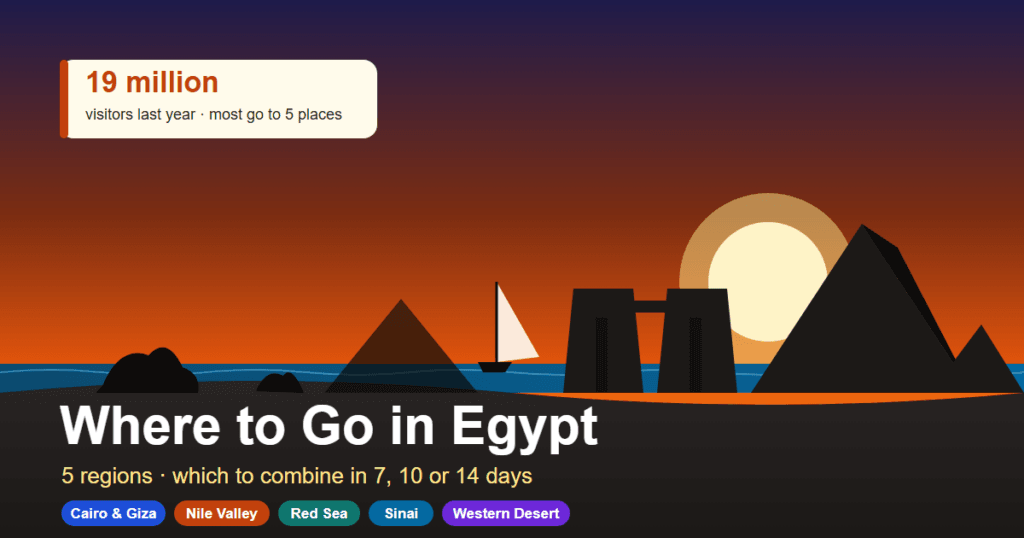
Egypt closed 2025 with a record 19 million visitors, up about 21% on the year before (Daily News Egypt, 2026). Almost all of them went to the same five places. The “best places to visit in Egypt” lists are a big part of why.
Disclosure: Some links in this guide may earn us a commission, at no extra cost to you. It never changes what we recommend.
Here’s the problem with those lists. Ranking hides geography. Siwa is a ten-hour bus ride from Cairo. Abu Simbel is a pre-dawn flight from Aswan. Dahab and Hurghada sit on opposite coasts with a gulf between them. A top-20 list doesn’t tell you any of that, so people build trips that look great on paper and fall apart on a map.
So this guide to the best places to visit in Egypt does it differently. Egypt is five travel regions, and each one is good for something specific. I’ll walk through what each region is for, how long it needs, how the regions connect, and which ones to drop when you’re short on days. If you want the practical side first (visas, budget, safety), start with the practical side of planning Egypt and come back here for the where.
Key Takeaways
- The best places to visit in Egypt fall into five travel zones, not one destination: the Nile Valley, Cairo & Giza, the Red Sea coast, Sinai, and the Western Desert oases.
- The Nile Valley and Cairo go on every first trip. Your real decision is the third region, and it depends on trip length, season, and whether you dive.
- Egypt drew 19 million visitors in 2025 and 6.1 million more in the first four months of 2026 (Egypt’s State Information Service, 2026), so the classic sites are busier than older guides suggest.
- Most major antiquities sites now take cards only at the gate, while the oases still run on cash.
Table of Contents
How Should You Think About the Best Places to Visit in Egypt?
Think of the best places to visit in Egypt as regions, not rankings. In the first four months of 2026 alone, Egypt received 6.1 million international arrivals, 7% more than the same stretch of 2025 (Egypt’s State Information Service, 2026). The vast majority of those trips follow one of a handful of routes, and every route is a combination of the same five zones.
The Nile Valley is the river corridor from Luxor south to Aswan and Abu Simbel, and it’s the reason most people book the trip. The other zones are Cairo and Giza, the Red Sea mainland (Hurghada, El Gouna, Marsa Alam), the Sinai Peninsula (Sharm el-Sheikh, Dahab, Mount Sinai), and the Western Desert (Siwa, Bahariya, the White Desert). Alexandria and the Mediterranean coast make a sixth, smaller one.
Here’s what I noticed after reading every ranking page for this search. Of the 20 places on the longest-running “best places in Egypt” list, 15 sit in the Nile Valley or Cairo. Every top-10 is secretly a Cairo–Luxor–Aswan list wearing a disguise. That means the list isn’t really helping you choose. The first two regions are fixed. The decision you’re actually making is the third one: beach, Sinai, or desert.
Distances make that decision for you more often than preferences do. Cairo to Aswan is 879 km. Cairo to Siwa is roughly 750 km by road, with no airport at the far end. Sinai and the Red Sea mainland face each other across the Gulf of Suez, and the ferry between them runs when it runs. Egypt’s regions don’t chain neatly, and nearly every combination returns through Cairo.
How many days you have is the first filter. Our comparison of the three itinerary lengths maps 7, 10, and 14 days stop by stop, and our guide to flights, sleeper trains and Nile cruises compared covers the moving between them. The rest of this page is the regions themselves.
Cairo & Giza: How Many Days Does It Really Need?
Cairo is the first of the best places to visit in Egypt that every itinerary shares, and it needs two full days at minimum, three if you add Saqqara and Dahshur. In 2026, the Giza Plateau charges 700 EGP (about $14) for foreign adults, with the Great Pyramid interior another 1,500 EGP on top (egymonuments.com, Giza plateau booking, September 2026). What the Giza ticket actually covers lists every add-on. Cairo is not a city you “see” on a stopover. It’s three separate days once traffic is factored in.
Day one is the plateau: the three pyramids, the Sphinx, and a decision about whether 1,500 EGP to stand inside a hot, empty granite chamber is worth it. I’d say once, yes. Day two is the Grand Egyptian Museum, which sells tickets online only through tickets.gem.eg since its on-site office closed in December 2025, with foreign adult entry at 1,500 EGP and rising by $5 on November 1, 2026 (Ahram Online, 2026). Day three is Islamic Cairo, Coptic Cairo, and Khan el-Khalili. How GEM booking works now has the full price list.
A quick note on the museum confusion, because it catches almost everyone. Cairo now has three: the GEM at Giza (Tutankhamun’s complete collection), the old Egyptian Museum on Tahrir Square (550 EGP), and the NMEC in Fustat, where the royal mummies actually are. You don’t need all three on a first trip. Two is plenty. My comparison shows which Cairo museum is worth your time.
Cairo is also the hub everything routes through. In 2025, Cairo International handled 30.94 million passengers, up 6.8% on the year before, which makes it comfortably the busiest airport in Africa (Business Today Egypt, 2026). Whatever third region you choose, you’ll probably pass through Cairo twice.
What I’d do differently: Saqqara over a second morning at Giza. The Step Pyramid complex, the painted tombs, and the Bent and Red Pyramids at Dahshur have a fraction of the visitors and a fraction of the hassle. Saqqara costs 600 EGP. On my own trip, it was the morning I enjoyed most in Cairo, and I nearly cut it to save time.
Hassle is part of the Giza experience, and our guide to how the touts at major sites actually operate is worth reading before you go. For the city itself, see our full Cairo guide and our guide to where to stay in Cairo.
The Nile Valley: Is Luxor or Aswan Better?
This is the trip, and the Nile Valley holds most of the best places to visit in Egypt by any measure. In 2026, the Valley of the Kings costs 750 EGP for three tombs (egymonuments.com), Karnak 600 EGP, and Abu Simbel 822 EGP at the official checkout (egymonuments.com, read October 24, 2026). Those three sites, plus Philae and the temples between, are why people come to Egypt. Everything else is an add-on.
Is Luxor or Aswan better? It’s a false choice, and I’ll explain why in a moment. First, what each does. Luxor has the most monuments per day of anywhere in Egypt. Karnak and Luxor Temple sit on the east bank. The Valley of the Kings, Hatshepsut’s temple (440 EGP), and the workers’ village at Deir el-Medina are on the west. Tutankhamun’s tomb is an extra 700 EGP, and Seti I more again.
Aswan has the pace. The Nile is wider and cleaner here. The Nubian villages on the west bank are a different Egypt from anything upriver, as the Egyptian culture guide explains, and Philae (550 EGP) sits on an island you reach by motorboat. Aswan is also the launch point for Abu Simbel: about 280 km by road, three to four hours each way, or a 45-minute flight.
Here’s why you don’t pick. A three- or four-night cruise between Luxor and Aswan is how most first-timers see both. Edfu and Kom Ombo come with the sailing, their tickets usually inside the fare. The boat is your transport and your hotel. Whether that’s the right kind of boat is its own question, and our Nile cruise guide prices standard boats, dahabiyas, and Lake Nasser honestly.
The catch with the Nile Valley is heat. Luxor averages a 41°C high in July and Aswan 42°C, against 23°C in January for both (Climates to Travel, climate normals). That swing decides whether you get a full morning in the Valley of the Kings or you’re back at the hotel by 11am. Upper Egypt is an October-to-April region; our guide to month-by-month heat and crowds covers the shoulder months in detail.
For the city-level detail, see our Luxor guide, our Aswan guide, and our Abu Simbel logistics comparison. And if you’re trying to decide which tombs justify the extra tickets, our Valley of the Kings tomb guide has the answer.
Red Sea Coast: Hurghada, El Gouna or Marsa Alam?
The mainland Red Sea is Egypt’s beach-and-diving engine. In 2025, Hurghada International Airport handled 12.35 million passengers, and another 3.5 million in the first four months of 2026, up 12% on the year before (Hurghada International Airport, passenger statistics, 2026). That’s a lot of Germans, Brits, and Italians who never see a pyramid. They’re not wrong to skip it, but you probably shouldn’t.
The coast splits into three personalities. Hurghada is the big, slightly scruffy resort town with the widest range of budgets and the most direct flights. El Gouna, 25 km north, is the planned, polished version: lagoons, marinas, and a price tag to match. Marsa Alam, about 275 km south, is where the reefs get quieter and the wildlife gets bigger: dugongs in the seagrass, and oceanic whitetips further out.
Which one suits you? Hurghada or El Gouna for families, for budget, and for the road link to Luxor. That road runs four to five hours and turns “Pyramids + Nile + beach” into a ten-day trip. Marsa Alam for divers who’ve already done the easy reefs. The Hurghada vs Sharm comparison and the Marsa Alam guide go deeper on each.
Here’s the part the ranking lists miss. The Red Sea is the only region of Egypt that works in every month. Hurghada’s July high is 37°C with a sea breeze, and the water reaches 28–29°C by late summer. In winter the air drops to 22°C and the water to 21–23°C, still swimmable (Climates to Travel, climate normals). When Luxor is 41°C, the coast is where the August traffic goes.
That makes the Red Sea the default third region on any list of the best places to visit in Egypt for a first trip, and the default first region if you’re coming in summer. It’s also the one with the clearest logic for where to stay in Egypt: all-inclusive resorts on the mainland, dive camps further south. My Red Sea stays comparison explains which to book, and my Red Sea diving guide covers the water itself.
Sinai (Sharm, Dahab & Mount Sinai): Worth the Extra Flights?
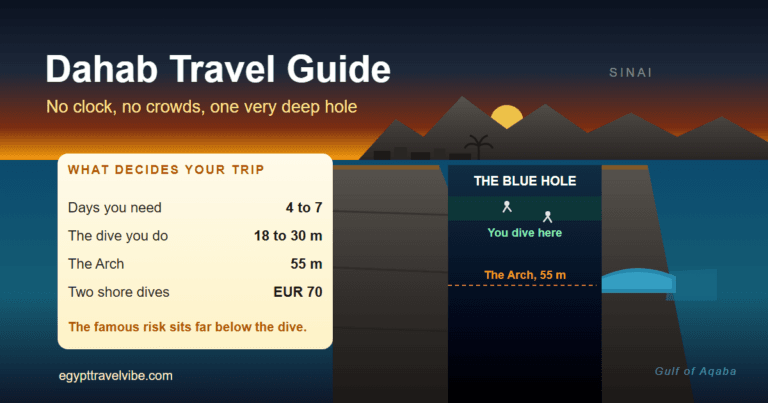
Sinai is the other coast, and among the best places to visit in Egypt it’s the one that feels like a different trip. Ras Mohammed, Egypt’s first national park, sits about 25 km from Sharm el-Sheikh, and dive operators add a 7 euro park fee to each visit (Circle Divers, checked September 2026). Its reef walls and the Straits of Tiran are the reason Sharm exists. Dahab, 90 minutes north, is the reason many people never leave.
The two attract opposite travelers. Sharm is resort diving. Think boat trips to Ras Mohammed and Tiran, big hotels on Naama Bay, and a proper international airport. Dahab is a small town with shore-entry dives, the Blue Hole and the Canyon, and a freediving scene that’s become its identity. It’s Egypt’s backpacker and solo-traveler capital, and our guide to solo female travel in Egypt, honestly spends a lot of time there for a reason.
Inland is the third thing Sinai offers. St. Catherine’s Monastery, inscribed by UNESCO in 2002, is the world’s oldest continuously operating Christian monastery, active since the sixth century (UNESCO World Heritage Centre, 2026). The night climb up Mount Sinai from the monastery to watch sunrise is the one Egyptian experience that isn’t about pharaohs or reefs. Our Mount Sinai guide has the logistics.
Safety is the question people ask about Sinai, so here’s the straight answer. Every major government advisory draws the same lines: the avoid zone is North Sinai, and the South Sinai tourist areas, including Sharm, Dahab, and St. Catherine, sit outside it (U.S. Department of State, 2026). The FCDO does flag parts of South Sinai for essential travel only, mostly the interior away from the coast road. Our honest read on the advisory zones maps it in detail.
Why doesn’t Sinai appear on more first-trip itineraries? Distance. You fly into Sharm, and Dahab is another 90 minutes. The Cairo–Dahab bus is around nine hours. Combining Sinai with the Nile Valley in under 12 days means two extra flights through Cairo. It’s worth it on a 14-day trip. On a 10-day trip, the Red Sea mainland does the same job with a four-hour road from Luxor. Our Dahab guide is the full case for going anyway.
Western Desert Oases (Siwa & the White Desert): First Trip or Second?
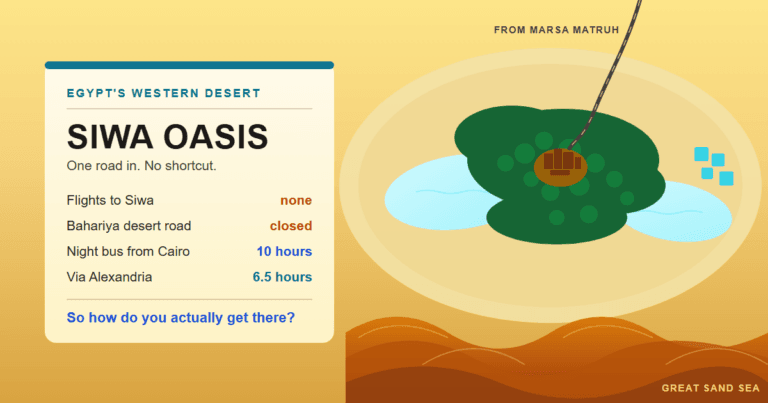
The Western Desert holds the best places to visit in Egypt on a second trip. In 2026, Siwa is roughly 750 km from Cairo by road, a nine- to ten-hour overnight bus with West Delta from the Turgoman station, or six to seven hours from Alexandria (our Siwa Oasis guide, 2026). The White Desert is a 4×4 overnight from Bahariya, itself four to five hours from Cairo. Both reward three days or more. Neither fits a seven-day first trip.
What’s out there? Siwa is an Amazigh oasis with its own language, a mud-brick fortress town called Shali, and salt lakes you float in. It’s quiet, conservative, and the nearest thing Egypt has to a place that doesn’t perform for tourists. The ATMs are unreliable, so bring every pound you’ll need from Cairo or Alexandria. The White Desert is different: wind-carved chalk mushrooms and icebergs, a night under stars with a Bedouin guide, and a silence you don’t get on the Nile.
The easy version of the desert is Fayoum, two hours from Cairo. Wadi al-Hitan there is Egypt’s only natural UNESCO World Heritage Site, one of seven in the country, with fossilized early whales lying where they died 40 million years ago (UNESCO World Heritage Centre, 2026). If you want a taste of the Western Desert on a ten-day trip, that’s the day trip to take, and it’s the one oasis entry on most lists of the best places to visit in Egypt that a first-timer can actually reach.
A word on the advisory, because the Western Desert gets flagged. The zones governments tell you to avoid are the strip along the Libyan border and the deep south-west. The Cairo–Bahariya–Farafra road and the Cairo–Marsa Matruh–Siwa road are the corridors every licensed operator uses, and they sit outside those zones. Go with a licensed operator for the White Desert, because you need a 4×4 and a permit anyway.
The matrix explains the whole “third region” problem in one glance. Cairo reaches everywhere in under two hours by air, except Siwa. Nothing else reaches anything else quickly. Pack for the desert differently, too; our season-by-season packing list covers the cold desert nights most people don’t expect. For the oases themselves, see our Siwa guide, our White Desert overnight guide, and our desert eco-lodge roundup.
Alexandria & the Mediterranean: Worth a Day, a Night, or Neither?
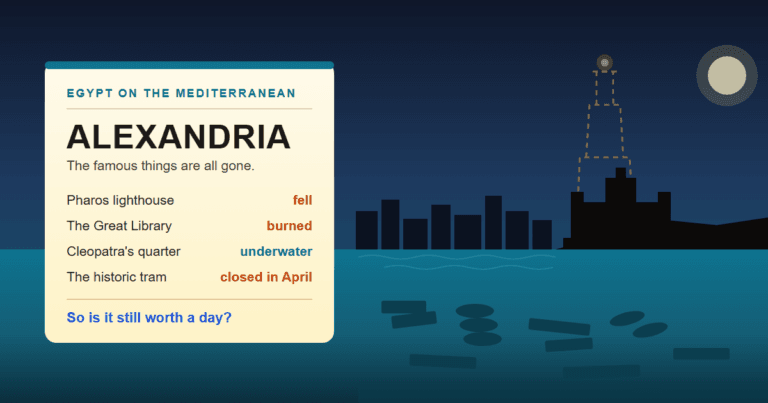
Alexandria sits lower on most lists of the best places to visit in Egypt than its fame suggests: worth a long day trip from Cairo, two and a half to three hours by train, and a night if you’re continuing to Siwa. It’s not worth trading a Nile Valley day for. Alexandria’s July high is 31°C against Cairo’s 35°C and Luxor’s 41°C (Climates to Travel, climate normals), which makes it the one Egyptian city that genuinely works in summer.
Manage expectations before you go. The ancient library and the Pharos lighthouse are gone. What’s there instead is the Bibliotheca Alexandrina, a striking modern library built in their memory. The Citadel of Qaitbay stands on the lighthouse’s old footprint. Add the catacombs of Kom el-Shoqafa and a Corniche that’s more about sea air and seafood than any single monument. It’s a Mediterranean city first and a pharaonic site a distant second.
For completists, Abu Mena, an early Christian pilgrimage city about 45 km south-west, is one of Egypt’s seven UNESCO sites and currently on the in-danger list because of ground subsidence (UNESCO World Heritage Centre, 2026). Most people won’t make the detour. I did, and it’s for the history-obsessed only.
Where Alexandria earns its place is as a routing stop. The Alexandria–Siwa road is 6.5 hours against Cairo’s 9.5, so if Siwa is in your plan, a night on the Corniche on the way out is the smart sequencing. Our guide to flights, sleeper trains and Nile cruises compared covers the train. Our Alexandria guide makes the case both ways.
How to Combine the Best Places to Visit in Egypt by Trip Length
Combining the best places to visit in Egypt comes down to trip length. Seven days is Cairo plus the Nile Valley, flying both legs. Ten days adds three nights on the Red Sea mainland via the Luxor–Hurghada road. Fourteen days swaps the mainland for Sinai, or adds the Western Desert, but not both. That’s the whole framework, and our 7 vs 10 vs 14-day itinerary comparison fills in the day-by-day.
The seven-day version has no slack. Fly Cairo–Luxor, cruise or train to Aswan, then fly Aswan–Cairo. That’s every day used. It works. It just doesn’t forgive a delayed flight. Ten days is the sweet spot. The Luxor–Hurghada road (four to five hours) lets you finish on a beach without a flight. Then you fly Hurghada–Cairo for the trip home.
Fourteen days is where the real choice appears. Option one: replace Hurghada with Dahab. It costs you two extra Cairo flights but buys you Ras Mohammed, the Blue Hole, and Mount Sinai. Option two: keep the Nile plus Red Sea plan and add three days for Bahariya and the White Desert on the front end. I’d pick the desert in winter and Sinai in the shoulder months. Neither belongs in July.
What does each plan cost at the gate? Here’s what the major sites charge foreign adults in 2026, which adds up faster than people expect. Our full Egypt budget in EGP and USD puts the classic circuit at about 10,210 EGP per person in entry tickets alone.
| Region | Core sites counted | Per person (EGP) | ≈ USD | Common extras |
|---|---|---|---|---|
| Cairo & Giza | Giza Plateau, Grand Egyptian Museum, Saqqara | 2,940 | $59 | Great Pyramid interior +1,500 EGP |
| Nile Valley | Karnak, Luxor Temple, Valley of the Kings, Hatshepsut, Philae, Abu Simbel | 3,660 | $73 | Tutankhamun +700 EGP, Seti I more |
| Red Sea & Sinai | Ras Mohammed National Park | Gate rate unpublished | n/a | Dive operators add 7 EUR per visit |
| Western Desert | White Desert park permit (bundled by operators) | Varies | n/a | 4×4 and guide are the real cost |
Foreign adult fees, 2026 lists; USD at roughly 50 EGP per dollar, August 2026.
One more thing the chart can’t show. Almost all of these sites now take card payment only at the gate, and cash is no longer accepted at major sites like the Pyramids and Karnak (Nile Empire, Egypt Entrance Fees 2026, updated April 2026). Meanwhile, the oases, the taxis, and every tip you’ll give still run on small notes. Carry both. Our guide to how baksheesh works, with real amounts explains the cash side. For whether your cruise boat should double as your hotel, see my Nile cruise vs hotels comparison.
Which of the Best Places to Visit in Egypt Can You Skip?
On a first trip under ten days, skip Alexandria unless you’re heading to Siwa, skip Marsa Alam, skip Sharm if you don’t dive, and skip Fayoum. In 2026, with Egypt running at record arrival numbers, the cost of overpacking an itinerary is real. Every extra region is a Cairo transit and a half-day lost (Daily News Egypt, 2026). Honest skip lists are the thing tour-operator pages about the best places to visit in Egypt never publish, so here’s mine.
Marco’s cut list, with reasons. Dendera and Abydos: extraordinary temples, but they’re a long day north of Luxor. You’ll have seen Karnak by then. Save them for trip two. Marsa Alam: the reefs beat Hurghada’s, but the transfer is two hours longer and the town is thinner. Divers only. Sharm without diving: a resort strip with good hotels and not much else. Alexandria from Cairo on a seven-day trip: it eats a full day you’d otherwise spend at Saqqara, and Saqqara wins.
What survives the cut? Abu Simbel, every time, even with the 4am start. Saqqara, which is the best half-day in Cairo. And one night on a felucca or dahabiya between Aswan and Luxor if the budget allows. The slow river is the thing you’ll remember. The rest is for when you come back, and most people do. Our list of underrated places beyond the Pyramids-and-Nile classics is the second-trip list. For everything else first-timers get wrong, see 15 things worth knowing on a first trip.
Frequently Asked Questions
What are the best places to visit in Egypt for a first trip?
The best places to visit in Egypt on a first trip are Cairo and Giza plus the Nile Valley: Luxor, Aswan, and Abu Simbel. Add three nights on the Red Sea coast with ten days or more. Egypt received 19 million visitors in 2025 (Daily News Egypt, 2026), and the Nile Valley is where most of them go, for good reason.
Is Luxor or Aswan better?
Both are among the best places to visit in Egypt, so the question is what you want. Luxor for monuments per day: the Valley of the Kings (750 EGP) and Karnak (600 EGP) are both there. Aswan for pace, Nubian culture, and Abu Simbel access by a 45-minute flight. Most first-timers don’t choose; a three- or four-night cruise between them covers both plus Edfu and Kom Ombo on the way.
Hurghada or Sharm el-Sheikh?
Both rank among the best places to visit in Egypt for a beach finish. Hurghada for families, budget, and the four- to five-hour road link to Luxor. Sharm for Ras Mohammed and the Straits of Tiran if diving is the point of the trip. Hurghada’s airport handled 12.35 million passengers in 2025 (Hurghada International Airport, 2026), which tells you which one the package market has chosen.
Is Alexandria worth visiting?
As a day trip from Cairo, yes: two and a half to three hours by train for the Bibliotheca Alexandrina, Qaitbay, and the catacombs. Its 31°C July high against Luxor’s 41°C (Climates to Travel, climate normals) also makes it the one Egyptian city that works in summer. Don’t trade a Nile Valley day for it.
Can you see the Pyramids and the Red Sea in one trip?
Yes, in ten days. Cairo for three days, fly to Luxor, cruise or train to Aswan, return to Luxor, then take the four- to five-hour road to Hurghada for three nights and fly home via Cairo. That route avoids any extra domestic flights and finishes on a beach when you’re tired of temples.
Is the Western Desert safe to visit?
The Cairo–Bahariya–White Desert and Cairo–Marsa Matruh–Siwa corridors are the standard tourist routes, and every major government advisory’s avoid zone is the strip along the Libyan border, not the oases (U.S. Department of State, 2026). Go with a licensed operator for the White Desert; you need a 4×4 and a permit regardless.
The Bottom Line
The best places to visit in Egypt sort into five regions, and now you know what each is for:
- Cairo & Giza: two to three days, non-negotiable, book the GEM online before you fly
- The Nile Valley: Luxor, Aswan, Abu Simbel, ideally linked by boat, October to April
- The Red Sea mainland: the default third region, and the only one that works every month
- Sinai: Sharm for boat diving, Dahab for everything else, 14 days or a trip of its own
- The Western Desert: Siwa and the White Desert, three days minimum, a second-trip region for most
Pick your third region from the best places to visit in Egypt above, then open its guide. For what to do once you arrive, the best things to do in Egypt, priced and timed, covers the twelve experiences worth planning around. The Cairo, Luxor, and Aswan guides are where most readers go next, and the practical side of planning Egypt covers visas, budget, and timing before you book anything.
Every fee and travel time on this page carries a date and a source, because Egypt’s prices moved repeatedly over the past year and will move again. I re-check the numbers monthly against the official portals and update the same week anything changes. Treat any undated Egypt price with suspicion, including mine.